 Charlie
In an earlier piece, I wrote about the need to unlearn and relearn in the AI age. At the rate AI is changing business, many of today’s doctrines turn into tomorrow’s dogma.
What is even more urgent is to “unbelieve” and “rebelieve” what we internalize as the gospel truths of work, which intelligence abundance is actively obsolescing.
Beliefs are assumptions that we hold to be true. Collectively, they form our mindset: the kernel of our work operating system. They underpin every action and decision that we make, even if unconsciously.
Unbelieving and rebelieving the previously empowering, and now limiting, beliefs will make the difference between the laggards and leaders in the transition to the new work order.
I’d like to suggest 15 such limiting beliefs (8 in this newsletter and the rest in the next).
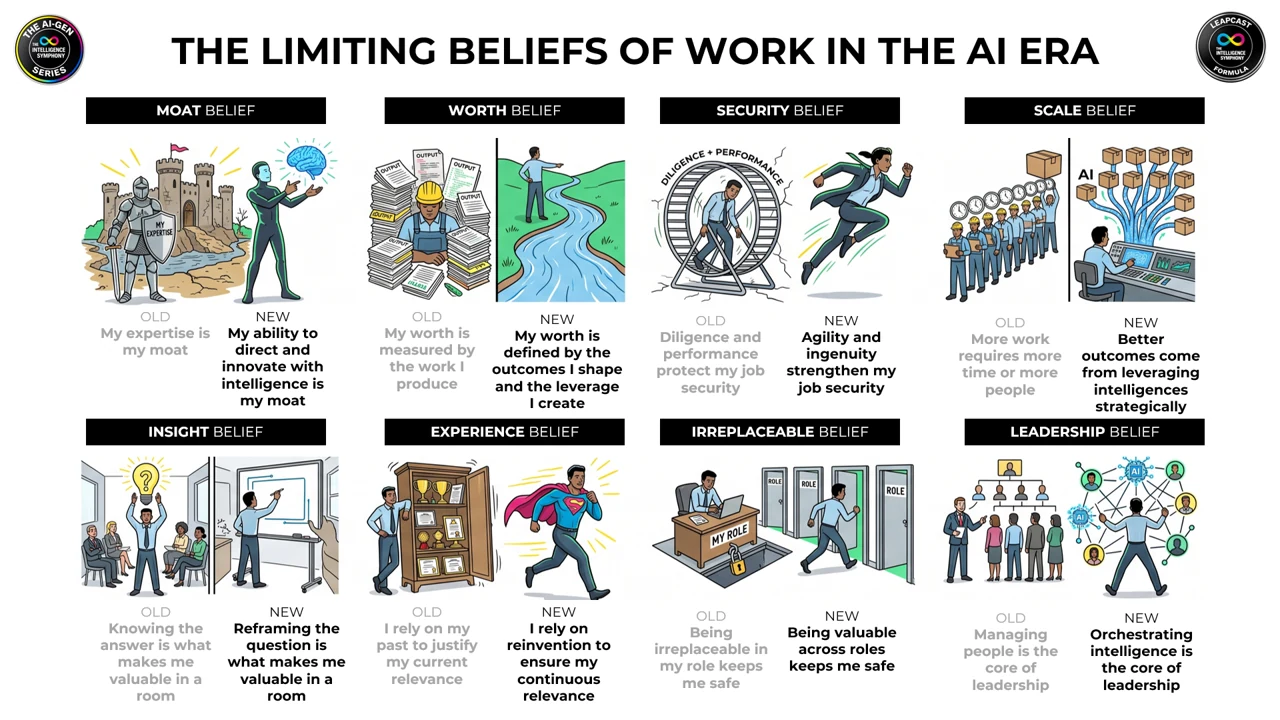
Belief 1: Moat Belief
Old: My expertise is my moat.
New: My ability to direct and innovate with intelligence is my moat.
Reframe: My edge is no longer what I know; it’s how fast I can apply, evolve, and combine ideas in ways others can’t.
Read the full Moat Belief deep diveBelief 2: Worth Belief
Old: My worth is measured by the work I produce.
New: My worth is defined by the outcomes I shape and the leverage I create.
Reframe: My worth shifts upstream. AI has made production cheap: what matters now is deciding what to produce, for whom, and to what end.
Read the full Worth Belief deep diveBelief 3: Security Belief
Old: Diligence and performance protect my job security.
New: Agility and ingenuity strengthen my job security.
Reframe: Performance is rewarded by a stable system and is now mere table stakes. When the system itself is being rewritten, agility provides the real security.
Read the full Security Belief deep diveBelief 4: Scale Belief
Old: More work requires more time or more people.
New: Better outcomes come from leveraging digital intelligence more strategically.
Reframe: Work and people were the units we measured. AI didn’t just replace the inputs and outputs; it changed the equation altogether.
Read the full Scale Belief deep diveBelief 5: Insight Belief
Old: Knowing the answer is what makes me valuable in a room.
New: Reframing the question is what makes me valuable in a room.
Reframe: Answers are only as good as the question behind them. In a world where the rules keep changing, the question is everything.
Read the full Insight Belief deep diveBelief 6: Experience Belief
Old: I rely on my past to justify my current relevance.
New: I rely on reinvention to ensure my continuous relevance.
Reframe: In a stable world, experience compounded. In a disrupted world, it decays. Reinvention is no longer optional; it’s the job.
Read the full Experience Belief deep diveBelief 7: Irreplaceable Belief
Old: Being irreplaceable in my role keeps me safe.
New: Being valuable across roles keeps me safe.
Reframe: The visible risk is being replaced by another person or automation. The hidden risk is being irreplaceable at something AI has made redundant.
Read the full Irreplaceable Belief deep diveBelief 8: Leadership Belief
Old: Managing people is the core of leadership.
New: Orchestrating intelligences is the core of leadership.
Reframe: Leadership used to mean getting the best out of people. Now it means building and managing the best team out of human and digital intelligence.
Read the full Leadership Belief deep diveOriginally published in Charlie Ang's Intelligent Reinvention Memo newsletter on LinkedIn (Issue 47).

Charlie Ang is an Intelligent Reinvention Strategist, corporate futurist and AI keynote speaker based in Singapore and speaking worldwide. He helps organisations and leaders reinvent, rewire and retool for the Age of Intelligence, and has been featured by the BBC, Financial Times, National Geographic and CNA.