 Charlie
This is one of 15 limiting beliefs of work in an intelligence-abundant world, in detail.
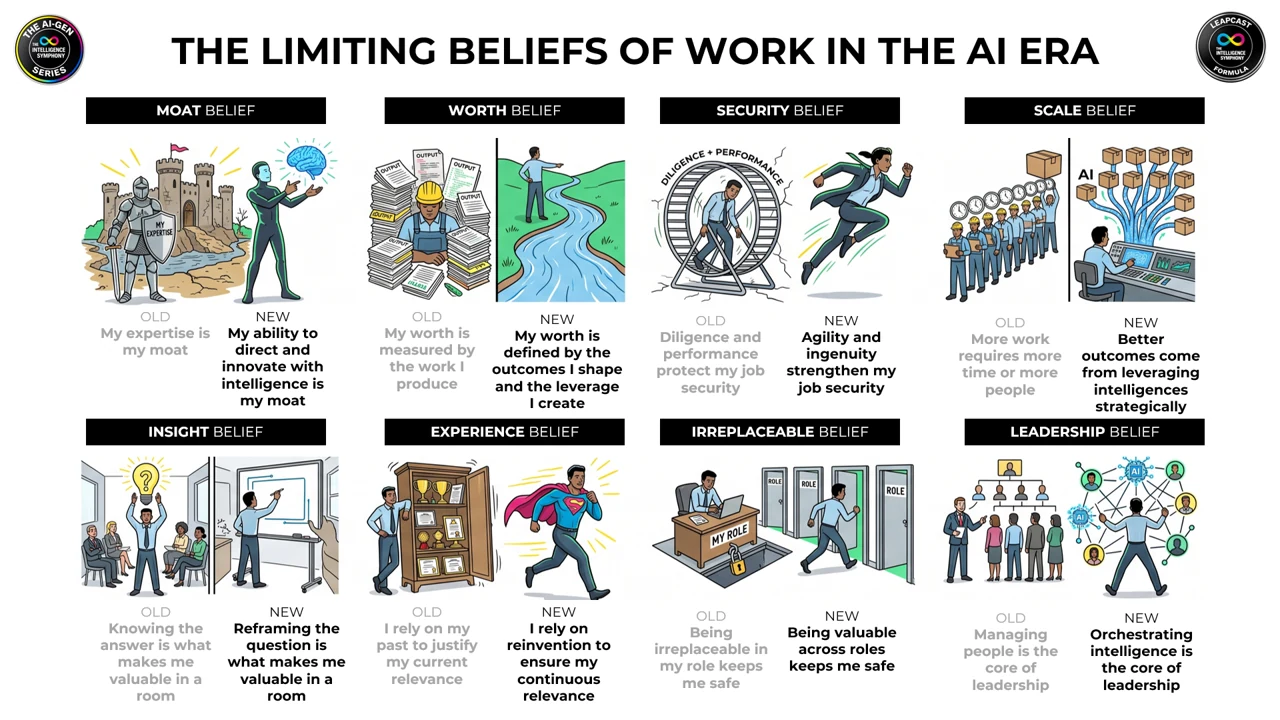
Belief 7: Irreplaceable Belief
Old: Being irreplaceable in my role keeps me safe.
New: Being valuable across roles keeps me safe.
Reframe: The visible risk is being replaced by another person or automation. The hidden risk is being irreplaceable at something AI has made redundant.
Stop Being Irreplaceable. Start Being Indispensable Everywhere.
Why this was true
For most of professional history, depth was the safest strategy. The more embedded you were in a role (the more you knew, the more you were relied upon, the harder you were to remove), the more secure your position. Organisations built around irreplaceable people. Clients requested them by name. Teams couldn’t function without them. The deeper you were embedded, the safer you were. Irreplaceability was not just a career strategy. It was the closest thing to job security a professional could engineer for themselves in a world where the primary threat was another person doing your job better or cheaper.
The historical context
The strategy of irreplaceability was born in a world where roles were stable and long-lived. Industries evolved slowly. Functions persisted for decades. The person who mastered a role and embedded themselves deeply within it could reasonably expect that role to outlast them. In that environment, depth was defence. The more specialised your knowledge, the more central your function, the harder you were to remove. Organisations rewarded this through tenure, through seniority, through the accumulated deference that came with being the person who knew the most about a specific thing in a specific place.
The moment it broke
When AI began collapsing the barriers between roles. Historically, moving between functions required years of retraining: a finance professional couldn’t easily contribute to marketing strategy, a lawyer couldn’t credibly weigh in on technology architecture, an operations manager couldn’t meaningfully engage with customer experience design. Those barriers created the conditions in which depth in one role was the only viable strategy. AI dissolved those barriers. The professional who can direct AI across multiple domains (strategy, analysis, communication, design, research) can now contribute value across functions that previously required separate specialists. Depth in one role stopped being the ceiling. Breadth across roles became the new advantage.
Who is most at risk
Professionals whose entire value is concentrated in one role, one function, one organisation. The specialist who has never needed to operate outside their domain. The long-tenured professional whose institutional knowledge is so context-specific it has no market value elsewhere. The expert whose identity is so fused with their role that the idea of contributing value in a different context feels foreign rather than exciting. The deeper and more specific the irreplaceability, the thinner the safety net, because it is calibrated to a single point of failure.
Negative Example
A senior risk manager at an insurance firm had spent sixteen years building unmatched expertise in actuarial risk modelling for commercial property. He was the definitive authority, internally and in the market. Every major underwriting decision passed through him. His depth was genuine and his judgment was respected. But it was also entirely contained. He had never needed to operate outside his domain; his expertise was so valued that nobody had ever asked him to. When the firm restructured its underwriting model around AI-driven risk assessment, his role changed significantly. What he found was that he had no natural adjacent territory to move into. His sixteen years of depth had been accumulated in a single direction. He had never built the breadth (the commercial acumen, the client relationship skills, the strategic perspective) that would have made him valuable in the restructured model. His irreplaceability had been real. Its portability had been zero.
Positive Example
The same risk manager, in a parallel universe where he had thought differently, saw the restructuring coming and asked himself a question his peers never thought to ask: where else in this company does what I know matter, in ways nobody has connected yet? Not adjacent roles in underwriting. Not a lateral move within risk. Genuinely different parts of the business that had never had access to the kind of thinking he had spent sixteen years developing.
He approached the product innovation team (a function that had never worked with a risk professional) and showed them how probabilistic scenario modelling could help them evaluate which new products to develop and which to kill before they consumed budget. He walked into the people and culture team and introduced them to actuarial thinking applied to workforce planning: modelling attrition risk, succession gaps, and talent concentration risk in ways the HR function had never quantified before. He sat down with the marketing team and reframed customer churn as a risk portfolio problem, using the same frameworks he had applied to commercial property to identify which customer segments were most likely to lapse and when.
None of these teams had asked for him. None of their job descriptions had ever included the word actuarial. But every one of them had problems that his expertise, retranslated into their language and applied to their context, solved better than anything they had tried before. By the time his original function was restructured, he had become genuinely useful in three parts of the business that had never previously known he existed. His irreplaceability in one role had been dissolved by AI. His value across the organisation had never been higher.
The cost of holding on
The cost is not that you get replaced by someone better. It is that when your role shifts (and in the AI era, every role is shifting), you have nowhere natural to go. The professional with deep irreplaceability in one role and no adjacent value anywhere else is structurally exposed in a way they cannot see from inside their role. Their security feels absolute right up until the moment it evaporates, because they built it on a single foundation in a world that is now demanding multiple ones.
The warning sign
Your professional identity is entirely contained within your current role and function. You have not contributed meaningfully outside your domain in more than two years. When someone asks what you do, your answer is a job title rather than a description of the value you create. You feel most comfortable operating within your defined scope and mildly uncomfortable when asked to contribute outside it. These are not signs of focus. They are signs of a safety strategy built on a single point of failure.
The AI angle
AI has done something unprecedented: it has made cross-functional contribution accessible to anyone willing to direct it. A finance professional who would previously have needed years of marketing experience to contribute meaningfully to brand strategy can now use AI to close that gap in weeks. A lawyer who would previously have needed technical training to engage credibly with technology architecture can now use AI to operate at a meaningful level in that domain. The barriers that once made depth in one role the only viable strategy have been dissolved. The professional who uses AI to build breadth across roles is now structurally safer, and more impactful, than the one who uses it only to go deeper in one.
The first move
Identify two functions adjacent to your current role where your contribution would create genuine value: not just where you could observe, but where you could meaningfully engage. Then ask yourself: what is the underlying thinking my expertise has given me, and where else in my organisation is that thinking missing? Use AI to accelerate your competence in those areas. Not to become a specialist, but to become credibly useful. The goal is not to abandon your depth. It is to ensure that your depth is connected to enough adjacent value that if your primary role shifts, you have somewhere natural, and valuable, to go.
If your current role disappeared tomorrow (not to redundancy, but to restructuring), how many other places in your organisation could you walk into and immediately create value?
The bottom line: In an AI-rich world, the safest professional is not the one who is hardest to remove from their current role. It is the one whose value travels: across functions, across contexts, across the shifting landscape of what organisations need. Depth is still valuable. But only if it is connected to breadth. Irreplaceability tied you to a role. Transferability sets you free.
Originally published in Charlie Ang's Intelligent Reinvention Memo newsletter on LinkedIn (Limiting Beliefs special series).

Charlie Ang is an Intelligent Reinvention Strategist, corporate futurist and AI keynote speaker based in Singapore and speaking worldwide. He helps organisations and leaders reinvent, rewire and retool for the Age of Intelligence, and has been featured by the BBC, Financial Times, National Geographic and CNA.