 Charlie
This is one of 15 limiting beliefs of work in an intelligence-abundant world, in detail.
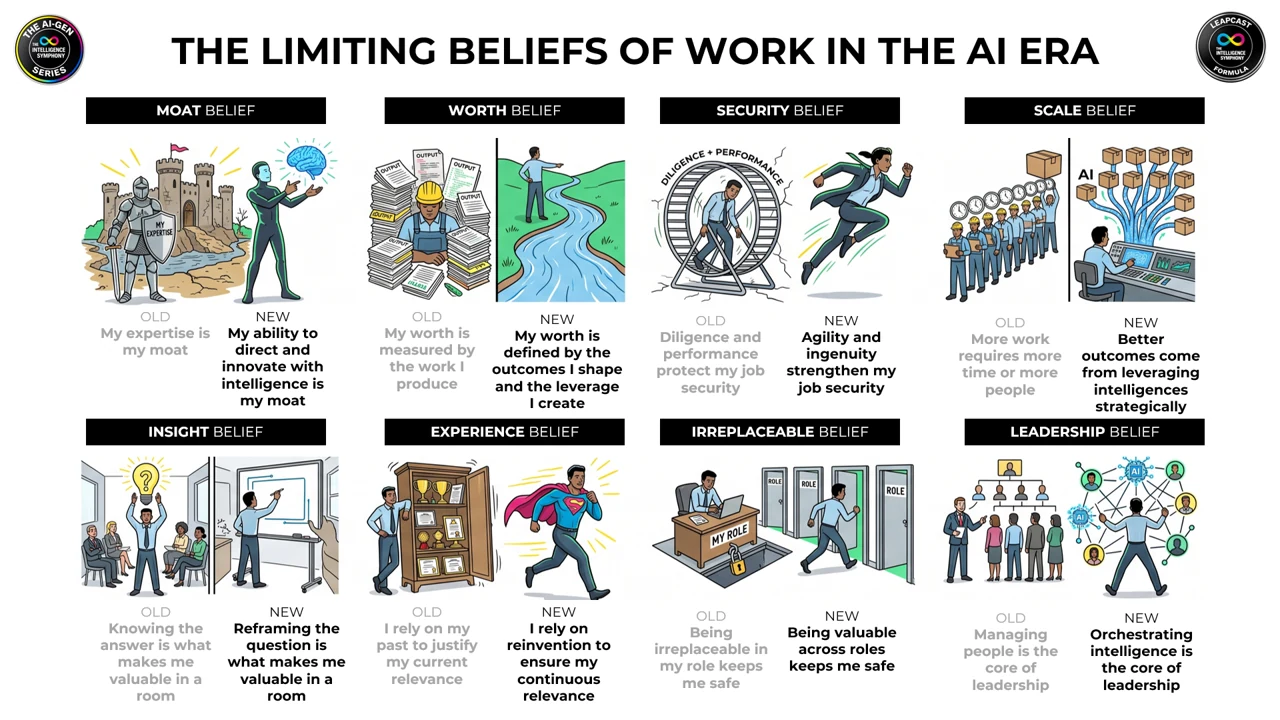
Belief 8: Leadership Belief
Old: Managing people is the core of leadership.
New: Orchestrating intelligence is the core of leadership.
Reframe: Leadership used to mean getting the best out of people. Now it means building and managing the best team out of human and digital intelligence.
The Best Leaders Don’t Just Manage People. They Harness Collective Intelligence.
Why this was true
For most of organisational history, leadership was a fundamentally human enterprise. You led people. You motivated them, developed them, directed them, and held them accountable. The size of your team was a measure of your seniority. The quality of your people was a reflection of your judgment. The best leaders were the ones who could get the most out of the humans around them: who could read a room, build trust, navigate conflict, and create the conditions for others to perform at their best. Management theory, leadership development, executive coaching: all of it was built on the same foundational assumption. Leadership is about people, and the better you are with people, the better a leader you are.
The historical context
The equation of leadership with people management was cemented in the industrial era, where output literally required human labour, and the leader’s job was to direct and coordinate that labour as effectively as possible. The knowledge economy softened the equation (leadership became less about directing bodies and more about developing minds) but the fundamental unit remained human. Teams were people. Organisations were people. Strategy was executed by people. The leader who could not manage people effectively could not lead effectively. Full stop. That logic held for over a century of organisational thinking. And it produced genuinely great leaders: people who understood that the highest leverage point in any organisation was the human beings inside it.
The moment it broke
When the ceiling of what a leader could achieve through people alone was surpassed by what a leader could achieve through people and AI together. For a century, the highest expression of leadership was maximising human potential: finding the right people, developing them, and creating the conditions for them to perform at their best. That remains important. But it is no longer sufficient as the complete definition of leadership excellence. The leader who is extraordinary with people but directs no intelligence beyond them is now operating at a fraction of their potential impact. The shift is not that AI created a new problem for leaders to manage. It is that AI expanded what leadership is optimising for: from maximising the output of people to harnessing the full spectrum of intelligence available, human and digital, in service of outcomes that neither could achieve alone.
Who is most at risk
Leaders who have defined their entire identity and craft around the human side of leadership, and who have not yet expanded that definition to include the intelligence available beyond their people. Not because they are poor leaders; often the opposite. The most people-centric leaders are sometimes the slowest to make this shift, precisely because they are so good at the human dimension that they haven’t felt the need to look beyond it. The risk is not that their people leadership deteriorates. It is that they leave an extraordinary amount of potential unrealised (in their teams, their functions, and their own impact) by optimising for only one form of intelligence when two are now available.
Negative Example
A highly regarded people leader at a professional services firm had spent twenty years building a reputation as the manager everyone wanted to work for. His team retention was exceptional. His engagement scores were the highest in the firm. His ability to develop junior talent into senior performers was genuinely rare. When the firm began integrating AI tools across its delivery functions (research, analysis, drafting, client reporting), he supported the initiative enthusiastically but stayed at the edges of it. He trusted his team to figure out the tools. He focused on what he had always focused on: the people. Within eighteen months his peers who had leaned into the AI integration were delivering faster, at higher quality, with leaner teams. His team was still engaged and well-developed, but they were working harder than necessary because nobody had designed how human and AI work should be distributed, sequenced, and quality-controlled. He had maximised his people. He had not yet learned to harness the collective intelligence available to him. His leadership was excellent. It was also incomplete.
Positive Example
A senior manager at a financial services firm inherited a team that was struggling to keep up with the volume and complexity of client reporting. The team was talented and diligent but perpetually behind. Her first move was not to hire more people or push the team harder. It was to ask a different question entirely: what is this team’s collective intelligence, human and AI combined, and am I deploying it well? She mapped every task in the workflow and asked two questions for each: what requires human judgment, and what requires human execution? The answer reshaped her entire approach. AI handled the processing, the formatting, the summarising, the first-pass drafting. Humans handled the interpretation, the client relationship, the quality calls that required context and judgment. Within three months the team was ahead of their reporting schedule for the first time in two years. Within six months two team members had been redeployed to higher-value client-facing work because the redesigned workflow had freed their capacity. She hadn’t managed her way to that outcome. She had orchestrated it, by treating human and digital intelligence as a single collective resource and leading both with the same intentionality a great people manager brings to building a human team.
The cost of holding on
The cost is not that you become a poor leader. Your people leadership remains strong. The cost is unrealised potential: in your team’s output, in your function’s impact, in your own effectiveness as a leader. The leaders around you who have expanded their definition of leadership are not better with people than you are. They are better at harnessing everything available to them. Over time that difference compounds, not in a single dramatic moment but in the steady accumulation of faster delivery, higher quality output, and more impactful teams that characterises those who lead collective intelligence rather than just the human portion of it.
The warning sign
Your team uses AI tools but you have never personally designed how they integrate into the workflow. You think of AI as something your team manages individually rather than something you lead collectively. Your definition of a great team is still entirely human. You measure your leadership effectiveness through people metrics alone (engagement, retention, development) without any equivalent sense of how well you are directing your team’s full collective intelligence. You feel most in your element in one-to-ones, team meetings, and performance conversations, and least comfortable in conversations about how work itself should be redesigned. These are not signs of a people-first philosophy. They are signs of a leadership definition that has not yet caught up with what leadership now encompasses.
The AI angle
AI doesn’t just give leaders more tools; it gives them a new form of intelligence to harness. And like human intelligence, it performs best when it is directed with clarity, deployed with judgment, and integrated thoughtfully into how the team works. The leaders who get the most from AI are not the most technically proficient. They are the ones who ask the same questions of AI that great people leaders ask of their teams: what are we trying to achieve, who is best placed to do which part of it, how do we ensure quality, and how do we course-correct when something isn’t working? The medium is different. The leadership discipline is the same. The best leaders have always been in the business of harnessing intelligence. AI just expanded the definition of what intelligence they have access to.
The first move
Map your team’s current workflow and ask one question for every task: does this require human judgment, or human execution? The distinction matters more than most leaders realise. Many tasks require humans currently not because they require human judgment but because nobody has yet designed the alternative. For every task that falls into that category, ask what it would take to integrate AI into that step, with the right direction and quality controls, so that your human team is freed to focus on the work that genuinely requires them. That mapping exercise is the first act of collective intelligence leadership. It is also the most direct path to a team that is both more effective and more fulfilled.
If you mapped everything your team produced last week, human and AI combined, how intentionally did you design that collective output, and how much of it just happened without your direction?
The bottom line: In an AI-rich world, the best leaders are not the ones who get the most out of their people. They are the ones who harness the full collective intelligence available to them, human and digital, and design how it works together with intention, clarity, and judgment. Managing people was the last century’s leadership. Harnessing collective intelligence is this century’s.
Originally published in Charlie Ang's Intelligent Reinvention Memo newsletter on LinkedIn (Limiting Beliefs special series).

Charlie Ang is an Intelligent Reinvention Strategist, corporate futurist and AI keynote speaker based in Singapore and speaking worldwide. He helps organisations and leaders reinvent, rewire and retool for the Age of Intelligence, and has been featured by the BBC, Financial Times, National Geographic and CNA.