 Charlie
This is one of 15 limiting beliefs of work in an intelligence-abundant world, in detail.
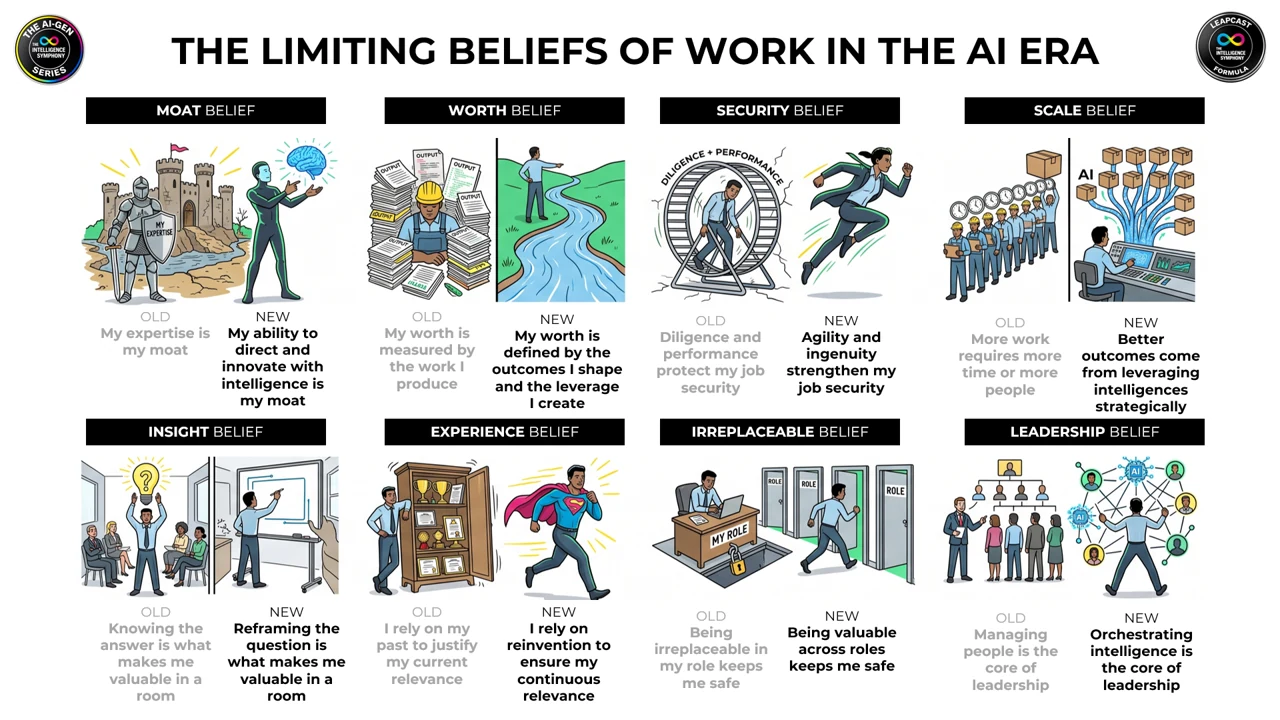
Belief 2: Worth Belief
Old: My worth is measured by the work I produce.
New: My worth is defined by the outcomes I shape and the leverage I create.
Reframe: My worth shifts upstream. AI has made production cheap: what matters now is deciding what to produce, for whom, and to what end.
Why this was true
For most of professional history, output was the most visible and measurable proof of contribution. You wrote the report. You built the model. You delivered the deck. Work was tangible, countable, and directly tied to your value in the organisation. The more you produced, and the better the quality, the more indispensable you became. In a world where production was hard, slow, and required skill, the person who produced the most was worth the most.
The historical context
This belief has its roots in the industrial era, where output was literally the unit of value: pieces produced per hour, reports filed per week, cases closed per month. The knowledge economy inherited this logic without questioning it. Even in professional services, consulting, and creative industries, the deliverable remained the proof of worth. Timesheets, billable hours, word counts, slide decks: all were proxies for the same underlying assumption. Production equals value.
The moment it broke
When AI made production cheap. A report that took three days now takes three hours. A financial model that required a specialist now requires a prompt. A first draft that blocked progress for a week now exists in seconds. When the cost of production collapses, production can no longer be the primary unit of value. The work itself has been commoditised. What remains scarce, and therefore valuable, is the judgment about what to produce, the vision of what it should achieve, and the leverage it creates beyond the deliverable itself.
Who is most at risk
Professionals whose identity and compensation model is built entirely around the deliverable. Analysts who produce reports. Writers who produce content. Consultants who produce frameworks. Lawyers who produce documents. Anyone whose answer to “what do you do?” is a noun (a thing they make) rather than an outcome they drive. The more your value is tied to the artifact, the more exposed you are when AI produces the same artifact faster and cheaper.
Negative Example
A senior financial analyst spent a decade producing the monthly performance reports that the executive team relied on to make decisions. He was meticulous, trusted, indispensable. Then the company implemented an AI-powered dashboard that generated the same reports automatically, updated in real time, with variance analysis built in. The reports didn’t stop. He did. Not because he was fired, but because the executives stopped reading his version when the dashboard gave them the same thing instantly. He had spent ten years perfecting the work. He had spent zero years building the skill of telling the executives what the numbers actually meant for the decisions they faced next quarter. The work outlived its value. He almost did too.
Positive Example
A corporate lawyer spent fifteen years building her reputation on the quality of her contract drafting and legal opinions. Meticulous, thorough, authoritative. Then her firm deployed AI contract review and drafting tools. What took her two days took the system two hours. Her managing partner didn’t let her go, but the conversation shifted. “We don’t need you drafting anymore. We need you in the room telling clients what the contract risk actually means for their business strategy.” Her worth hadn’t disappeared. It had moved, from the document to the judgment behind it. The ones who made that move thrived. The ones who kept defending the document became expensive proofreaders.
The cost of holding on
The real cost is not losing your job overnight. It’s a slow compression of your value that feels like efficiency gains until it feels like irrelevance. You produce more with AI but get credit for less, because the output is no longer the differentiator. You become a faster version of what you were, when what the market now needs is a fundamentally different version. The professionals who hold on to production as their identity are not just at risk of being replaced. They are at risk of becoming invisible while still being present.
The warning sign
You measure your own contribution by what you delivered this week. Your self-assessment at the end of a day is based on how much you produced, not what you moved forward. You feel vaguely uncomfortable when a meeting ends without a clear deliverable assigned to you. You equate being busy with being valuable. These are not signs of diligence. They are signs of a worth model that was built for a different era.
The AI angle
AI doesn’t just speed up production; it separates the act of producing from the act of thinking. Before AI, the two were bundled together. The analyst who built the model also had to think through its structure, its assumptions, its implications. That thinking was embedded in the production. AI unbundles them. It handles the production. What it cannot do is decide what the model should be testing for, what the client actually needs to know, and what the right question is in the first place. That unbundling is the most important structural shift AI has introduced to professional work, and most professionals haven’t noticed it yet.
The first move
Take your last three major deliverables and ask: what decision did each one enable? If you struggle to answer that question, your worth is currently tied to the artifact, not the outcome. Start working backward from decisions: what does this person need to decide, and how does my work make that decision better, faster, or clearer? That reorientation, from producer to enabler, is the shift that future-proofs your value in an AI-rich workplace.
The bottom line: AI produces the work. What it cannot do is decide what work is worth doing, for whom, and to what end. In an AI-rich world, that upstream judgment is where your worth now lives, and it cannot be replicated by any model, however capable.
Your Output Was Your Value. AI Just Made It a Commodity.
If AI produced everything you delivered this week, what would you still have been needed for?
Originally published in Charlie Ang's Intelligent Reinvention Memo newsletter on LinkedIn (Limiting Beliefs special series).

Charlie Ang is an Intelligent Reinvention Strategist, corporate futurist and AI keynote speaker based in Singapore and speaking worldwide. He helps organisations and leaders reinvent, rewire and retool for the Age of Intelligence, and has been featured by the BBC, Financial Times, National Geographic and CNA.