 Charlie
This is one of 15 limiting beliefs of work in an intelligence-abundant world, in detail.
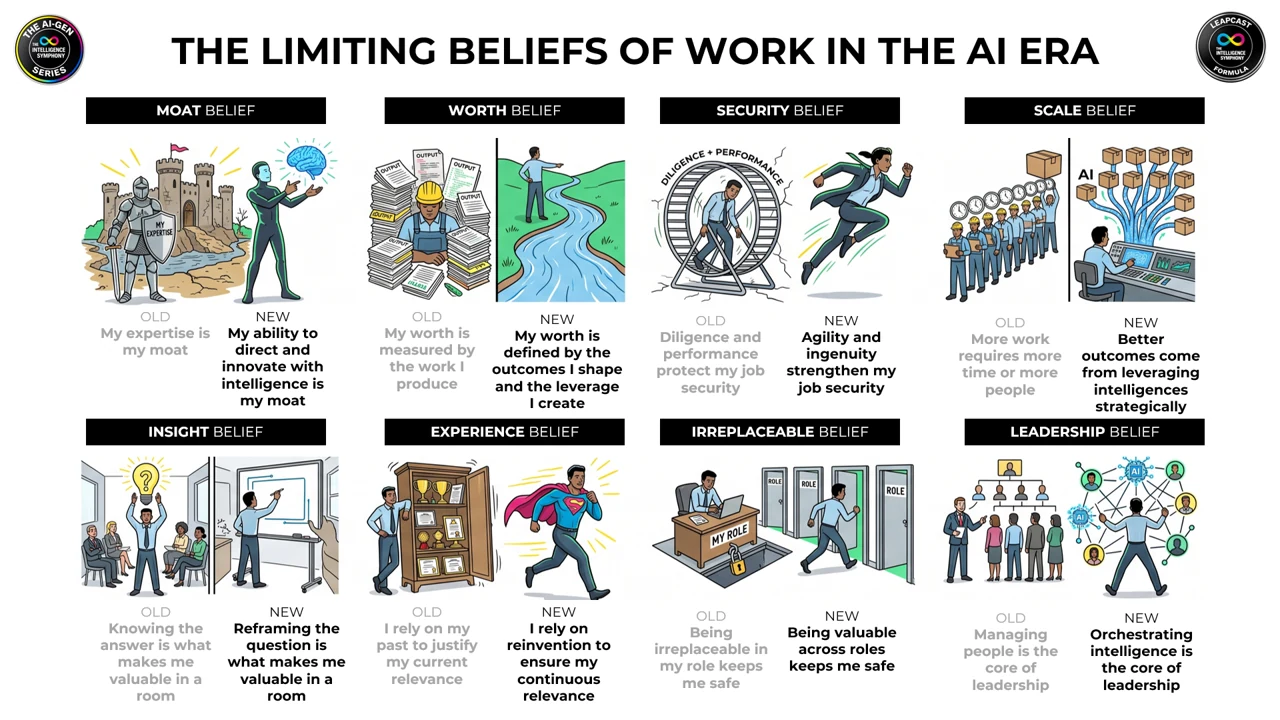
Belief 1: Moat Belief
Old: My expertise is my moat.
New: My ability to direct and innovate with intelligence is my moat.
Reframe: My edge is no longer what I know; it’s how fast I can apply, evolve, and combine ideas in ways others can’t.
Why this was true
For most of the 20th century and well into the 21st, expertise was the ultimate professional asset. You spent years, sometimes decades, accumulating deep knowledge in a domain. That depth was your protection. It was what justified your salary, your seniority, your seat at the table. The more you knew, the harder you were to replace. Building a moat around your expertise was not just smart; it was the game.
The historical context
This belief was born in the industrial and post-war professional era, when information was scarce, access was gatekept, and the person who had spent the most time in a domain was by definition the most qualified. Professional guilds, academic tenure, chartered qualifications, all were built on the same premise: knowledge accumulated over time is the highest form of professional value. It was rational. It was rewarded. And for decades, it worked.
The moment it broke
When AI made domain knowledge instantly accessible to anyone. Not just searchable, but synthesisable, applicable, and extendable. The knowledge that took you ten years to accumulate can now be summoned, contextualised, and deployed by anyone with the right prompt in under ten seconds.
The moat didn’t just get smaller. It got crossable.
Who is most at risk
Professionals who built their entire identity and career capital on being the smartest person in the room in their domain. Senior specialists, technical experts, long-tenured consultants, and subject matter experts whose value proposition is “I know this better than anyone else.” The deeper and narrower the expertise, the higher the risk. Paradoxically, the most decorated experts are often the most exposed.
Example 1
Two consultants walk into a client engagement. The first spent fifteen years mastering industry regulation: every rule, every precedent, every nuance. The second has five years of experience but knows how to direct AI to surface, synthesise, and apply regulatory knowledge faster than any individual could. Then they ask the question the client hasn’t thought to ask yet. The first consultant owns the knowledge. The second owns the outcome. In the AI era, the second consultant wins.
Example 2
A senior analyst has spent eight years becoming the go-to person for competitive intelligence in her firm. Every time a business unit needed a read on the market, they called her. Then quietly, without announcement, they stopped calling. Not because her work was poor. Not because someone better came along. Because the head of strategy started prompting an LLM directly, getting good enough answers in minutes, without scheduling time, without waiting, without a brief. She didn’t lose her job to a competitor. She lost her relevance to a habit. The moat was still there. The traffic just stopped crossing it.
The cost of holding on
The real cost is invisible until it’s too late. You don’t get fired for knowing too much. You get quietly passed over (for the project, the promotion, the executive room) by someone who knows less but does better. Expertise without the ability to innovate and evolve it is a depreciating asset in an AI-rich workplace. And unlike most assets, you don’t feel it losing value until the gap is already too wide to close.
The warning sign
You find yourself saying “let me check on that” less and “I know that” more. You default to what you already know rather than exploring what you don’t. You feel mild irritation when a junior colleague produces something comparable to your work using AI. That irritation is the signal: not of their shortcut, but of your exposure.
The AI angle
AI doesn’t just replicate knowledge; it democratises it. Every LLM has effectively ingested the collective expertise of millions of professionals across every domain. What took you a decade to learn, it learned from a thousand sources simultaneously. This doesn’t make your experience worthless. It makes the raw knowledge component of your experience worthless. What remains valuable is your judgment about which knowledge matters, your instinct about where it applies, and your ability to direct AI toward the right problems with the right framing.
The first move
Pick one piece of work you did last week that relied purely on what you know. Now ask yourself: could someone with half your experience have produced the same output using AI? If the answer is yes, that’s your starting point. Not to panic, but to evolve. Find the layer above the knowledge (the judgment call, the framing, the synthesis) and start building there deliberately.
Your Expertise Was Your Moat. AI Just Drained It.
If everything you know became available to everyone tomorrow, what would you still have that nobody else could replicate?
The bottom line: The moat hasn’t disappeared. It just moved, from what you know to how you think, direct, and innovate with AI.
Originally published in Charlie Ang's Intelligent Reinvention Memo newsletter on LinkedIn (Limiting Beliefs special series).

Charlie Ang is an Intelligent Reinvention Strategist, corporate futurist and AI keynote speaker based in Singapore and speaking worldwide. He helps organisations and leaders reinvent, rewire and retool for the Age of Intelligence, and has been featured by the BBC, Financial Times, National Geographic and CNA.