 Charlie
This is one of 15 limiting beliefs of work in an intelligence-abundant world, in detail.
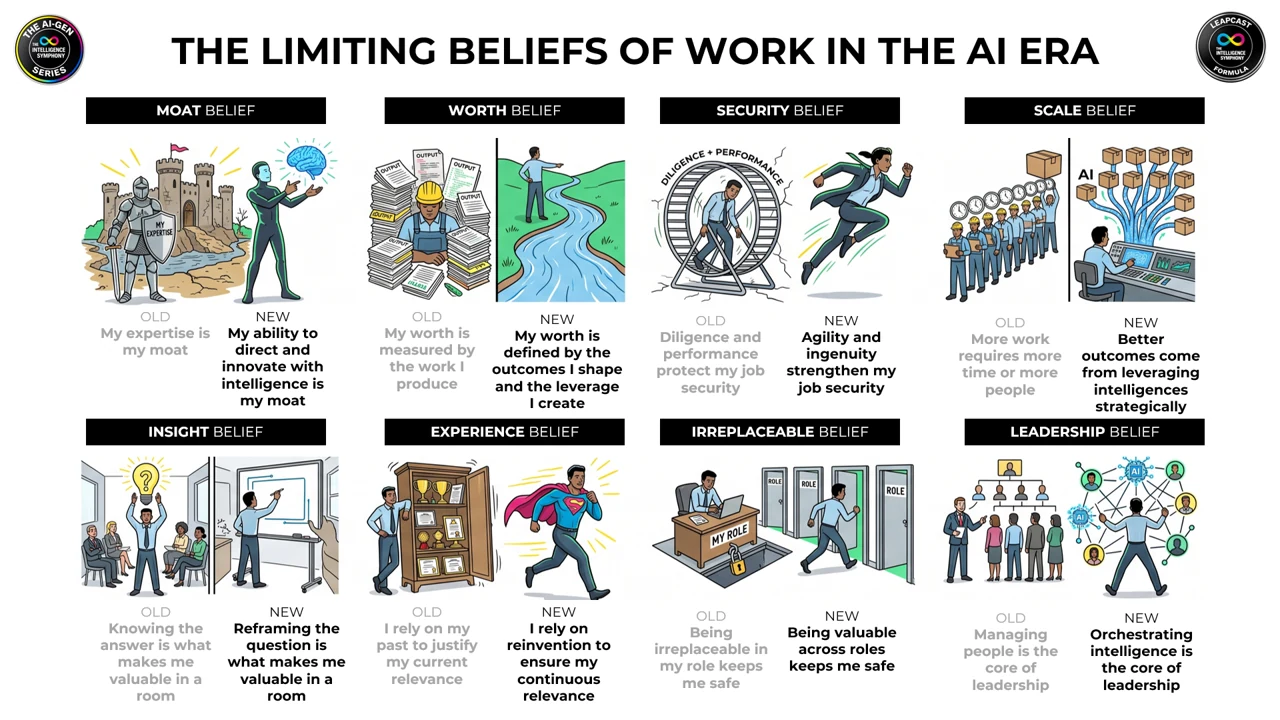
Belief 6: Experience Belief
Old: I rely on my past to justify my current relevance.
New: I rely on reinvention to ensure my continuous relevance.
Reframe: In a stable world, experience compounded. In a disrupted world, it decays. Reinvention is no longer optional; it’s the job.
Your Experience Got You Here. It Won’t Keep You Here.
Why this was true
For most of professional history, experience was the most reliable currency a professional could hold. The more you had done, the more you had seen, the more you had navigated, the more valuable you were. Experience was not just knowledge; it was pattern recognition, judgment, instinct. It took time to accumulate and could not be shortcut. A thirty-year veteran of an industry brought something a five-year professional simply could not replicate: not just what they knew, but how they saw. That accumulated seeing was worth something. It justified seniority, commanded premium fees, and earned the deference of younger colleagues. Relying on your past was not arrogance. It was evidence.
The historical context
The professional value of experience was built on the assumption of a slowly changing world. Industries evolved over decades. Best practices shifted gradually. The lessons of the past were reliably applicable to the present because the present looked enough like the past to make them relevant. In that environment, a deep well of accumulated experience was genuinely predictive: someone who had seen a market cycle, managed a crisis, or navigated a complex negotiation before was better equipped to do it again. Experience compounded because the world it was built on remained recognisable.
The moment it broke
When the rate of change outpaced the relevance of accumulated experience. AI is not just changing tools and workflows; it is restructuring the fundamental nature of entire professions. The patterns a veteran professional has spent decades learning to recognise are being scrambled. The playbooks that experience built are being rewritten. In that environment, past experience is still valuable, but it is no longer sufficient. And the professional who leads with their past rather than their capacity to navigate the new terrain is not demonstrating authority. They are demonstrating distance from the present and the future.
Who is most at risk
Senior professionals who have spent decades accumulating experience in a domain and who have built their authority on that accumulation. The veteran who leads every conversation with what they have seen before. The long-tenured executive whose confidence comes from pattern recognition built over decades. The expert whose primary value proposition is “I have been here before.” In a world changing faster than experience can track, the professional most at risk is not the junior who hasn’t learned enough; it is the senior who stopped learning because they already had enough.
Negative Example
A managing director at a financial services firm had spent twenty-five years building a reputation as the person who had seen everything. Every market downturn, every regulatory shift, every client crisis: he had navigated them all. His experience was genuine and his track record was exceptional. When AI began reshaping the firm’s advisory model (automating analysis, personalising client communications, restructuring how advice was delivered), he responded the way he always had: by drawing on what had worked before. He advised caution. He referenced precedents. He applied frameworks built for a different era. His colleagues listened respectfully. Then they moved without him. Not because his experience was wrong, but because the situation was new enough that experience alone was no longer the most useful thing in the room.
Positive Example
A senior partner at a law firm had thirty years of experience in corporate transactions. When AI contract tools began entering the market, she could have defended her territory: argued that AI couldn’t replicate the nuance of her judgment, the depth of her relationships, the value of her experience. Instead she got curious. She spent three months learning how the tools worked, where they were strong, and where they introduced new risks that required exactly the kind of judgment her experience had built. She repositioned herself not as the expert who knew the old way best, but as the partner who could navigate the intersection of AI capability and human judgment that her clients were now desperately trying to understand. Her billings went up. Her relevance deepened. Not because she abandoned her past, but because she refused to be defined by it.
The cost of holding on
The cost is not sudden. It is the gradual irrelevance of someone who is still excellent, just at things the world has moved past. You remain respected for what you were. You stop being sought for what you are. The meetings you used to lead become meetings you are invited to out of courtesy. The questions that used to come to you first start going elsewhere. None of it is dramatic. None of it announces itself. It just quietly accumulates until the gap between your past and the present is too wide to paper over with reputation alone.
The warning sign
You find yourself referencing what worked in the past more than exploring what might work now. You feel mild impatience with new approaches that contradict your experience. You are more comfortable being the person who contextualises the present through the past than the person navigating the present on its own terms. Your most recent significant professional reinvention was more than three years ago. These are not signs of wisdom. They are signs of a relevance model running on borrowed time.
The AI angle
AI has effectively democratised accumulated experience. Pattern recognition, one of the most valuable outputs of professional experience, is something AI does extraordinarily well, at scale, across far more data than any individual could have encountered in a career. This doesn’t make human experience worthless. It makes the pattern-recognition component of experience (the part that can be replicated) worth less. What remains irreplaceable is the capacity to navigate genuinely novel territory, to make judgment calls in situations that have no precedent, and to reinvent in real time. That capacity is not built by accumulating more of the same experience. It is built by deliberately seeking out new ones.
The first move
Identify the part of your professional identity that is most dependent on your past (the credential, the track record, the domain depth) and ask: if that foundation shifted tomorrow, what would I build on instead? Then start building that now, while the foundation is still intact. Reinvention is far easier when it is chosen than when it is forced. The professionals who thrive in the AI era are not the ones who abandon their experience; they are the ones who refuse to be imprisoned by it.
When did you last do something professionally for the first time, and what does it say about your relevance that you have to think hard to answer that?
The bottom line: In an AI-rich world, your past is a platform to launch from, not a position to defend. The professionals who stay relevant are not the ones with the most experience. They are the ones who use their experience as a foundation for continuous reinvention rather than a substitute for it.
Originally published in Charlie Ang's Intelligent Reinvention Memo newsletter on LinkedIn (Limiting Beliefs special series).

Charlie Ang is an Intelligent Reinvention Strategist, corporate futurist and AI keynote speaker based in Singapore and speaking worldwide. He helps organisations and leaders reinvent, rewire and retool for the Age of Intelligence, and has been featured by the BBC, Financial Times, National Geographic and CNA.