 Charlie
This is one of 15 limiting beliefs of work in an intelligence-abundant world, in detail.
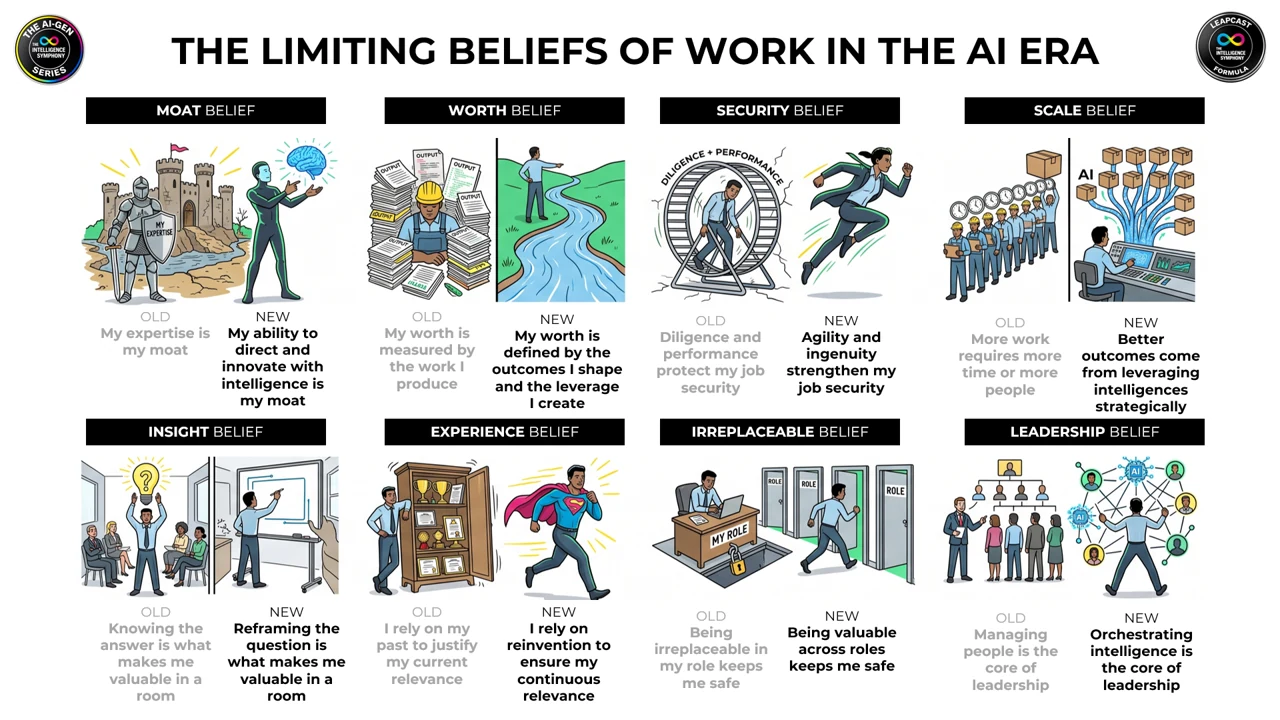
Belief 3: Security Belief
Old: Diligence and performance protect my job security.
New: Agility and ingenuity strengthen my job security.
Reframe: Performance is rewarded by a stable system and is now mere table stakes. When the system itself is being rewritten, agility is the only real security.
You Performed Perfectly. For a Game That No Longer Exists.
Why this was true
For most of the 20th century, the professional contract was simple and reliable. Show up, work hard, perform consistently, and your position was secure. Organisations rewarded loyalty and diligence with stability. The employee who put in the hours, delivered reliably, and stayed out of trouble could reasonably expect a long, secure career. Performance reviews, incremental promotions, and tenure-based compensation all reinforced the same message: do the work well and you will be protected. It was a contract that held for decades. And for the people who lived by it, it felt like the most rational strategy available.
The historical context
This belief was forged in the post-war era of institutional stability: large corporations, lifetime employment, defined benefit pensions, and predictable career ladders. The system itself was stable enough that performing within it was sufficient. Disruption happened slowly, if at all. Industries didn’t disappear overnight. The rules of the game changed incrementally. In that environment, diligence and performance were not just smart strategies; they were rational bets on a system that reliably rewarded them.
The moment it broke
When the system itself started being rewritten faster than performance could be rewarded. AI is not just changing how work gets done; it is changing which work gets done, which roles exist, and which skills are valued. In that environment, performing well at a role that is being restructured around you is not security; it is precision in the wrong direction. Diligence optimises your position within a system. It does not protect you when the system changes. And right now, the system is changing faster than any performance review cycle can track.
Who is most at risk
Professionals who have spent their careers perfecting execution within a defined role, and who have built their confidence and identity around being reliably excellent at what they do. The high performer who has never had to reinvent. The diligent specialist who has never had to pivot. The long-tenured employee whose security has always come from being good, not from being adaptable. Paradoxically, the most consistently high-performing professionals are often the least prepared for a world where the performance criteria themselves are being rewritten.
Negative Example
A senior project manager at a professional services firm had fifteen years of flawless delivery. Every project on time, on budget, stakeholders consistently satisfied. His performance reviews were exemplary. Then the firm restructured its delivery model around AI-assisted project management tools: automated scheduling, real-time risk flagging, instant status reporting. The coordination and oversight work that had defined his role for fifteen years was now handled largely by the system. He was still performing at the same high level. The role he was performing in had simply shrunk around him. He was the last to notice because his performance reviews still looked the same. His diligence had protected his past. It had not prepared him for his future.
Positive Example
A mid-level HR manager saw the shift coming before her organisation did. Her role had always been performance management, recruitment administration, and compliance. Solid, necessary, unglamorous. When AI tools started automating the administrative core of her function, she didn’t wait to be restructured. She spent six months learning how AI was changing talent strategy: how predictive analytics could reshape workforce planning, how AI-assisted hiring tools introduced new bias risks that needed human oversight, how leaders needed to reskill their teams faster than ever before. She repositioned herself as the person who could help the organisation navigate the human side of AI adoption. Her role didn’t shrink. It expanded. Not because she performed harder. Because she reinvented faster.
The cost of holding on
The cost is not immediate and it is not visible. You keep performing. Your reviews keep reflecting that performance. And then one day the restructuring arrives (a reorg, a role elimination, a function being absorbed by AI) and you realise that your performance protected you within a game that has already ended. The cruelest version of this is the professional who was excellent right up until the moment their excellence became irrelevant. Diligence without agility is a map of a city that no longer exists.
The warning sign
Your definition of doing a good job hasn’t changed in three years. You feel most secure when you are executing within a well-defined scope. The idea of your role changing significantly makes you anxious rather than curious. You are optimising your performance rather than questioning whether you are performing in the right direction. These are not signs of excellence. They are signs of a security model that was built for a world that is no longer the one you are working in.
The AI angle
AI doesn’t threaten the diligent professional directly. It threatens the system they are diligent within. When AI restructures a function, it doesn’t evaluate individual performance; it evaluates whether the function itself is still necessary at the same scale and cost. The most diligent person in a restructured function is still in a restructured function. What AI rewards is not better performance of existing tasks; it is the ability to identify which new tasks matter, learn them quickly, and create value in territory that didn’t exist before.
The first move
Ask yourself: if your role was restructured tomorrow, what would you bring to the next one? Not your track record, but your transferable capability. Not your tenure, but your adaptability. If the answer feels thin, that is your starting point. Identify one adjacent skill or emerging need in your organisation that AI is creating rather than eliminating. Start building there. Not to abandon your current role, but to ensure you are never entirely defined by it.
If your role was restructured tomorrow, what would you bring to the next one that no job description could have prepared you for?
The bottom line: In an AI-rich world, performance is the entry ticket, not the strategy. The professionals who stay secure are not the ones who perform the best within the current system. They are the ones who can reinvent themselves faster than the system changes around them.
Originally published in Charlie Ang's Intelligent Reinvention Memo newsletter on LinkedIn (Limiting Beliefs special series).

Charlie Ang is an Intelligent Reinvention Strategist, corporate futurist and AI keynote speaker based in Singapore and speaking worldwide. He helps organisations and leaders reinvent, rewire and retool for the Age of Intelligence, and has been featured by the BBC, Financial Times, National Geographic and CNA.