 Charlie
The Back Story
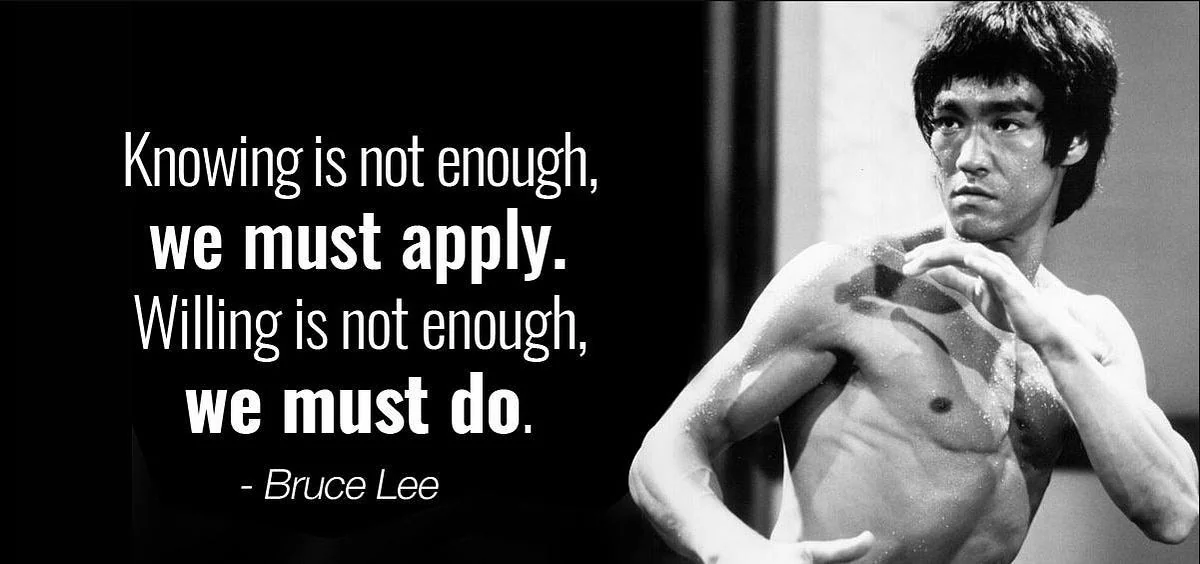
I started as a digital futurist in 2013, helping senior leaders preview the future and anticipate the winds of change. However, (paraphrasing Bruce Lee’s quote below) seeing the future is not enough; we must innovate towards it.
So, I swam downstream to become an innovation strategist, guiding enterprises to discover and exploit invisible opportunities and seize the initiative ahead of their peers.
But I soon encountered an intellectual conundrum that plagued many innovation leaders. The leading innovation frameworks are disparate and disjointed: coherent on their own but incomplete in themselves.
Foremost of these theories are disruptive innovation (“The Innovator’s Dilemma”), value innovation (“Blue Ocean Strategy”) and Jobs-to-be-Done, or JTBD in short (popularized by Prof Clayton Christensen and Anthony Ulwick).
How do you drive innovation with three overlapping frameworks causing cognitive dissonance?
Without a coherent mental model, innovators are either confused about when to use what, or worse, they cling religiously to one model and inadvertently miss out on insights offered by the others.
The state of innovation felt akin to physics. Albert Einstein dedicated the latter part of his life to constructing a unified field theory of nature’s forces.
“The intellect seeking after an integrated theory cannot rest content with the assumption that there exist two distinct fields totally independent of each other by their nature.”
Albert Einstein, Nobel lecture, 1923My open search for a complete model ended in failure. Unsatisfied with the status quo and inspired by Einstein, I set out to formulate a universal theory of innovation.
By and large, I am confident that I have succeeded in my quest, albeit with some lingering rough edges in my model.
While I have taught this framework for many years, this is the first time I am publishing it.
There is increased urgency to share this because the common enterprise use cases of AI often miss the mark.
They usually focus on process rather than product innovations. And even when attention is placed on products, it tends to be within a narrow set of possibilities.
Everyone goes for the obvious options but the invisible choices that they missed out on are often the most precious and impactful.
The Unified Theory of Innovation
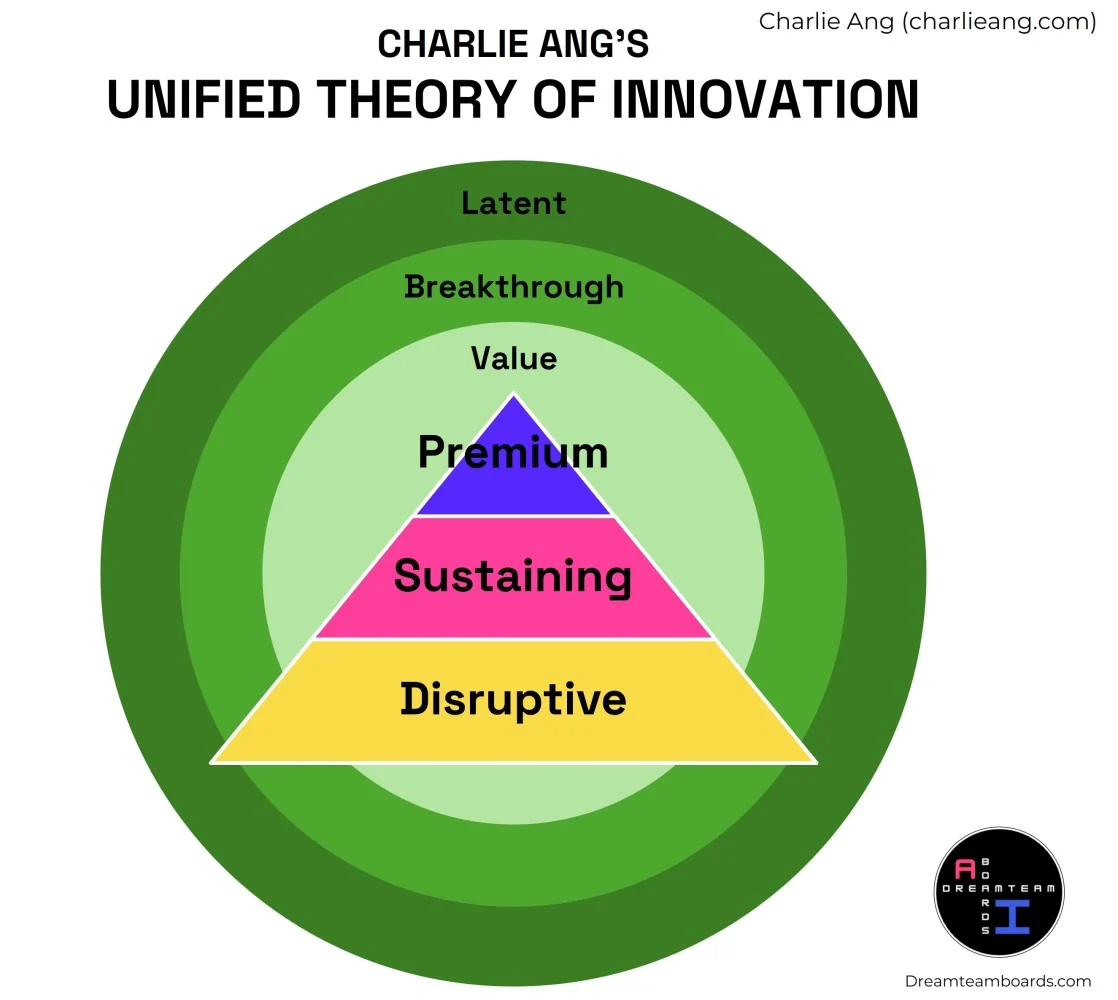
In this model, there are six types of innovation, encapsulated within a 3-tier pyramid and 3 concentric circles.
The pyramid represents the visible and obvious options for innovation, best explained by Clayton Christensen, while the concentric circles reveal hidden and non-obvious opportunities, explored in the Blue Ocean Strategy.
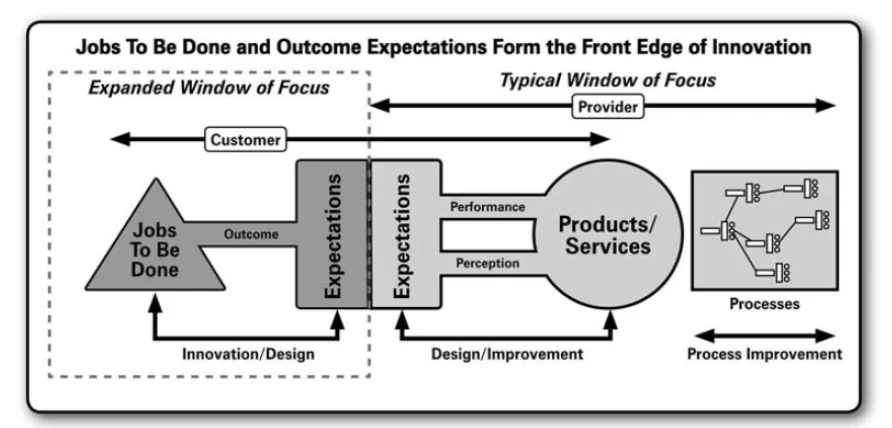
Our focus is solely on products because they are the primary vehicle for delivering value to the customer.
I use “product” as a generic term that includes services, solutions, results, and experiences that customers use and pay for.
It does not cover process and business model innovations that merely enhance efficiency or reduce costs without altering the product itself.
If a change affects the product in a way that is visible to the customer, it falls under the definition of product.
Let’s break down the unified framework into these three constituent parts:
Part 1: The Master Theory of Business
The underlying theory is Jobs-to-be-Done (JTBD).
Just as mathematics describes the laws of nature, JTBD is the language that attempts to explain the laws of business. These laws are like the air around us: they exist whether you perceive them or not.
Whether you are a physicist at the dawn of the scientific revolution or a modern business leader, understanding the science of your field provides a tremendous advantage over others who practice it as an art form.
For a contemporary executive, it can be your superpower.
In JTBD, the unit of analysis for customer needs is not products but Customer Jobs: what jobs do customers want to get done?
Customers buy products and services not for their own sake, but to employ them to perform a particular Customer Job.
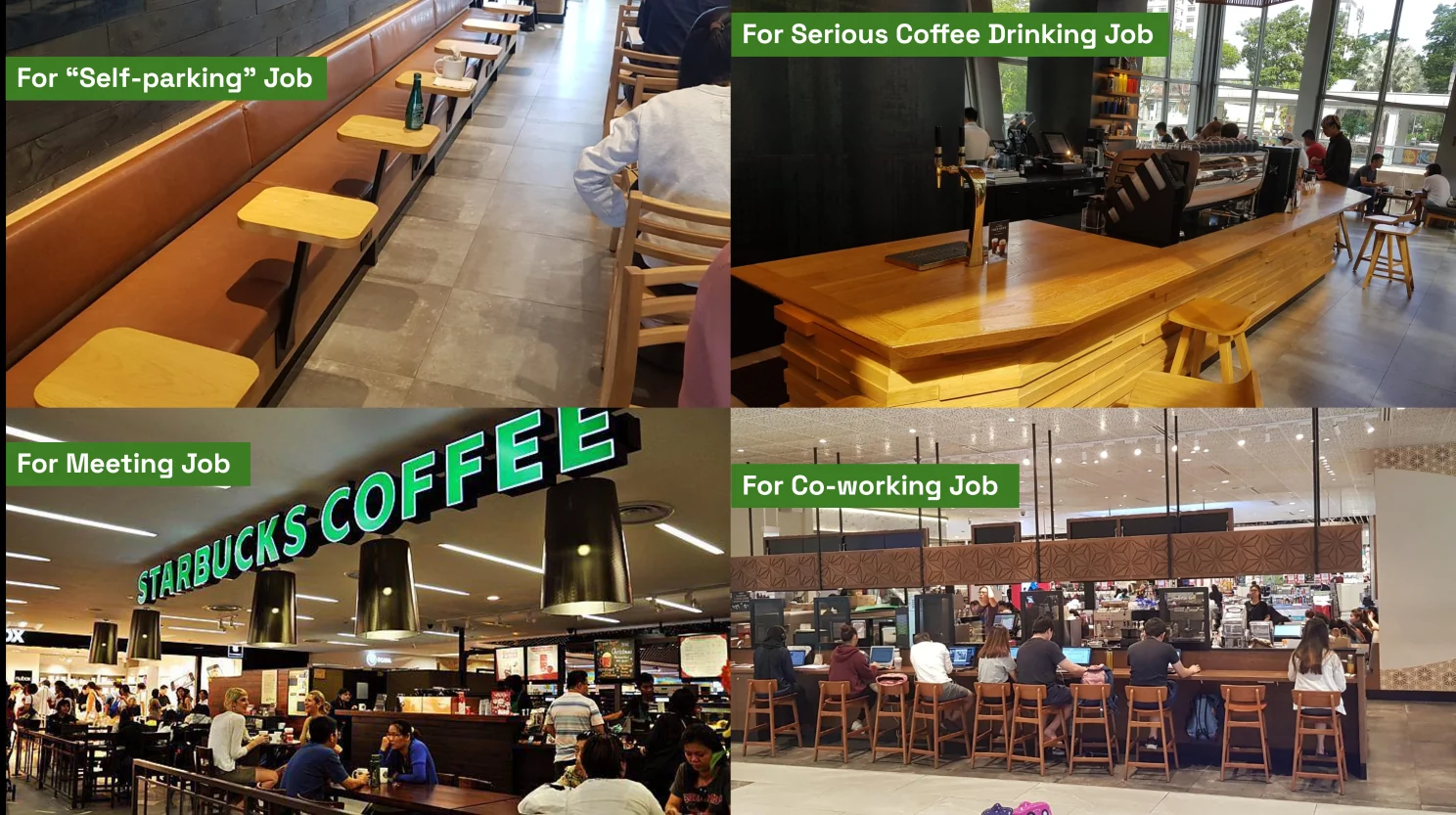
For instance, whenever I visit Starbucks or other coffee joints, it’s rarely about the coffee or food. My Customer Job is usually to park myself while my family shops at the mall, or to meet someone.

Starbucks is just one of many options for fulfilling this job. Other significant Customer Jobs Starbucks serves include working remotely, getting a quick bite, or grabbing a caffeine fix on the go.
When we want to commute from Point A to Point B, we may hire an Uber ride, cycle on a shared bike, hop onto the subway, or simply walk.
The competitive set of Starbucks isn’t just other coffee chains; it includes any alternatives that fulfill these Customer Jobs.
Similarly, Uber’s competitors aren’t limited to other ride-hailing platforms; they include all commuting options for getting from A to B.
Thus, the concept of industry competition is outdated. Viewed through the JTBD lens, Starbucks and Uber are competing against a broader set of solutions that get the same jobs done.
Rita McGrath, Professor of Management at Columbia Business School, calls this competitive arenas.
Innovation is the process of inventing and improving products to best serve the customer’s job (under varying circumstances).
For example, if it’s raining or I’m late for an appointment, an Uber ride may be the best choice. Otherwise, I might opt for a cheaper public transportation mode.
If I’m meeting someone important and want to impress, an upscale hotel café is likely to serve this specific job better than Starbucks.
Circumstance is the context of the Customer Job, and it matters.
To me, JTBD is not just the master theory of innovation but of business itself. After all, all businesses exist to serve customer needs.
Beyond innovators, every executive, entrepreneur, and marketer MUST understand JTBD as though their professional lives depend on it.
I always tell my students that JTBD is not an easy concept to grasp, but once you get it, it changes the way you view everything in business.
The effort you put into learning JTBD is one of the best investments you can make in yourself.
Part 2: The Pyramid of Obvious Customer Needs
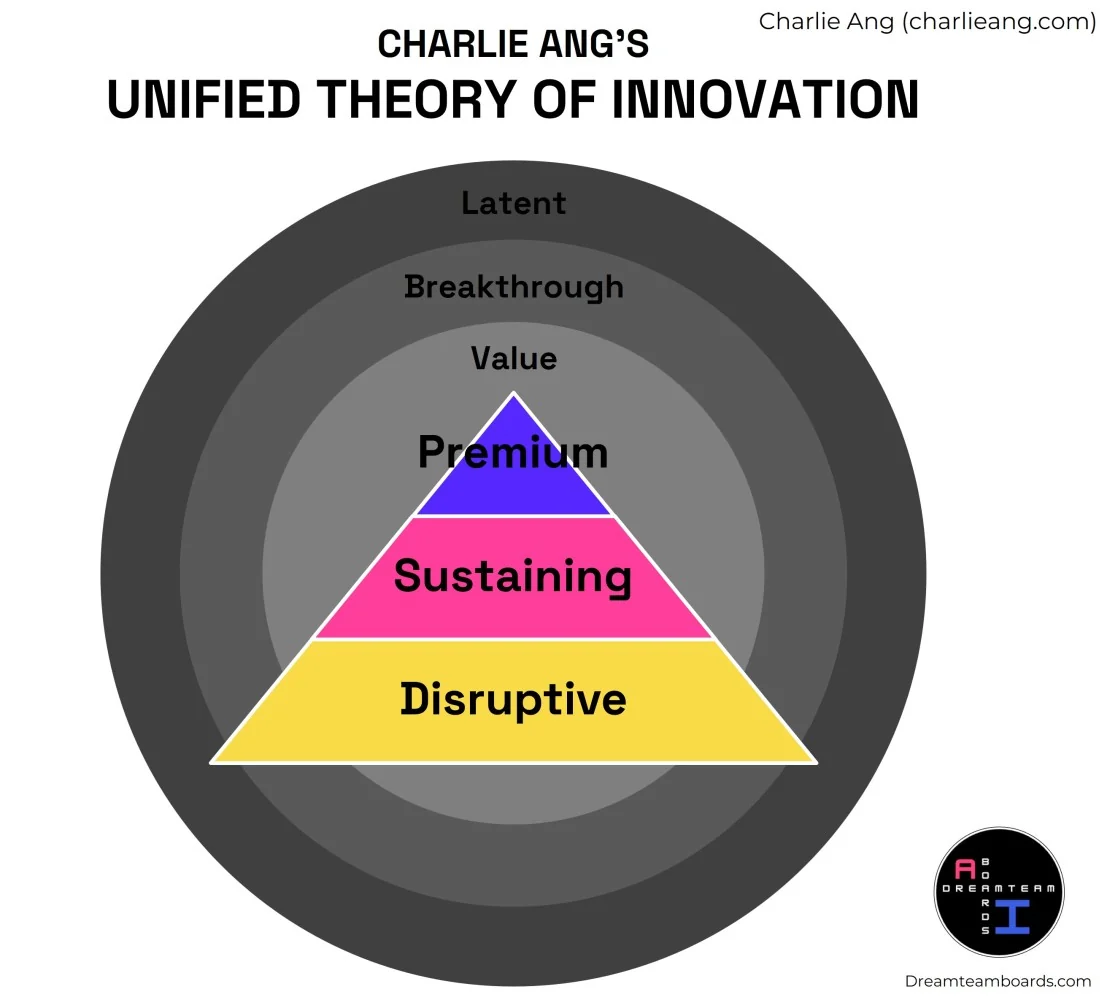
Why obvious customer needs? Because there are already existing versions of the product in the market that customers are actively buying.
The Customer Job is known and proven, with verifiable market sizing and industry statistics for the product category.
As a rule of thumb, the higher up the pyramid you go, the more expensive the product and the smaller the target market.
Let’s use the airline industry as a comprehensive case study. The Customer Job it serves: “travelling between distant locations”.
Sustaining
Sustaining innovation is exactly what the name suggests: improving the product over time, while keeping the customer segment and prices relatively constant.
Sustaining innovation is the simplest and most basic form of innovation. Everyone does it to stay in the game.
Since the first Corolla model in 1966, Toyota’s primary goal has been to create an affordable, efficient, and reliable people’s car for everyday families. Year by year, decade by decade, Toyota has improved the Corolla to keep up with the times while generally maintaining the same customer segment and price point.
In air travel, the volume category is the economy class. Airlines continually and incrementally improve their economy products to serve the same mass-market customer segment.
Premium
The top of the pyramid represents premium innovation.
This is straightforward: charge more for better products that more demanding or affluent customers are willing to pay for to accomplish the same job.
If you don’t, you are leaving money on the table, “under-satisfying” customers who are willing to pay more for a superior product.
Consider Singapore Airlines (SIA). For most airlines, First Class seats are the highest-end offering. Yet, SIA identified unmet demand and under-satisfied flyers.
To capture this segment, it introduced an even more exclusive and expensive product: private, enclosed Suites, costing 20–30% more than First Class fares.
Premium innovation can also involve thin-slicing existing products.
Many airlines have introduced Premium Economy class to cater to underserved Economy flyers who cannot afford Business class. Add-ons such as priority boarding, preferential seat selection, and ticket flexibility also serve this purpose.
Disruptive
Below the Sustaining category is the base of the pyramid: consumers who have the same Customer Job but are either unable or unwilling to pay for existing products.
They are left with the choices of a) not performing the job, b) doing the job themselves, or c) using a less ideal product. These are the non-consumers, or un-served consumers.
For every mass-market product in developed economies, there are exponentially more people in low-income countries, and at the lower end of the pyramid within high-income economies, who desire the same product but cannot access it.
This is where disruptive innovation comes in, a concept coined by Clayton Christensen in his seminal book: The Innovator’s Dilemma.
Disruptive products convert non-consumers into consumers (“new market disruption”) or attract over-served consumers of incumbent products (“low-end disruption”).
Historically, innovation has often been synonymous with disruption, as new product categories usually start out expensive before they become more affordable through newer technologies and economies of scale.
While we often associate disruptive innovation with technology, technology itself isn’t always the enabler.
For example, Unilever, through its Indian subsidiary Hindustan Lever Limited, famously pioneered one-rupee, single-use shampoo sachets in the 1980s, dramatically increasing accessibility for low-income consumers.
Back to the airline case study: Before the rise of low-cost carriers, a business model innovation rather than a technological one, low-income travelers had limited options.
They either avoided distant travel, traveled less frequently, or used less convenient transportation modes, such as coaches or complex, multi-stop commutes.
AirAsia, Asia’s most successful budget airline, epitomizes this new market disruption with its motto “Now Everyone Can Fly”.
But low-cost carriers are rarely viable by converting non-consumers alone. Many over-served consumers switch from full-service airlines (low-end disruption). Circumstances and context matter.
For instance, these switchers often choose a more affordable option when traveling for family vacations, allowing them to either spend more at their destination or go on more frequent weekend getaways.
That’s it for today. I covered the essential obvious innovation this time and will dive into the advanced non-obvious types and discovering AI innovation in the upcoming issues.
Originally published in Charlie Ang's Intelligent Reinvention Memo newsletter on LinkedIn (Issue 10).

Charlie Ang is an Intelligent Reinvention Strategist, corporate futurist and AI keynote speaker based in Singapore and speaking worldwide. He helps organisations and leaders reinvent, rewire and retool for the Age of Intelligence, and has been featured by the BBC, Financial Times, National Geographic and CNA.