 Charlie
In 1965, Singapore was an improbable nation.
No natural resources. No hinterland. A tiny domestic market. High unemployment. Deep ethnic divisions. An uncertain future.
Conventional wisdom held that economic viability required territory, resources and a substantial domestic market.
Lee Kuan Yew and Singapore’s founding leadership challenged that logic.
Instead of accepting what a small nation could not have, they reimagined what it could become.
Their reinvention of nation-building rested on five radical departures.
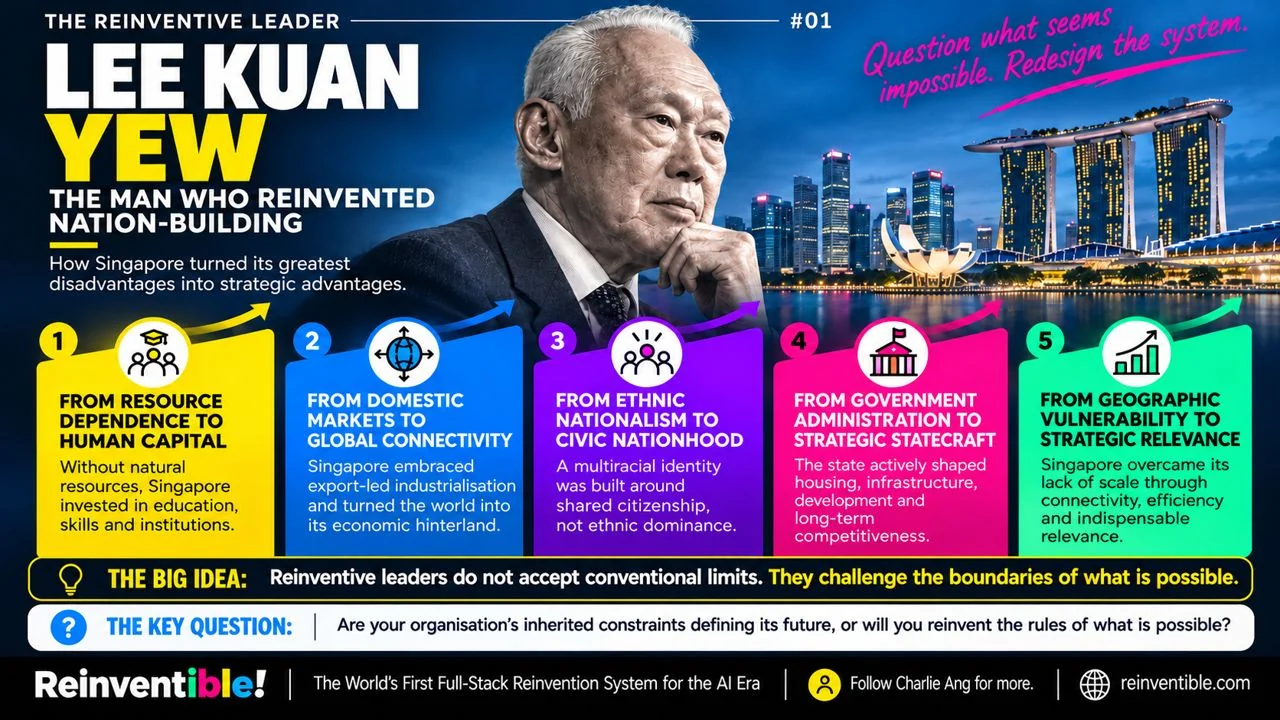
Departure 1: From Resource Dependence to Human Capital
Without natural resources, Singapore made education, skills and institutional capabilities its strategic assets.
Departure 2: From Domestic Markets to Global Connectivity
Instead of relying on import substitution, Singapore embraced export-led industrialisation and multinational corporations, turning the world into its economic hinterland.
Departure 3: From Ethnic Nationalism to Civic Nationhood
Rather than defining identity by the majority race, Singapore pursued a multiracial nation built on shared citizenship.
Departure 4: From Government Administration to Strategic Statecraft
The state became an architect of economic development, housing, infrastructure, institutions and long-term competitiveness.
Departure 5: From Geographic Vulnerability to Strategic Relevance
Singapore countered its lack of scale through connectivity, efficiency, reliability and global economic relevance.
The Result
The result was not simply a more prosperous city-state.
It was a different model of what a small nation could achieve.
This was a collective accomplishment, involving Goh Keng Swee, S. Rajaratnam and generations of Singaporeans. Its achievements also invite debates over political freedoms and concentrated power.
But Lee Kuan Yew exemplified a defining characteristic of Reinventive Leadership:
The courage to challenge conventional wisdom, question underlying assumptions and reimagine what is possible.
He did not merely help Singapore become a better version of what it was.
He helped create a nation that conventional assumptions could scarcely imagine.
Are your organisation’s inherited constraints defining its future, or will you reinvent the rules of what is possible?
About The Reinventive Leader Series
Featuring extraordinary leaders who challenged conventional wisdom, reimagined what was possible and reinvented businesses, industries, institutions and societies.
Originally published as a post by Charlie Ang on LinkedIn, part of his series The Reinventive Leader.

Charlie Ang is an Intelligent Reinvention Strategist, corporate futurist and AI keynote speaker based in Singapore and speaking worldwide. He helps organisations and leaders reinvent, rewire and retool for the Age of Intelligence, and has been featured by the BBC, Financial Times, National Geographic and CNA.