 Charlie
Furniture used to follow a familiar logic.
Manufacturers made it. Retailers displayed it. Workers delivered it. Customers paid for all the complexity built into that system.
Ingvar Kamprad questioned the system itself.
Instead of asking how IKEA could sell furniture more cheaply, he reimagined how furniture could be designed, made, transported, sold and assembled.
His reinvention of furniture retail rested on five radical departures.
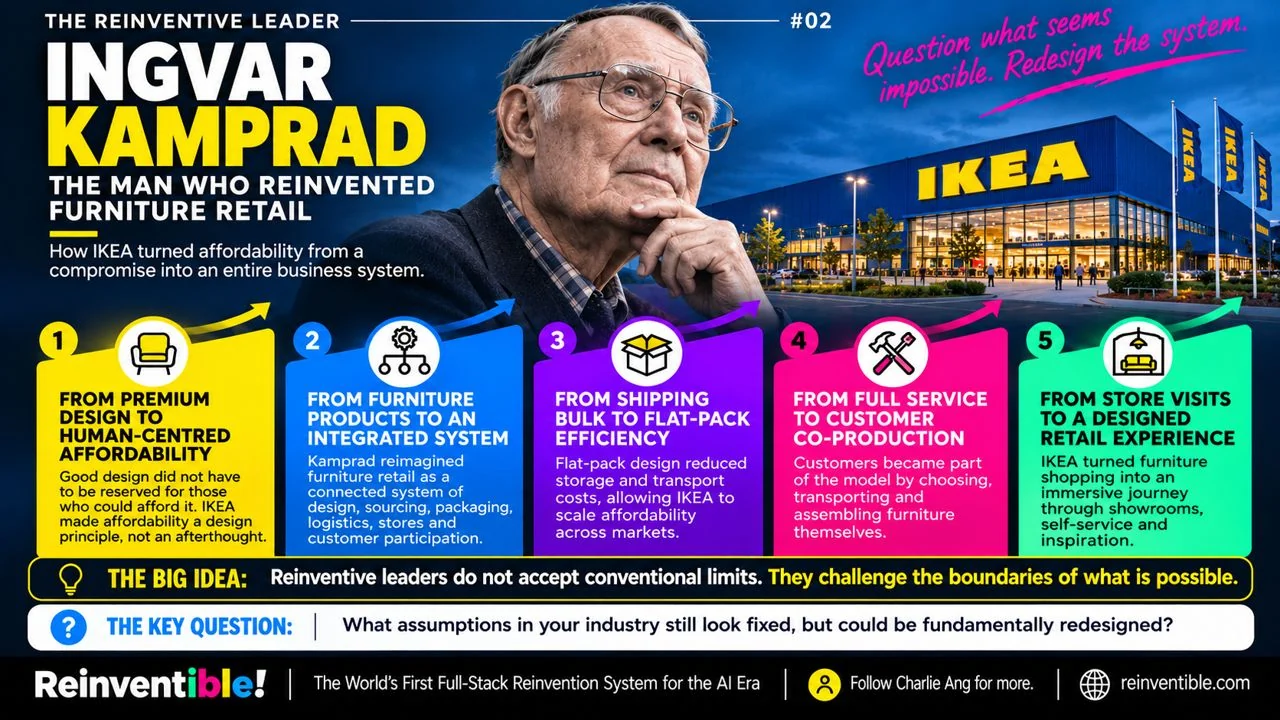
Departure 1: From Premium Design to Design for the Many
Good design did not have to be reserved for people who could afford expensive furniture. IKEA made affordability a design constraint, not an afterthought.
Departure 2: From Furniture as Product to Furniture as System
Price was not solved at the checkout. It was engineered across design, sourcing, packaging, logistics, stores and customer behaviour.
Departure 3: From Shipping Air to Flat-Pack Efficiency
Bulky assembled furniture consumed space and cost. Flat-packing radically reduced storage and transportation requirements.
Departure 4: From Full Service to Customer Co-Production
Customers transported and assembled much of their own furniture. What looked like less service became part of the economic model that made lower prices possible.
Departure 5: From Retail Store to Designed Experience
The IKEA store became more than shelves of products. Showrooms let customers imagine complete living spaces, while warehouses, restaurants and self-service created an entirely different retail journey.
The Reinvention Lesson
Kamprad's genius was not inventing one revolutionary product.
It was reinventing the architecture of an industry around a fundamentally different proposition: good design at prices the many could afford.
That is what Reinventive Leaders do.
They do not merely optimise the existing value chain.
They redesign the system that creates the value.
About The Reinventive Leader Series
Featuring extraordinary leaders who challenged conventional wisdom, reimagined what was possible and reinvented businesses, industries, institutions and societies.
Originally published as a post by Charlie Ang on LinkedIn, part of his series The Reinventive Leader.

Charlie Ang is an Intelligent Reinvention Strategist, corporate futurist and AI keynote speaker based in Singapore and speaking worldwide. He helps organisations and leaders reinvent, rewire and retool for the Age of Intelligence, and has been featured by the BBC, Financial Times, National Geographic and CNA.