 Charlie
Before Sony became a global icon, Japanese electronics companies were largely seen as manufacturers of inexpensive products rather than creators of breakthrough consumer experiences.
Akio Morita refused to accept that position.
He believed Sony should not simply compete on existing products. It should create things people had never imagined needing.
Instead of asking consumers what they wanted, Morita imagined how technology could change the way they lived.
His reinventive leadership rested on five powerful departures.
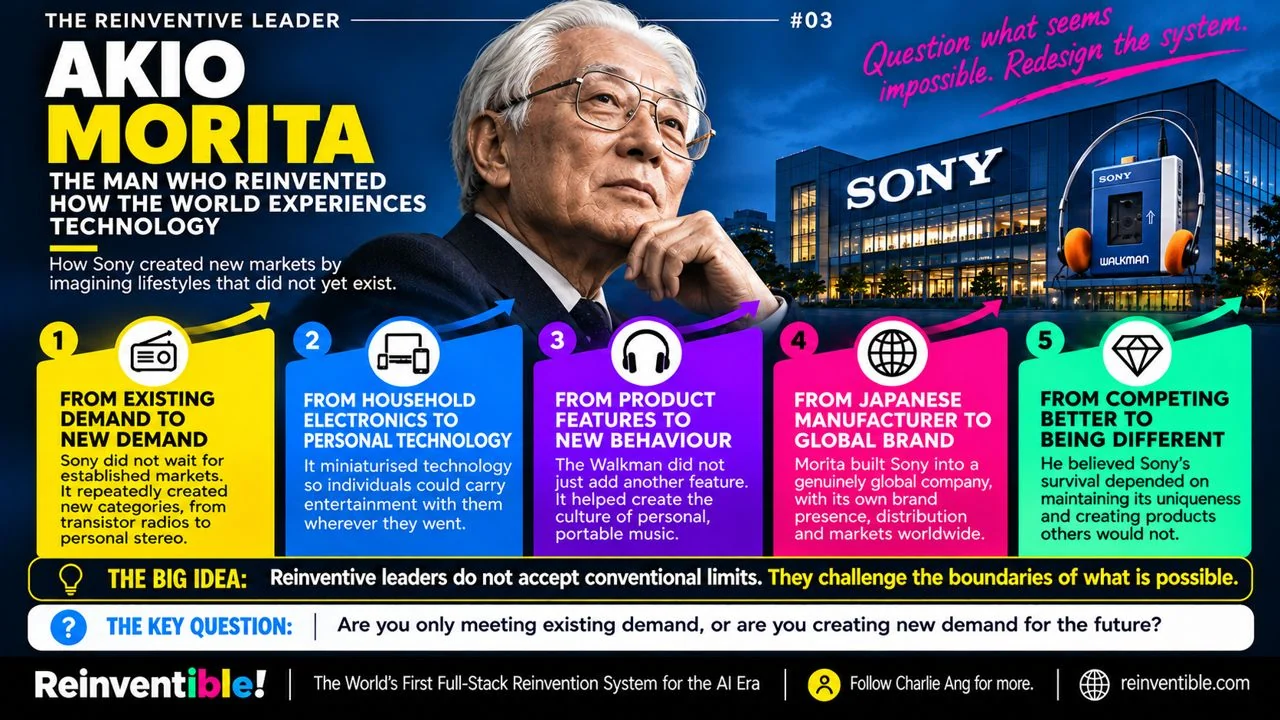
Departure 1: From Existing Demand to New Demand
Sony did not wait for established markets. It repeatedly created new categories, from portable transistor radios to personal stereo.
Departure 2: From Household Electronics to Personal Technology
Radios and music systems had traditionally belonged to the household. Sony miniaturised technology so individuals could carry entertainment with them wherever they went.
Departure 3: From Product Features to New Behaviour
The Walkman famously lacked a recording function, which many inside Sony believed made it commercially irrational.
Morita saw something different: people would want to take their music into the world.
The Walkman did not merely sell a device. It helped create the culture of personal, portable music.
Departure 4: From Japanese Manufacturer to Global Brand
Morita understood early that Sony could not remain a domestic company exporting products abroad. It needed to become a genuinely global corporation, building its own presence, distribution and brand in major markets.
Departure 5: From Competing Better to Being Different
Morita believed Sony's survival depended on maintaining its uniqueness and creating products others would not.
The Reinvention Lesson
That may be the deepest lesson of Akio Morita.
Reinventive leaders do not merely identify unmet demand.
Sometimes they imagine a new behaviour, create the product that enables it, and build the market around it.
They do not ask only:
"What does the customer want?"
They also ask:
"What might people want once we show them what is possible?"
That is how companies stop following markets. And start creating them.
Originally published as a post by Charlie Ang on LinkedIn, part of his series The Reinventive Leader.

Charlie Ang is an Intelligent Reinvention Strategist, corporate futurist and AI keynote speaker based in Singapore and speaking worldwide. He helps organisations and leaders reinvent, rewire and retool for the Age of Intelligence, and has been featured by the BBC, Financial Times, National Geographic and CNA.