Steve Jobs reimagined feature phones for the mobile-first lifestyle and high bandwidth Internet environment of the digital age into a mobile computer that is always-with-us. The likes of Nokia, Blackberry and Motorola were still stuck in the phone-first thinking of the 1-2G era.

The iPhone has since become the most successful product in history. Tim Cook harvested its long tail for over a decade. But he failed to reimagine the smartphone for the intelligence age.

Reinventing the smartphone is not merely wrapping intelligence around the device. It is centralizing intelligence as the core, not a feature of the product.

It is not only improving the product, but transforming the entire ecosystem and business model economics.

It is not just creating the next generation product but enabling consumers to live an intelligence-first lifestyle, the way the original iPhone accelerated our mobile-first lifestyles.

The player that successfully reinvents the smartphone and the business model and ecosystem around it will ride on an even bigger and longer tail than the iPhone.

So how do you reinvent the smartphone? This is a demonstrative case study of applying the Reinventible! approach of 5 skills-steps to smartphones.
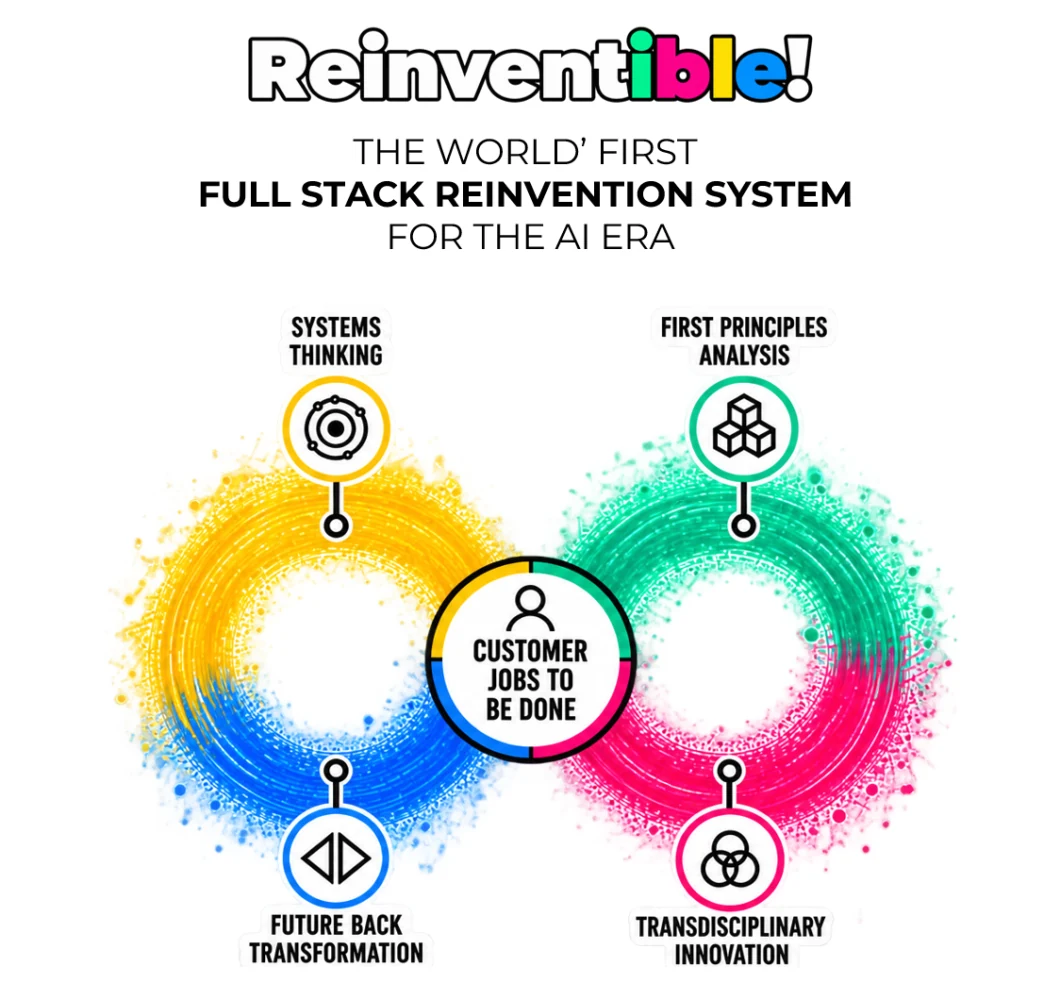
Reinventible!, the world's first full-stack reinvention system for the AI era. Customer Jobs to be Done sits at the centre, surrounded by four skills: Systems Thinking, First Principles Analysis, Future Back Transformation and Transdisciplinary Innovation.
Reinventible!, the full-stack reinvention system: five skills applied as five steps.Click to enlargeTap to enlarge
The five steps at a glance
StepWhat it doesSmartphone breakthrough
1. Customer Jobs to be DoneAnchors the customer need as the true northGrand customer job: help me live my life better, wherever I am
2. First Principles AnalysisChallenges inherited assumptions to find what remains trueFrom operating applications to expressing intent and achieving outcomes
3. Transdisciplinary InnovationSynthesises ideas from diverse disciplines and industriesThe smartphone becomes your Outcome Ally: advisor, assistant and agent
4. Systems ThinkingDesigns the growth system to take off and scaleTwo flywheels: trust and delegation, ecosystem and platform
5. Future-Back TransformationEnvisions the winning future and the roadmap to get thereBy 2032, the default gateway between human intent and the outside world

Step 1: "Customer" Jobs to be Done

First, Jobs to Be Done keeps us laser-focused on the real customer needs we want to serve. This anchors the Customer Need as the true north of the reinvention process.
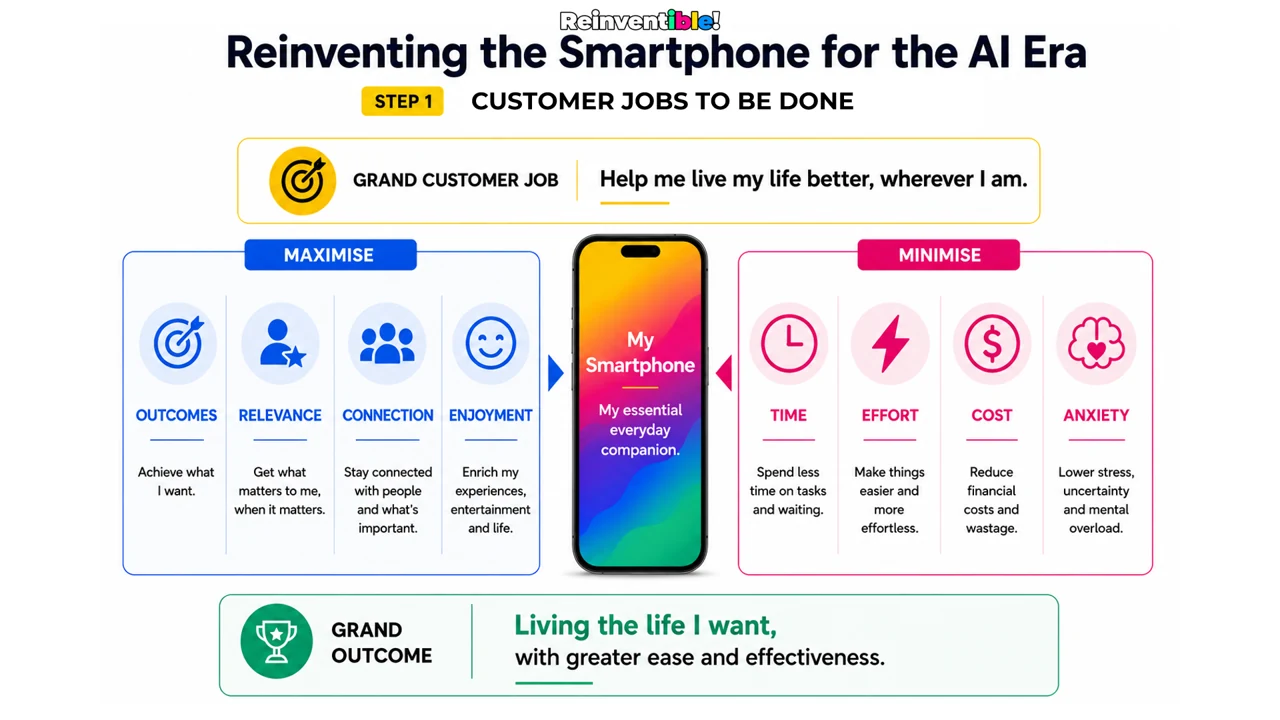
Reinventing the Smartphone for the AI Era, Step 1, Customer Jobs to be Done. Grand customer job: help me live my life better, wherever I am. The smartphone as my essential everyday companion. Maximise: outcomes (achieve what I want), relevance (get what matters to me, when it matters), connection (stay connected with people and what is important), enjoyment (enrich my experiences, entertainment and life). Minimise: time (spend less time on tasks and waiting), effort (make things easier and more effortless), cost (reduce financial costs and wastage), anxiety (lower stress, uncertainty and mental overload). Grand outcome: living the life I want, with greater ease and effectiveness.
Step 1: the grand customer job, what to maximise and minimise, and the grand outcome.Click to enlargeTap to enlarge

Step 2: First Principles Analysis

Second, First Principles Analysis challenges inherited structures and existing assumptions to distil what remains fundamentally true in the AI era. This enables us to build from a clean slate, rather than be burdened by legacy and aging assumptions.
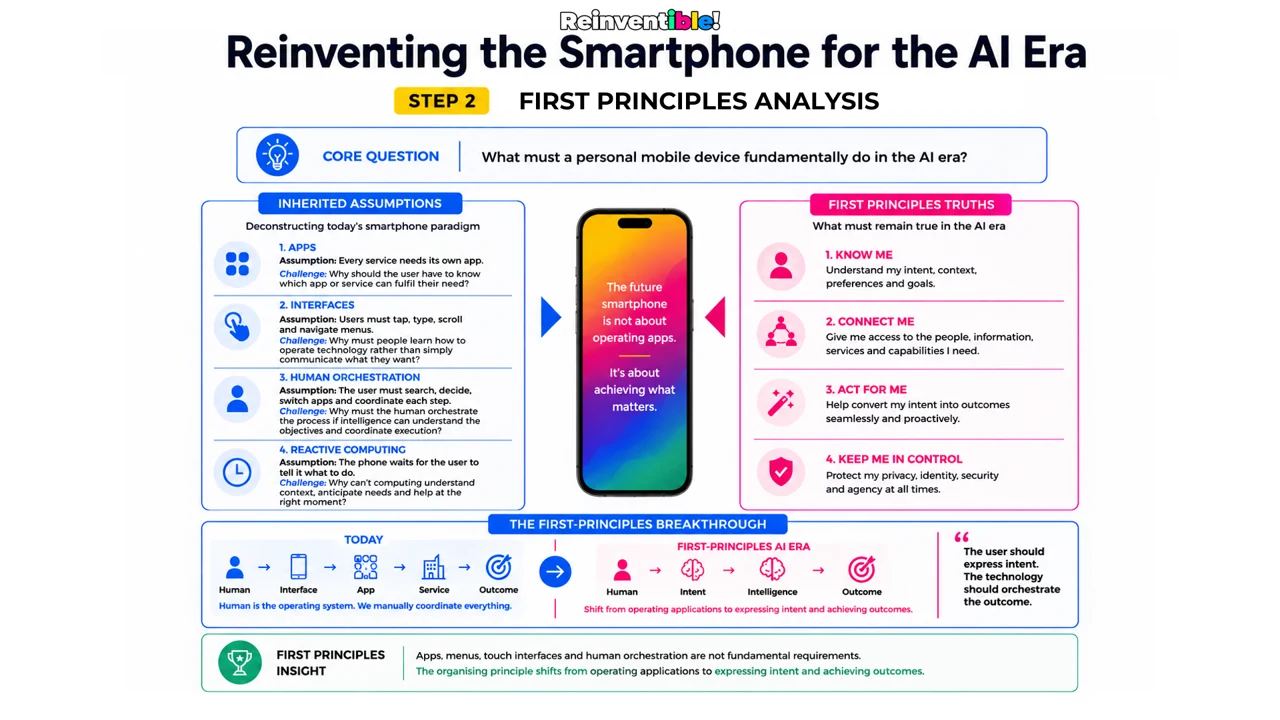
Reinventing the Smartphone for the AI Era, Step 2, First Principles Analysis. Core question: what must a personal mobile device fundamentally do in the AI era? Inherited assumptions challenged: every service needs its own app; users must tap, type, scroll and navigate menus; the user must orchestrate each step; the phone waits for the user to tell it what to do. First principles truths: know me, connect me, act for me, keep me in control. Breakthrough: today the human is the operating system, moving from human to interface to app to service to outcome; in the AI era it moves from human to intent to intelligence to outcome. The user should express intent and the technology should orchestrate the outcome. Insight: the organising principle shifts from operating applications to expressing intent and achieving outcomes.
Step 2: inherited assumptions versus first principles truths, and the shift from operating apps to expressing intent.Click to enlargeTap to enlarge

Step 3: Transdisciplinary Innovation

Third, Transdisciplinary Innovation synthesises ideas from diverse disciplines and industries to create breakthrough possibilities. This expands the solution space and compounds workable ideas from across disciplines and industries.
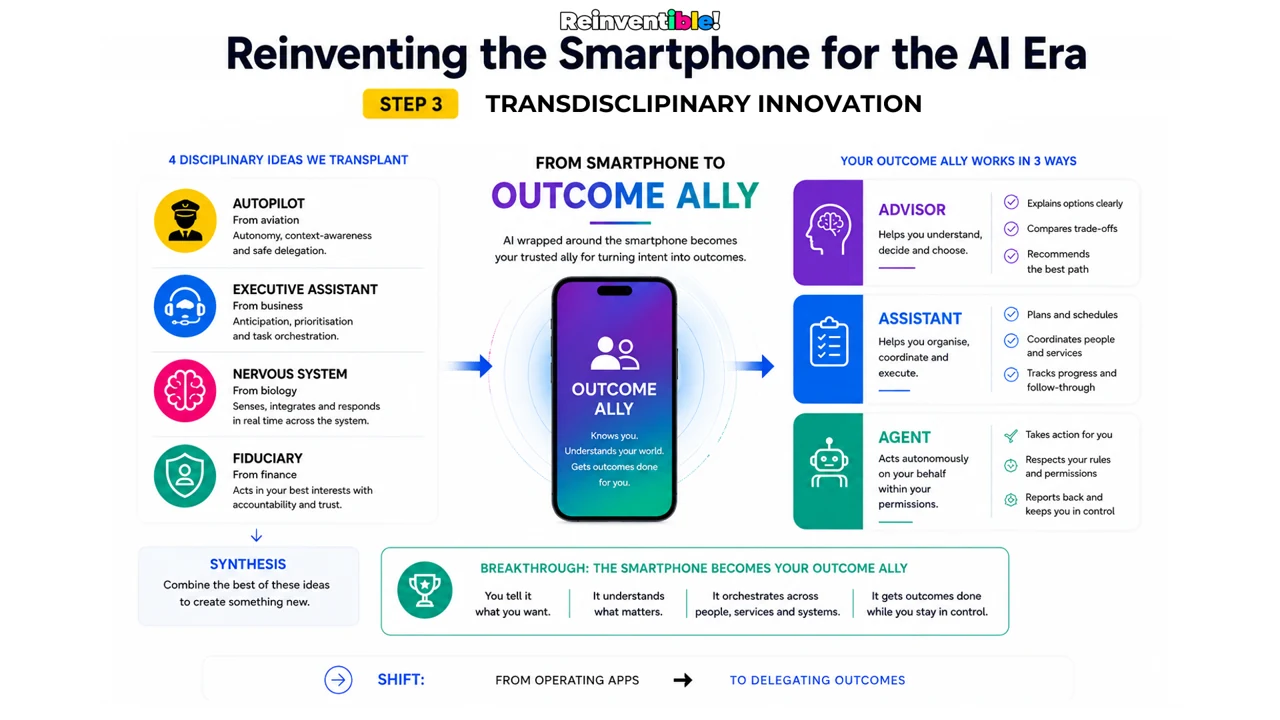
Reinventing the Smartphone for the AI Era, Step 3, Transdisciplinary Innovation. Four ideas transplanted: autopilot from aviation, executive assistant from business, nervous system from biology, fiduciary from finance. Synthesised into the Outcome Ally: AI wrapped around the smartphone becomes your trusted ally for turning intent into outcomes. It works in three ways: advisor (helps you understand, decide and choose), assistant (helps you organise, coordinate and execute) and agent (acts autonomously on your behalf within your permissions). Shift: from operating apps to delegating outcomes.
Step 3: four ideas from other disciplines combine into the Outcome Ally.Click to enlargeTap to enlarge

Step 4: Systems Thinking

Fourth, we use Systems Thinking to design the growth system for the new breakthrough to take off and scale. This creates the self-reinforcing momentum that allows value to compound over time.
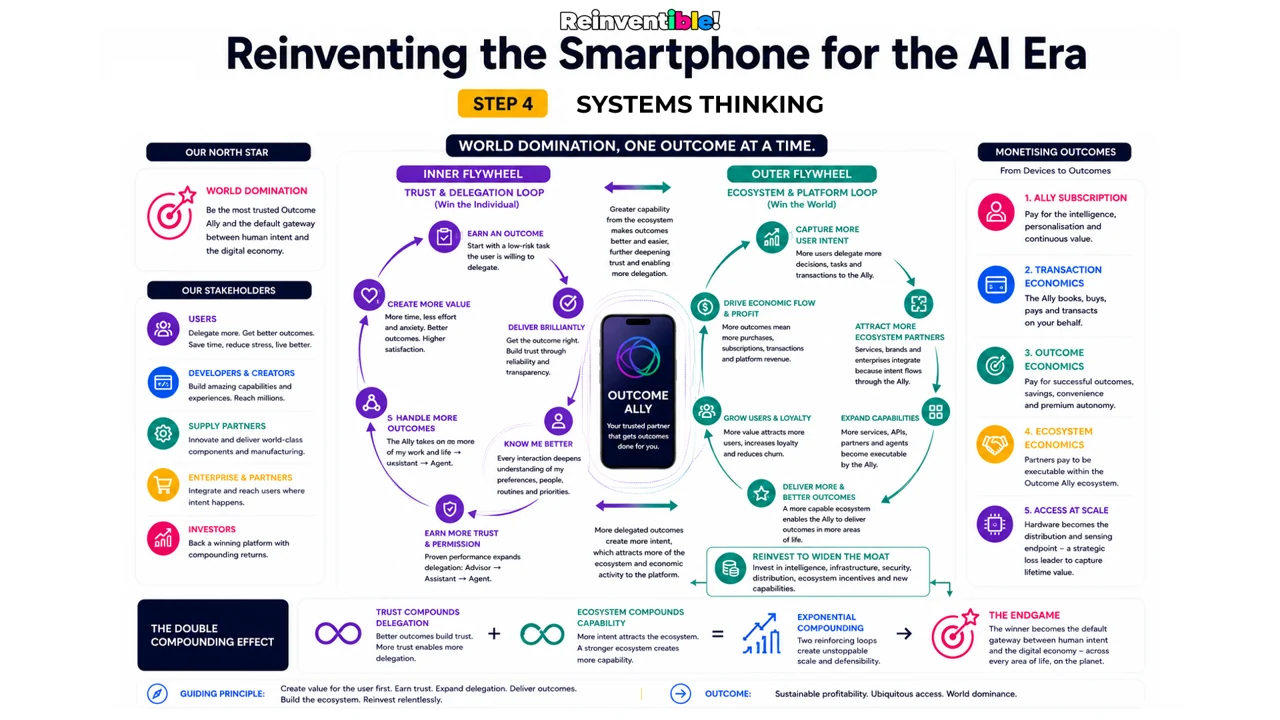
Reinventing the Smartphone for the AI Era, Step 4, Systems Thinking. North star: be the most trusted Outcome Ally and the default gateway between human intent and the digital economy. Stakeholders: users, developers and creators, supply partners, enterprises and partners, investors. Inner flywheel, the trust and delegation loop: earn an outcome, deliver brilliantly, know me better, earn more trust and permission, handle more outcomes, create more value. Outer flywheel, the ecosystem and platform loop: capture more user intent, attract more ecosystem partners, expand capabilities, deliver more and better outcomes, grow users and loyalty, drive economic flow and profit. Monetising outcomes: ally subscription, transaction economics, outcome economics, ecosystem economics, and access at scale with hardware as a strategic loss leader. The double compounding effect: trust compounds delegation and the ecosystem compounds capability.
Step 4: the inner trust flywheel, the outer ecosystem flywheel and how outcomes are monetised.Click to enlargeTap to enlarge

Step 5: Future-Back Transformation

And fifth, Future-Back Transformation envisions the winning future and develops the roadmap to get there. This translates the vision into the capabilities, innovations and actions required to make it happen.
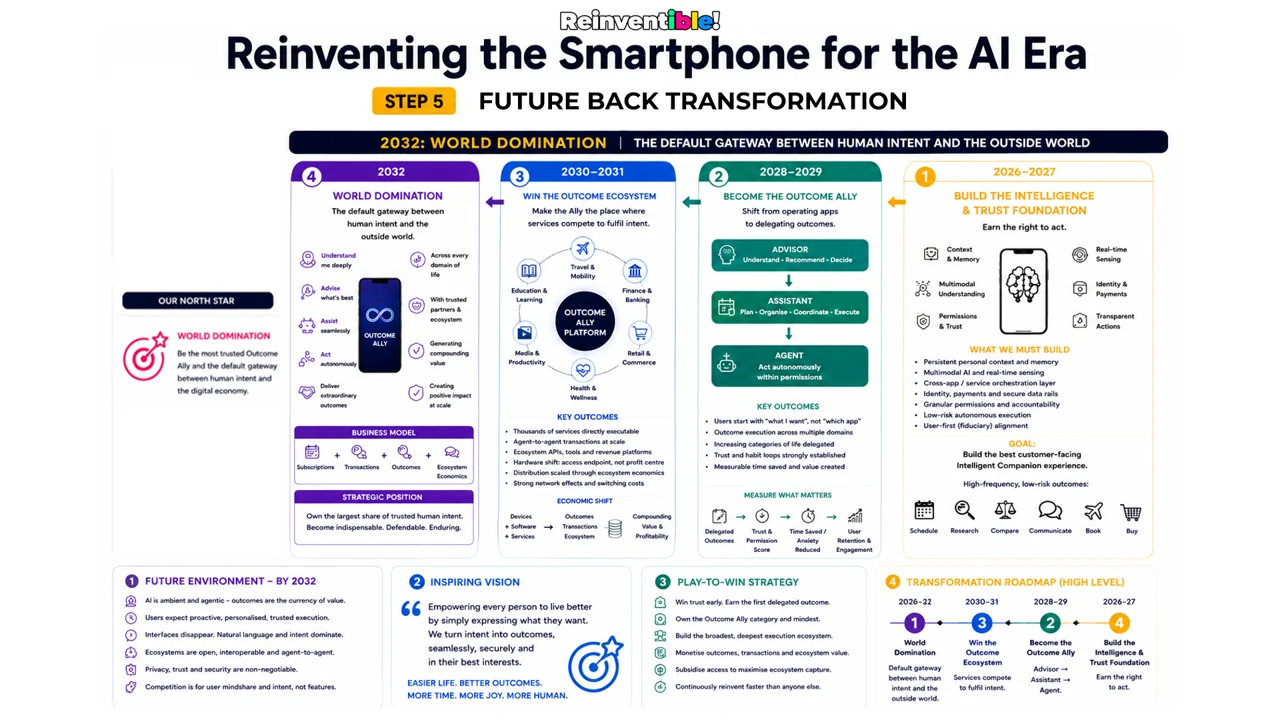
Reinventing the Smartphone for the AI Era, Step 5, Future Back Transformation. 2032 vision: the default gateway between human intent and the outside world. Working back: 2030 to 2031, win the outcome ecosystem; 2028 to 2029, become the Outcome Ally, moving from advisor to assistant to agent; 2026 to 2027, build the intelligence and trust foundation and earn the right to act. Inspiring vision: empowering every person to live better by simply expressing what they want. Play-to-win strategy: win trust early, own the Outcome Ally category, build the broadest execution ecosystem, monetise outcomes and transactions, subsidise access, and continuously reinvent faster than anyone else.
Step 5: the 2032 vision and the roadmap worked back to today.Click to enlargeTap to enlarge

In sum

In sum, the smartphone goes from a content and communications device to the outcome partner of the user. The key job is to translate user intents into good outcomes.

The dominant business model is likely to be for the hardware to become the loss leader for distribution and new source of growth revenue from accomplishing monetizable outcomes.

While it is illustrative to use the approach on the most iconic product in recent memory, Reinventible! can be applied to reinvent any business, product, service, function or team to become AI-native.

Not just the iPhone, but everything is up for reinvention.

Originally published in Charlie Ang's Intelligent Reinvention Memo newsletter on LinkedIn (Issue 53).

About the author
Charlie Ang

Charlie Ang is an Intelligent Reinvention Strategist, corporate futurist and AI keynote speaker based in Singapore and speaking worldwide. He helps organisations and leaders reinvent, rewire and retool for the Age of Intelligence, and has been featured by the BBC, Financial Times, National Geographic and CNA.