 Charlie
From preparing leaders for known roles to developing the capacity to lead through continuous reinvention.
For decades, leadership development has been designed around a relatively stable assumption: organisations know what leadership looks like, what capabilities leaders require and what roles they are being prepared to occupy.
That assumption is breaking down.
AI is changing the work of leaders themselves. Decisions can increasingly be augmented by machines. Expertise is becoming abundant. Organisational boundaries are becoming more fluid. Teams will increasingly include both humans and AI agents. Business models may need to be reinvented repeatedly rather than optimised incrementally.
The leadership challenge is therefore no longer simply developing better managers for existing organisations.
It is developing people capable of leading organisations that are themselves being continuously reinvented.
The Old Model
Traditional leadership development largely emerged from the managerial corporation of the twentieth century.
Organisations identified high-potential employees, assessed them against predefined leadership competencies, moved them through increasingly senior roles and sent them through structured development programmes.
The underlying architecture was relatively straightforward:
Competencies → Courses → Career Moves → Leadership Roles
Leadership pipelines were designed to reproduce the capabilities that had made existing leaders successful.
But when technology, industries, organisations and even the nature of work are changing rapidly, yesterday's leadership model becomes an increasingly unreliable blueprint for tomorrow's leaders.
AI therefore creates a deeper question:
What if leadership development should prepare leaders not for the organisation that exists today, but for organisations that do not yet exist?
Imagine Leadership Development in 2035
Imagine joining an organisation where leadership development begins not with a competency framework, but with a series of increasingly difficult missions.
You lead a human-AI team redesigning a customer journey.
You spend several weeks building a new business model outside your existing division.
An AI leadership coach analyses how you frame problems, make decisions, challenge assumptions, communicate and mobilise others.
Simulations expose you to geopolitical shocks, AI disruption, ethical dilemmas and collapsing business models.
Your development pathway continuously changes according to your experiences, strengths and future leadership potential.
Senior leaders no longer primarily teach what worked for them.
They create environments in which emerging leaders learn how to navigate what nobody has encountered before.
Leadership development becomes less like a curriculum.
It becomes a leadership laboratory.
Five Shifts for Leadership Development
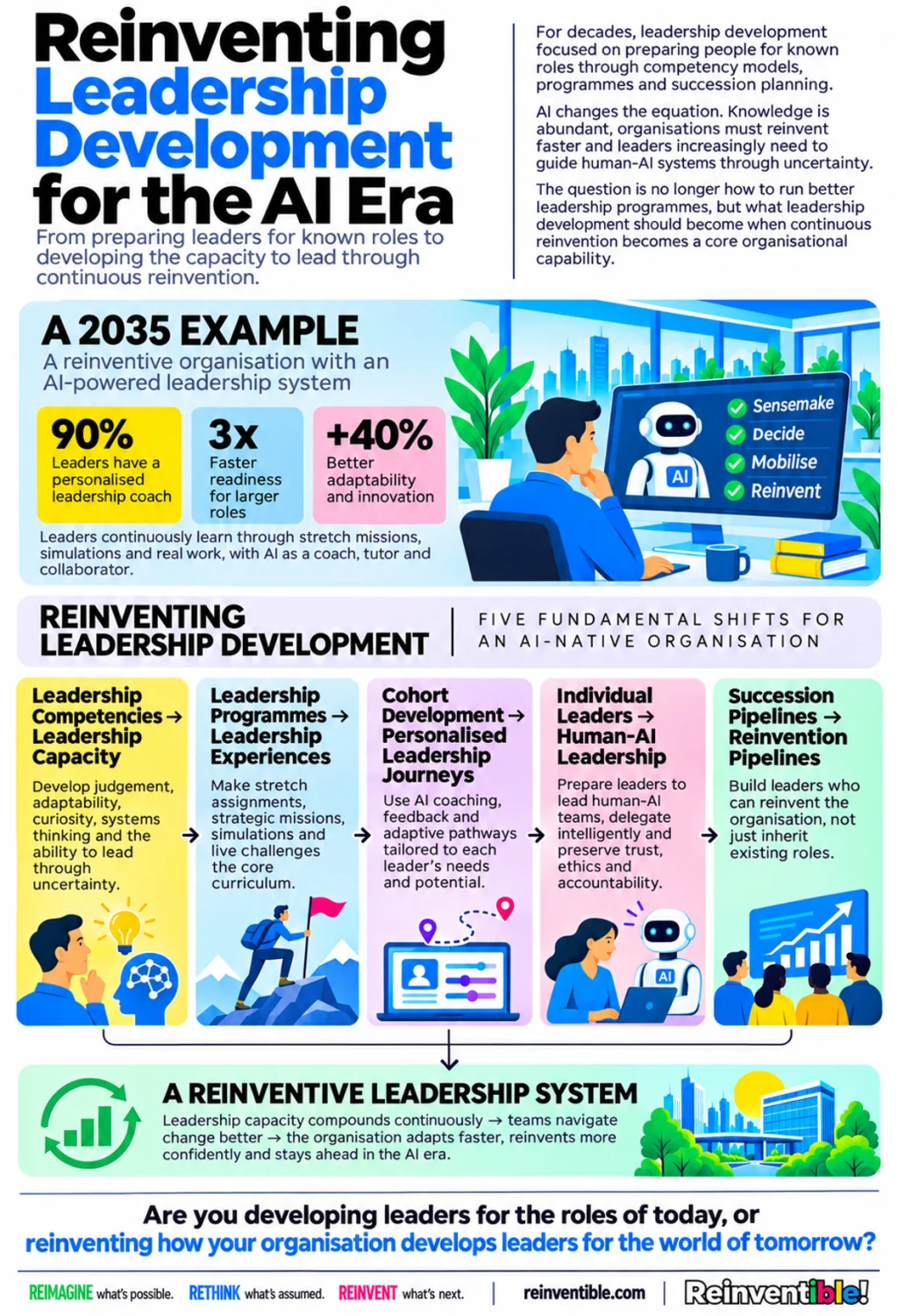
Shift 1: Leadership Competencies → Leadership Capacity
Traditional frameworks define the behaviours associated with effective leadership.
But fixed competency models risk encoding yesterday's definition of a good leader.
Future leadership development must cultivate deeper capacities that remain valuable even as contexts change: judgement, curiosity, sensemaking, adaptability, courage, imagination, systems thinking and the ability to mobilise people through uncertainty.
The question changes from:
“Does this person demonstrate our leadership competencies?”
to:
“Can this person successfully lead through situations we cannot yet predict?”
Shift 2: Leadership Programmes → Leadership Experiences
Leadership cannot be developed primarily inside classrooms.
The most powerful development increasingly comes from tackling consequential problems: launching new ventures, turning around businesses, leading transformations, entering unfamiliar markets and responding to crises.
Organisations should therefore design portfolios of increasingly demanding leadership experiences, supported by coaching, reflection and peer learning.
Courses become supporting infrastructure.
Experience becomes the curriculum.
Shift 3: Cohort Development → Personalised Leadership Journeys
Most leadership programmes still move entire cohorts through broadly identical content.
AI makes a radically different model possible.
Every leader can have an adaptive development journey shaped by their experience, aspirations, behaviour, performance and capability gaps.
AI coaches can provide continuous reflection, simulations can target specific weaknesses and learning resources can appear precisely when they are needed.
Leadership development shifts from periodic programmes to continuous personalised development.
Shift 4: Individual Leaders → Human-AI Leadership
Future leaders will increasingly lead organisations in which work is performed by combinations of humans, algorithms and autonomous AI agents.
That creates an entirely new leadership discipline.
Leaders must learn what decisions to delegate to machines, where human judgement remains essential, how to organise human-AI teams, how to maintain accountability and how to preserve trust when intelligent systems increasingly influence decisions.
Leadership development must therefore prepare people not merely to use AI, but to lead through AI.
Shift 5: Succession Pipelines → Reinvention Pipelines
Traditional leadership development ultimately feeds succession planning.
Who can replace the current business-unit head, CFO or CEO?
But the roles themselves may change dramatically.
Organisations increasingly need leaders capable of creating businesses, operating models and organisational forms that do not yet exist.
Leadership pipelines should therefore become reinvention pipelines.
Emerging leaders should repeatedly be placed in situations where they must challenge assumptions, imagine alternatives, design new systems and mobilise people to create them.
The ultimate test of leadership potential becomes increasingly simple:
Can this person help reinvent the organisation before circumstances force the organisation to reinvent itself?
What Would It Take?
Reinventing leadership development requires much more than adding AI modules to existing programmes.
Organisations would need to rethink the entire architecture.
Leadership competency frameworks would have to become more dynamic.
High-potential programmes would need to incorporate real strategic missions.
AI coaching and simulation could become persistent development infrastructure.
Career mobility would need to expose leaders to unfamiliar domains rather than simply move them upward through familiar hierarchies.
Senior executives would increasingly become sponsors of leadership experiments rather than lecturers explaining past success.
And leadership development would need to move much closer to strategy.
Because developing leaders and reinventing the organisation would increasingly become the same activity.
Risks and Trade-offs
AI-enabled leadership development brings its own dangers.
Algorithmic assessments could reinforce hidden biases.
Constant behavioural measurement could become intrusive.
AI coaching may optimise people toward overly standardised models of leadership.
Organisations may overvalue measurable capabilities while overlooking character, wisdom and moral judgement.
And experiential development becomes difficult when every assignment must also deliver business results.
The objective should therefore not be to automate leadership development.
It should be to use AI to create richer developmental environments while keeping profoundly human qualities at the centre of leadership.
What to Watch Next
The most interesting organisations will increasingly blur the boundaries between leadership development, talent management, strategy and transformation.
AI coaches will become persistent companions.
Leadership simulations will become dramatically more sophisticated.
Internal talent marketplaces will match emerging leaders with strategic challenges.
High-potential programmes will increasingly resemble venture studios and transformation labs.
And leadership academies may evolve from institutions that teach leadership into systems that continuously produce leaders through experience.
For much of the last century, leadership development helped organisations reproduce their existing leadership model.
The AI era requires something fundamentally different.
Develop leaders capable of reinventing the model itself.
Originally published in Charlie Ang's Intelligent Reinvention Memo newsletter on LinkedIn (Issue 67), part of his "Reinventing X for the AI Era" series.

Charlie Ang is an Intelligent Reinvention Strategist, corporate futurist and AI keynote speaker based in Singapore and speaking worldwide. He helps organisations and leaders reinvent, rewire and retool for the Age of Intelligence, and has been featured by the BBC, Financial Times, National Geographic and CNA.