 Charlie
From standardised training programmes to an intelligent, continuously evolving learning organisation
For decades, enterprise learning has operated on a simple assumption: employees need knowledge and skills, organisations identify the gaps, and L&D designs programmes to close them.
That model made sense when knowledge was relatively scarce, jobs were stable and expertise took years to acquire.
Artificial intelligence is dismantling those assumptions.
Knowledge is becoming abundant. AI can explain complex concepts, generate solutions, simulate scenarios and provide personalised coaching on demand. Tasks are being automated, jobs are being redesigned and the capabilities required of employees are changing faster than traditional learning systems can respond.
Yet much of enterprise learning remains organised around annual training plans, competency frameworks, standardised programmes and course completion metrics.
The question is no longer simply how AI can improve corporate training.
It is far more fundamental:
What should enterprise learning become when intelligence is abundant, AI becomes a collaborator and continuous reinvention becomes essential?
The Old Model
Enterprise learning today largely follows an industrial-age architecture, subsequently digitised for the knowledge economy.
Organisations identify skill gaps, develop competency frameworks, design training programmes, deliver learning content and measure participation.
The underlying model looks something like this:
Job Requirements → Skills Gaps → Training Programmes → Course Completion → Certification
It assumes that skills requirements can be reasonably predicted, that learning can be standardised across employees and that knowledge acquired today will remain valuable tomorrow.
Even modern learning management systems often preserve this basic logic, replacing classrooms with digital courses and learning catalogues.
The limitations are becoming increasingly apparent.
Training programmes take months to develop while AI capabilities evolve rapidly. Employees with different needs receive similar content. Learning is frequently disconnected from actual work. Completion rates are mistaken for capability development.
And perhaps most importantly, employees are still largely trained to perform work independently, even as AI increasingly becomes an integral part of how that work gets done.
The enterprise learning system needs to be reinvented around the new economics of intelligence, capability and work.
Imagine Enterprise Learning in 2035
Imagine joining an enterprise in 2035.
Instead of receiving a catalogue of mandatory courses, you are connected to a personal AI learning partner.
It understands your capabilities, development aspirations, current projects and the evolving requirements of your work.
When you encounter a complex problem, it helps you understand the underlying concepts, challenges your assumptions and guides you towards better solutions.
Before an important negotiation, you practise with an AI-generated counterpart. After a client presentation, you receive targeted feedback. When your organisation adopts new AI agents, you learn how to supervise, collaborate with and orchestrate them.
Your learning experiences continuously adapt to your progress, performance and changing responsibilities.
Meanwhile, the enterprise learning system identifies emerging capability gaps across teams, captures lessons from completed projects and helps distribute successful practices throughout the organisation.
Human coaches, mentors and experts remain essential, particularly for developing judgment, interpersonal intelligence, leadership and organisational culture.
There is no rigid distinction between training, learning and working.
The enterprise itself becomes an intelligent learning system, continuously upgrading the capabilities of its people and AI.
What would it take to make this future possible?
Reinventing Enterprise Learning: Five Fundamental Shifts
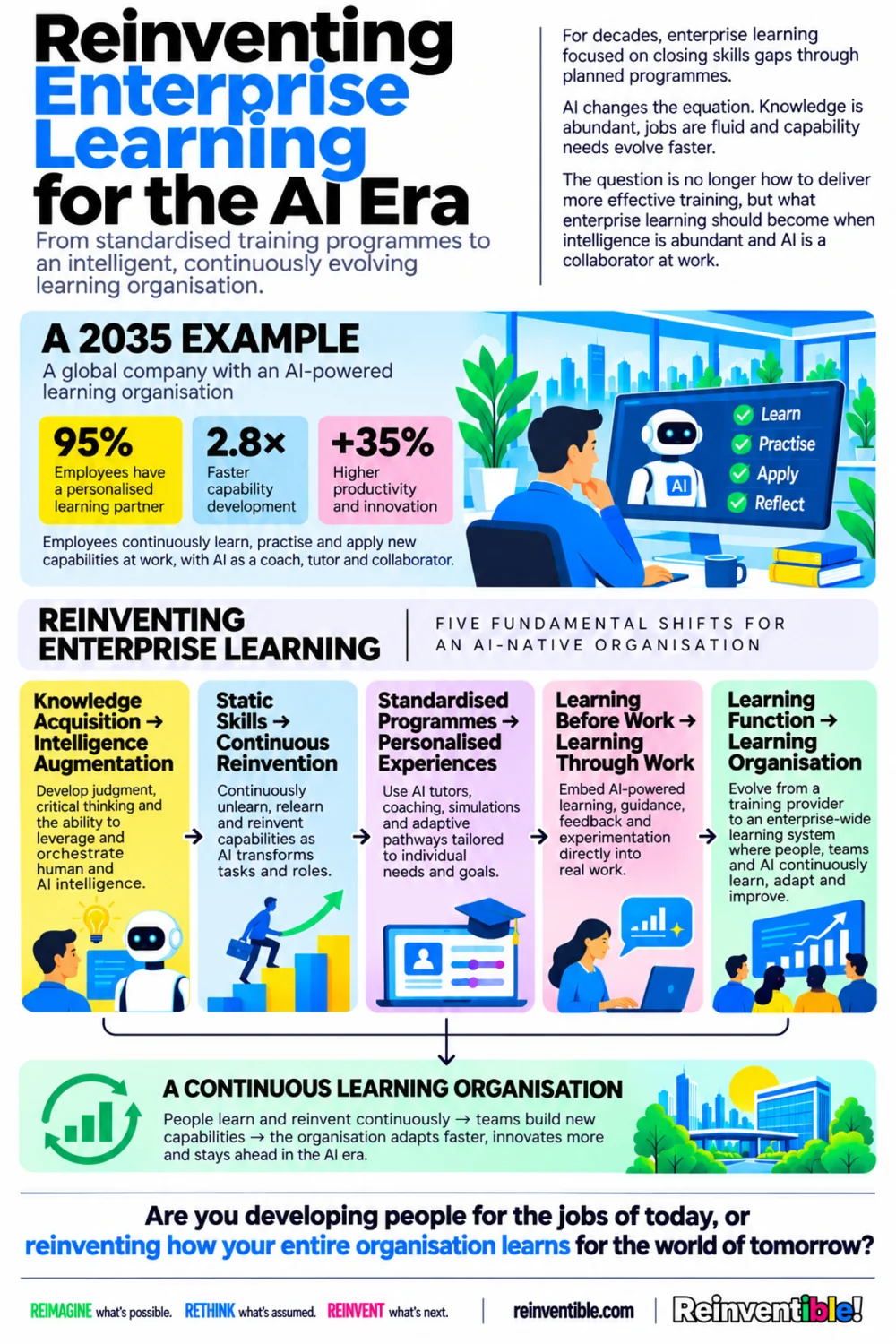
Shift 1: Knowledge Acquisition → Intelligence Augmentation
Traditional enterprise learning has largely focused on expanding what employees know and what they can do independently.
But when AI can retrieve, synthesise and generate knowledge on demand, accumulating information becomes a less important source of differentiation.
The new imperative is to develop augmented human capabilities.
Employees must learn how to combine their own intelligence with AI to solve problems, generate ideas, make decisions and achieve outcomes that neither could accomplish as effectively alone.
This requires a different set of competencies.
Critical thinking becomes essential for questioning AI-generated answers. Judgment becomes more valuable for evaluating competing recommendations. Problem framing determines whether AI is solving the right problem in the first place.
Employees must also develop the ability to delegate tasks to AI, supervise AI agents, evaluate their outputs and orchestrate human-AI workflows.
Enterprise learning should therefore focus less on how much knowledge employees possess and more on how effectively they can mobilise human and artificial intelligence together.
The central question changes from What do our employees need to know? to What must our people be capable of achieving with AI?
Shift 2: Static Skills → Continuous Reinvention
Traditional learning frameworks assume that organisations can identify the competencies required for specific roles and develop employees accordingly.
AI challenges the stability of those roles themselves.
As tasks are automated, augmented or newly created, job descriptions and capability requirements will continuously evolve.
An accountant may move from processing information towards interpreting AI-generated insights and advising clients. A marketer may shift from creating campaigns towards orchestrating AI-driven customer engagement. A manager may increasingly coordinate teams of humans and AI agents.
The challenge is no longer simply closing today's skills gaps.
It is preparing employees to continuously reinvent their capabilities as work itself changes.
Enterprise learning must therefore evolve from periodic upskilling initiatives towards continuous unlearning, relearning and reinvention.
Dynamic capability maps can help organisations anticipate emerging requirements, identify declining skills and redirect development investments as their strategies and operating models evolve.
Employees need to develop learning agility, adaptability and the ability to challenge the assumptions underlying their existing expertise.
The most valuable capability may ultimately be the capacity to repeatedly acquire new capabilities.
Shift 3: Standardised Programmes → Personalised Experiences
Corporate learning has traditionally operated on economies of scale.
Organisations design programmes for defined employee groups, deliver standardised content and assess participants against common learning objectives.
But employees differ in their existing knowledge, experience, learning preferences, aspirations and actual development needs.
Generative AI fundamentally changes the economics of personalisation.
AI-powered tutors can explain complex concepts in different ways, generate tailored examples, diagnose misconceptions and adjust difficulty dynamically.
AI coaches can simulate negotiations, leadership conversations, client interactions and operational decisions.
Learning pathways can adapt continuously based on demonstrated progress rather than predetermined curricula.
Instead of sending hundreds of managers through an identical leadership programme, an organisation could provide each manager with a personalised development experience addressing their specific challenges.
This does not eliminate shared learning, peer interaction or collective development.
It allows organisations to combine the benefits of common organisational standards with individualised pathways towards capability mastery.
The fundamental shift is from delivering content to designing intelligent learning experiences that is tailored to each employee.
Shift 4: Learning Before Work → Learning Through Work
Enterprise learning has historically treated learning and working as separate activities.
Employees attend programmes, acquire knowledge and are subsequently expected to apply it.
But much of what people learn in formal training is forgotten or never transferred into actual performance.
AI creates the possibility of fundamentally integrating learning with work.
An employee preparing a business proposal can receive contextual guidance while developing it.
A manager can practise difficult conversations before conducting them.
An analyst can learn unfamiliar techniques while solving an actual business problem.
A project team can use AI to review decisions, identify lessons and improve its approach throughout an engagement.
Learning becomes increasingly contextual, experiential and immediate.
Rather than relying exclusively on formal instruction followed by application, employees develop capabilities through AI-supported practice, feedback, experimentation and reflection embedded in real work.
Formal programmes will still matter, particularly where foundational knowledge, deep expertise or shared experiences are essential.
But the primary learning environment increasingly becomes the workplace itself.
The distinction between a learning platform and a work platform begins to disappear.
Shift 5: Learning Function → Learning Organisation
Perhaps the most consequential shift is from reinventing L&D to reinventing how the entire enterprise learns.
Traditional L&D functions are responsible for designing, procuring and delivering development programmes.
But organisational learning cannot depend primarily on a central department when technologies, customer expectations and competitive conditions are changing continuously.
AI makes it possible to create a more distributed, connected and adaptive learning system.
Knowledge generated in one team can be captured, synthesised and made accessible across the enterprise.
Lessons from projects, customer interactions and operational decisions can inform improvements elsewhere.
AI can help identify emerging capability gaps, recommend interventions and connect employees with relevant expertise.
Managers become capability developers. Employees become active agents of their own reinvention. AI becomes both a learning partner and a mechanism for amplifying organisational intelligence.
The L&D function evolves into the architect and orchestrator of the enterprise learning ecosystem.
Its responsibility expands beyond developing employees to designing systems through which the organisation continuously learns, adapts and reinvents itself.
The ultimate goal is an organisation that becomes more capable with every project, decision, interaction and experiment.
What Would It Take?
Making these five shifts requires much more than deploying AI tutors or upgrading a learning management system.
First, redefine the purpose of enterprise learning. Move beyond knowledge transfer and training delivery towards developing augmented human capabilities and organisational adaptability.
Second, redesign capability frameworks. Replace rigid, job-based competencies with more dynamic models reflecting evolving tasks, human-AI collaboration and emerging business requirements.
Third, reinvent learning experiences. Combine AI tutors, adaptive simulations, human coaching, experiential development and collaborative learning into personalised pathways.
Fourth, integrate learning with enterprise workflows. Connect learning systems with work environments so employees receive relevant support, feedback and opportunities for development when they need them.
Fifth, reposition L&D as a strategic capability architect. Equip learning professionals to design human-AI learning ecosystems, facilitate organisational change and measure improvements in actual business performance.
Above all, leadership must recognise that enterprise learning is no longer simply a support function.
It is becoming a core component of business strategy and organisational reinvention.
Risks and Trade-offs
The reinvention of enterprise learning is not without risks.
- AI dependence. Employees who rely excessively on AI assistance may fail to develop the underlying expertise needed to challenge its recommendations.
- Erosion of human learning. Hyper-personalised experiences could weaken peer interaction, shared organisational understanding and the social dimensions of learning.
- Quality and reliability. AI tutors and coaches can provide inaccurate explanations, inappropriate feedback or misleading assessments.
- Privacy and surveillance. Integrating AI with employee workflows introduces legitimate concerns about monitoring, consent and the use of individual performance data.
- Unequal access. Organisations may create new capability divides if AI-enabled learning opportunities are unevenly distributed across their workforce.
Successful reinvention therefore requires thoughtful governance, human oversight and deliberate preservation of experiences that develop independent judgment, interpersonal intelligence and collective capability.
The objective should be to strengthen human agency through AI, rather than create dependency on it.
What to Watch Next
Several developments will signal how quickly enterprise learning is being reinvented.
Watch AI tutors evolve from conversational assistants into persistent learning partners that understand individual development needs and work contexts.
Watch enterprise AI agents become integrated with learning platforms, talent systems and workplace applications.
Watch traditional competency frameworks evolve towards dynamic capability intelligence.
Watch organisations increasingly assess demonstrated performance and human-AI effectiveness rather than training attendance and completion rates.
And watch leading L&D functions evolve into enterprise-wide architects of learning, adaptation and reinvention.
The biggest transformation will occur when organisations stop treating learning as something delivered to employees and start designing enterprises that learn continuously.
In the AI era, competitive advantage will depend increasingly on how effectively an organisation can augment its intelligence, reinvent its capabilities and learn faster than its environment changes.
The ultimate question for every enterprise leader is therefore:
Are you developing people for the jobs of today, or reinventing how your entire organisation learns for the world of tomorrow?
Originally published in Charlie Ang's Intelligent Reinvention Memo newsletter on LinkedIn (Issue 66), part of his "Reinventing X for the AI Era" series.

Charlie Ang is an Intelligent Reinvention Strategist, corporate futurist and AI keynote speaker based in Singapore and speaking worldwide. He helps organisations and leaders reinvent, rewire and retool for the Age of Intelligence, and has been featured by the BBC, Financial Times, National Geographic and CNA.