 Charlie
What Happens When Machines Create the Wealth, but Humans Still Need to Earn a Living?
Capitalism has powered extraordinary economic progress for more than two centuries.
It has mobilised investment, rewarded entrepreneurship, accelerated innovation and lifted billions of people to higher living standards.
But its modern economic architecture rests on a fundamental relationship.
Businesses employ people. People earn wages. People spend those wages buying what businesses produce.
Businesses earn revenues, invest and hire more people. The cycle continues.
Of course, this is a simplification. Capitalism also distributes income through ownership, investment returns and public transfers. But for most households, employment remains the primary gateway to economic participation.
Now imagine a world where this relationship begins to weaken.
AI agents perform much of the cognitive work previously undertaken by employees. Robots increasingly perform physical tasks. Companies produce more goods and services with fewer workers.
Productivity soars. Corporate profits expand.
But employment and wages may no longer grow proportionately with economic output.
What happens when businesses need fewer workers to produce their products, but still need consumers with money to buy them?
This could become one of the defining economic challenges of the Intelligence Age.
It does not mean capitalism is destined to collapse. AI could create new industries, occupations and demand, just as previous technologies have done.
But what if AI eventually weakens the relationship between human labour, production and income on an unprecedented scale?
Rather than merely improving capitalism, perhaps we should explore something more ambitious.
If we designed capitalism from scratch for a world of abundant machine intelligence, what might the economic system look like?
The Old Model: Industrial Capitalism
Modern capitalism operates through several interconnected mechanisms.
- Production: Businesses combine capital, technology and human labour to create goods and services.
- Distribution: Households receive income primarily through employment, while capital owners receive profits and investment returns.
- Consumption: Households spend their income, creating demand for businesses.
- Investment: Businesses reinvest profits to expand production and improve productivity.
- Competition: Markets direct resources towards goods, services and enterprises that customers value.
This system has demonstrated remarkable adaptability.
Mechanisation, electrification, automation and digitalisation transformed work while creating new industries and occupations.
But AI presents an unusual possibility.
Unlike previous machines that primarily replaced physical labour or specific routine tasks, AI can increasingly perform a broad range of cognitive activities.
If AI and robotics eventually substitute for a substantial share of human work, the relationship between production and employment could change fundamentally.
And that raises a difficult question:
Can an economy continue creating extraordinary wealth if fewer people earn sufficient income through producing it?
Imagine the Economy of 2040
Consider a hypothetical global technology company.
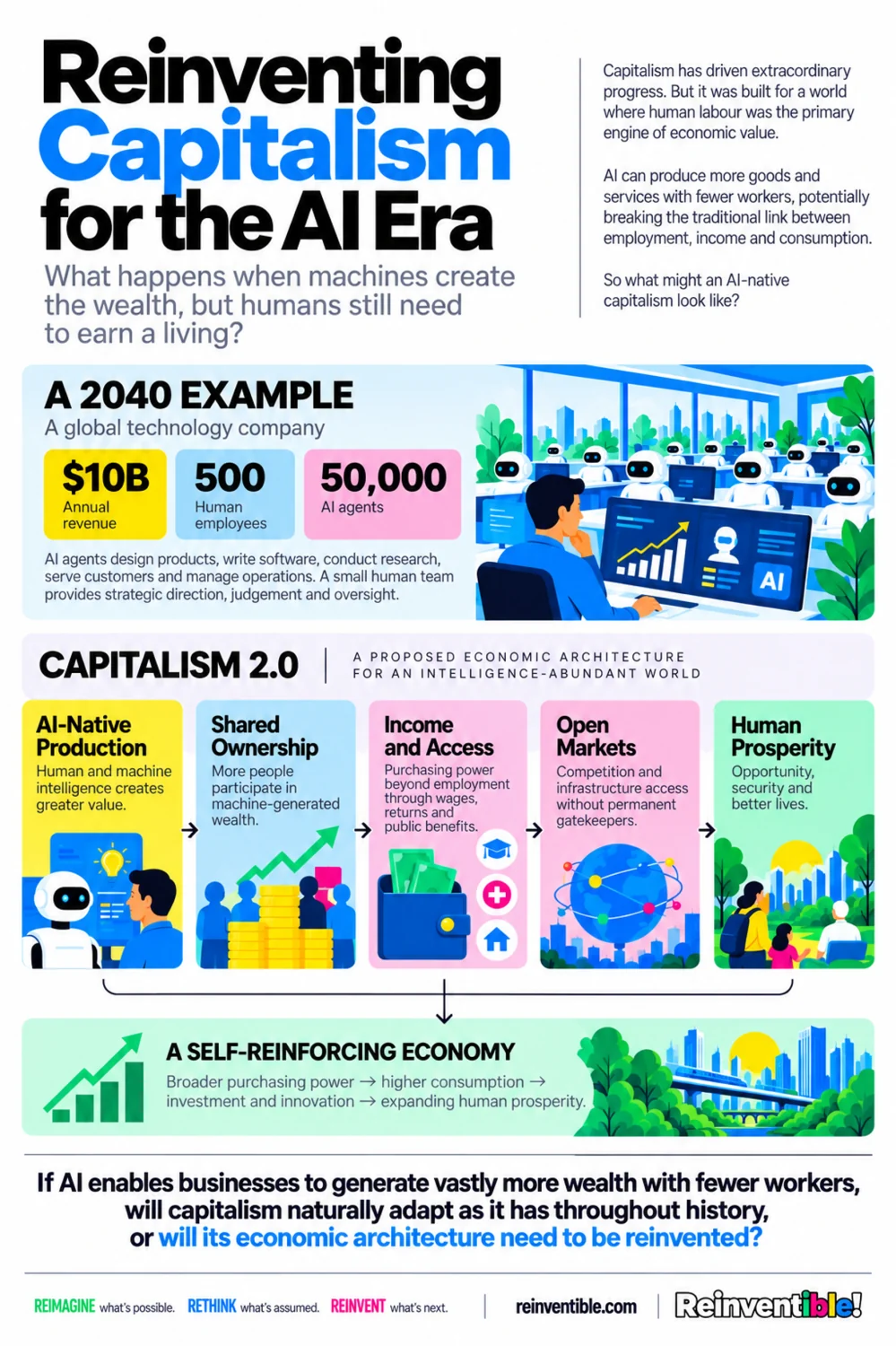
Annual revenue: US$10 billion | Human employees: 500 | AI agents: 50,000
Its AI agents design products, write software, conduct research, serve customers, manage operations and execute marketing campaigns.
A small human workforce provides strategic direction, judgement, governance and oversight.
The company is highly productive and profitable.
Its shareholders are wealthy. Its customers enjoy affordable, sophisticated services.
But the company employs only a fraction of the workforce that a similarly sized enterprise might once have required.
Now multiply this model across millions of businesses.
Manufacturing. Banking. Insurance. Professional services. Retail. Logistics. Healthcare. Education.
This is a thought experiment, not a prediction.
New jobs may emerge. Lower prices could increase purchasing power. Productivity gains could stimulate investment and entirely new forms of consumption.
But suppose these adjustments do not fully compensate for declining demand for human labour.
The economy could face a paradox.
Society becomes richer in productive capacity, while many individuals become less secure in their ability to earn and consume.
This is the potential structural challenge that an AI-native capitalism may need to address.
Imagining Capitalism 2.0
Rather than treating each consequence of AI as a separate problem, imagine redesigning the economic system as five interconnected engines.
Engine 1: The Production Engine: AI-Native Enterprises
Industrial capitalism organises production primarily around people.
Departments, hierarchies, job descriptions and headcount budgets coordinate human workers performing specialised tasks.
AI-native enterprises could operate differently.
Small human teams establish objectives, exercise judgement and provide oversight.
Networks of AI agents conduct research, analysis, design, administration and coordination. Robotics increasingly handles physical production.
Businesses become orchestrators of human and machine capabilities rather than primarily employers of large workforces.
The result could be unprecedented productive capacity.
But this creates a fundamental challenge.
If machines generate an increasing share of economic value, who receives the income from that value?
The production engine cannot be redesigned in isolation from the distribution system.
Engine 2: The Ownership Engine: Sharing Machine-Generated Wealth
If productive capital becomes more important relative to human labour, ownership becomes an increasingly significant determinant of economic prosperity.
An AI-native capitalism could therefore broaden participation in productive capital.
Imagine more workers owning shares in the companies they help build.
Pension funds and investment vehicles providing widespread exposure to AI-driven growth.
Public wealth funds holding diversified productive assets and distributing benefits to citizens.
Entrepreneurs using AI to launch businesses with far less capital and fewer employees.
The objective is not to abolish private ownership or distribute every company's profits equally.
It is to expand the number of people who benefit from increasingly capital-intensive economic production.
However, ownership is inherently unequal, and investments carry risk.
Broadening meaningful participation would require institutional innovation, not merely encouraging everyone to buy shares.
The economic bargain could evolve from earning prosperity principally through labour to participating through both labour and productive ownership.
Engine 3: The Income Engine: Purchasing Power Beyond Employment
Broader ownership may help, but it may not be sufficient.
Many people could still lack meaningful assets or reliable investment income.
An AI-native economy may need multiple channels through which households access purchasing power and essential services.
These could include employment income, investment returns, entrepreneurial earnings, social insurance and public benefits.
Some societies might experiment with citizen dividends or new income-support mechanisms.
Others might focus on making essential services dramatically more affordable through AI.
Imagine personalised education, preventive healthcare, legal assistance and professional advice becoming widely accessible at a fraction of today's cost.
Economic prosperity could expand not only because people receive more money, but because they can obtain more value for less.
None of these mechanisms is costless. Their viability depends on productivity, financing, incentives and institutional design.
But the underlying objective is clear.
Access to a decent standard of living should not become increasingly precarious simply because intelligent machines can perform more economically valuable work.
Engine 4: The Market Engine: Competition Without Permanent Gatekeepers
Abundant intelligence does not automatically mean abundant competition.
Advanced AI depends on computing infrastructure, specialised chips, energy, data and distribution networks.
These resources can create considerable economies of scale and powerful competitive advantages.
A handful of companies could potentially control critical layers of the intelligence economy.
Millions of smaller businesses might innovate using AI while remaining dependent on a few infrastructure providers.
An AI-native capitalism would need to preserve contestable markets.
Interoperable AI systems.
Portable data and agent capabilities.
Open technical standards.
Competitive access to computing infrastructure.
Competition policies that address exclusionary conduct without undermining legitimate investment incentives.
The objective is not to prevent companies from becoming successful.
It is to prevent success from becoming permanent control over everyone else's economic opportunities.
Capitalism thrives when entrepreneurs can challenge incumbents, not when they must perpetually depend on them.
Engine 5: The Human Prosperity Engine: Life Beyond Economic Necessity
Perhaps the biggest reinvention concerns the role of work in human life.
Industrial capitalism made employment central not only to income, but also to identity, purpose, social connection and status.
What if technological progress eventually reduced the amount of human labour required to sustain a high standard of living?
Some people might work fewer hours.
Others might pursue entrepreneurship, scientific discovery, creative pursuits, education, caregiving or community activities.
But such a future is not automatic.
Without effective institutions, declining demand for labour could instead produce insecurity, inequality and loss of purpose.
An AI-native capitalism would therefore need to think beyond simply maximising employment or productivity.
It would need to expand people's ability to lead meaningful, economically secure lives.
This does not mean a society without work.
Human ambition, creativity, competition and the desire to contribute will remain powerful.
It means creating an economy in which human prosperity is not entirely dependent on the amount of human labour required for production.
How Capitalism 2.0 Would Work
These five engines form an interconnected economic architecture.
- The Production Engine uses human and machine intelligence to generate greater economic value.
- The Ownership Engine broadens participation in returns from productive capital.
- The Income Engine sustains purchasing power and access to valuable goods and services beyond wages alone.
- The Market Engine preserves competition, entrepreneurship and innovation.
- The Human Prosperity Engine translates productive abundance into economic security, opportunity and better lives.
Together, they create a possible alternative to the conventional economic cycle.
Industrial capitalism:
Human Labour → Wages → Consumption → Business Revenue → Investment and Employment
Intelligence-era capitalism:
Human + AI Production → Economic Value → Wages + Ownership Returns + Public Benefits → Broad-Based Purchasing Power → Consumption + Investment + Human Prosperity
This proposed architecture is not a finished economic blueprint.
It is a way to explore how capitalism might evolve if employment becomes a weaker mechanism for distributing the benefits of production.
Crucially, these changes must preserve the incentives that make capitalism productive in the first place.
Entrepreneurship must remain rewarding.
Investment must remain attractive.
Competition must remain dynamic.
And the institutions supporting broader prosperity must be economically sustainable.
The challenge is not simply distributing existing wealth more widely.
It is designing an economic system that continuously creates new wealth while enabling broad participation in the benefits.
Who Will Reinvent Capitalism?
No individual company can redesign an entire economic system.
And governments cannot simply legislate a new capitalism into existence.
Reinvention would require innovation across multiple institutions.
Businesses could develop new models of AI-native production and employee ownership.
Financial institutions could broaden access to productive capital.
Governments could rethink taxation, social protection, competition and public investment.
Educational institutions could help people navigate changing relationships with intelligent machines.
Entrepreneurs could create entirely new markets and business models enabled by abundant intelligence.
There would be difficult trade-offs.
- Broader economic participation versus investment incentives.
- Income security versus fiscal sustainability.
- Competition versus economies of scale.
- Greater automation versus the social value of work.
These tensions cannot be eliminated through technology alone.
They require experimentation, institutional innovation and collective choices.
The Ultimate Reinvention Question
Capitalism has survived and adapted through successive waves of technological transformation.
The agricultural revolution, industrialisation, electrification, automation and digitalisation all reshaped how wealth was created and distributed.
AI could be another such transformation.
Or it could challenge something more fundamental.
For the first time, we are building technologies capable of performing an expanding range of the cognitive activities that have historically made human labour indispensable.
If machines eventually perform a substantial share of economically valuable work, the relationship between production, employment, income and consumption may have to be reimagined.
The greatest opportunity of the Intelligence Age may not simply be creating more wealth.
It may be creating an economic system that converts unprecedented productive abundance into unprecedented human prosperity.
But here is the question I would leave open:
If AI enables businesses to generate vastly more wealth with far fewer workers, will capitalism naturally adapt as it has throughout history, or will its fundamental economic architecture need to be reinvented?
And if reinvention is necessary, who should lead it?
Originally published in Charlie Ang's Intelligent Reinvention Memo newsletter on LinkedIn (Issue 62), part of his "Reinventing X for the AI Era" series.

Charlie Ang is an Intelligent Reinvention Strategist, corporate futurist and AI keynote speaker based in Singapore and speaking worldwide. He helps organisations and leaders reinvent, rewire and retool for the Age of Intelligence, and has been featured by the BBC, Financial Times, National Geographic and CNA.