 Charlie
From Financial Intermediaries to Intelligent Financial Ecosystems
Banks have existed for centuries, evolving from money changers and merchants into some of the world's largest and most powerful financial institutions.
Yet despite enormous technological progress, the fundamental architecture of banking has changed remarkably little.
Banks still take deposits, extend loans, process payments, manage investments and sell financial products. Their organisational structures remain largely built around these functions.
Digital transformation has made banking faster, more convenient and more accessible. Mobile apps have replaced branches. Algorithms have improved credit assessment. Digital payments have reduced friction. AI is increasingly automating customer service, fraud detection and operational processes.
But these improvements largely preserve the underlying model.
What if the greatest opportunity of AI is not to make banks more efficient, but to make much of traditional banking unnecessary?
What if we were to reinvent banking from scratch, starting with the fundamental economic needs it serves rather than the institutions, products and processes we have inherited?
The result could be something radically different.
The Old Model: Industrial-Age Banking
The modern banking system was largely designed for a world characterised by scarce information, fragmented financial markets, costly transactions and limited access to financial expertise.
Banks evolved to overcome these constraints.
They aggregated savings, evaluated creditworthiness, allocated capital, facilitated payments and provided institutional trust.
Over time, five defining characteristics became embedded in the banking model.
- 1. Standardised products: Banks manufacture relatively fixed financial products for broad customer segments, requiring customers to select and combine products to meet their needs.
- 2. Credit intermediation: Banks channel capital from savers to borrowers through institutional credit assessments, lending criteria and balance-sheet intermediation.
- 3. Customer-initiated banking: Customers generally need to recognise financial needs, compare options, make decisions and initiate transactions themselves.
- 4. Institutional silos: Financial services are distributed through separate products, institutions, channels and operating systems.
- 5. Transaction trust: Banks establish trust through identity verification, transaction authorisation, settlement, risk management and regulatory compliance.
These characteristics were not arbitrary. They emerged from the technological, informational and institutional constraints of their time.
But AI changes the economics of information, intelligence, coordination and decision-making.
Financial expertise can increasingly be delivered at dramatically lower cost. AI agents can analyse economic conditions continuously, negotiate financial arrangements and execute authorised transactions. Financial services can become more deeply embedded in everyday economic activity.
Some forms of financial intermediation may become less necessary, even as capital provision, risk absorption, regulation and trust remain essential.
The question is whether tomorrow's banks should continue to be organised around yesterday's constraints.
Imagine Banking in 2035
Imagine waking up in 2035.
Instead of holding a collection of separate bank accounts, loans, investment products and insurance policies that you must coordinate yourself, you have a personalised financial solution designed specifically for you.
Your financial solution is not fixed.
It continuously adapts to changes in your income, assets, liabilities, life circumstances, aspirations and risk preferences.
When you start a family, it adjusts your financial protection, savings strategy and long-term commitments.
When your income increases, it rebalances how much you save, invest and use to repay debt.
When you decide to buy a home, it evaluates affordability, compares financing alternatives and proposes an appropriate combination of credit, liquidity and protection.
Behind this experience, your personal financial AI continuously monitors your financial position, anticipates emerging needs and manages routine financial activities within boundaries you have authorised.
You no longer need to manage a complicated collection of disconnected financial products.
You have a living financial solution that evolves with you.
Now imagine running a small business.
Your enterprise AI continuously monitors orders, inventory, receivables, cash flow and emerging growth opportunities.
When it identifies a promising expansion opportunity, it analyses the company's economic potential and searches a network of capital providers for appropriate financing.
Rather than depending primarily on collateral and historical credit records, the business can demonstrate its ability to generate future cash flow using verified operational data.
Its financing arrangements adapt to changing business conditions, within agreed contractual and risk parameters.
Now imagine millions of authorised AI agents purchasing goods, negotiating services and coordinating transactions across the economy.
Banks and other trusted infrastructure providers verify their identities, confirm their permissions, authenticate financial commitments and support secure settlement.
By 2035, banking could become less visible, more personalised and more deeply embedded in economic life.
This is not a prediction that every bank or customer will operate this way within nine years. It is a plausible possibility that illustrates how banking could be fundamentally reinvented.
The question is what an institution designed for this future would look like.
Reinventing Banks for the AI Era
If we were designing banking from scratch for an intelligence-abundant world, we could imagine five interconnected reinventions.
Rather than simply upgrading traditional banking functions with AI, we could fundamentally redesign financial products, capital allocation, financial management, distribution and economic trust.
The Five Reinventions
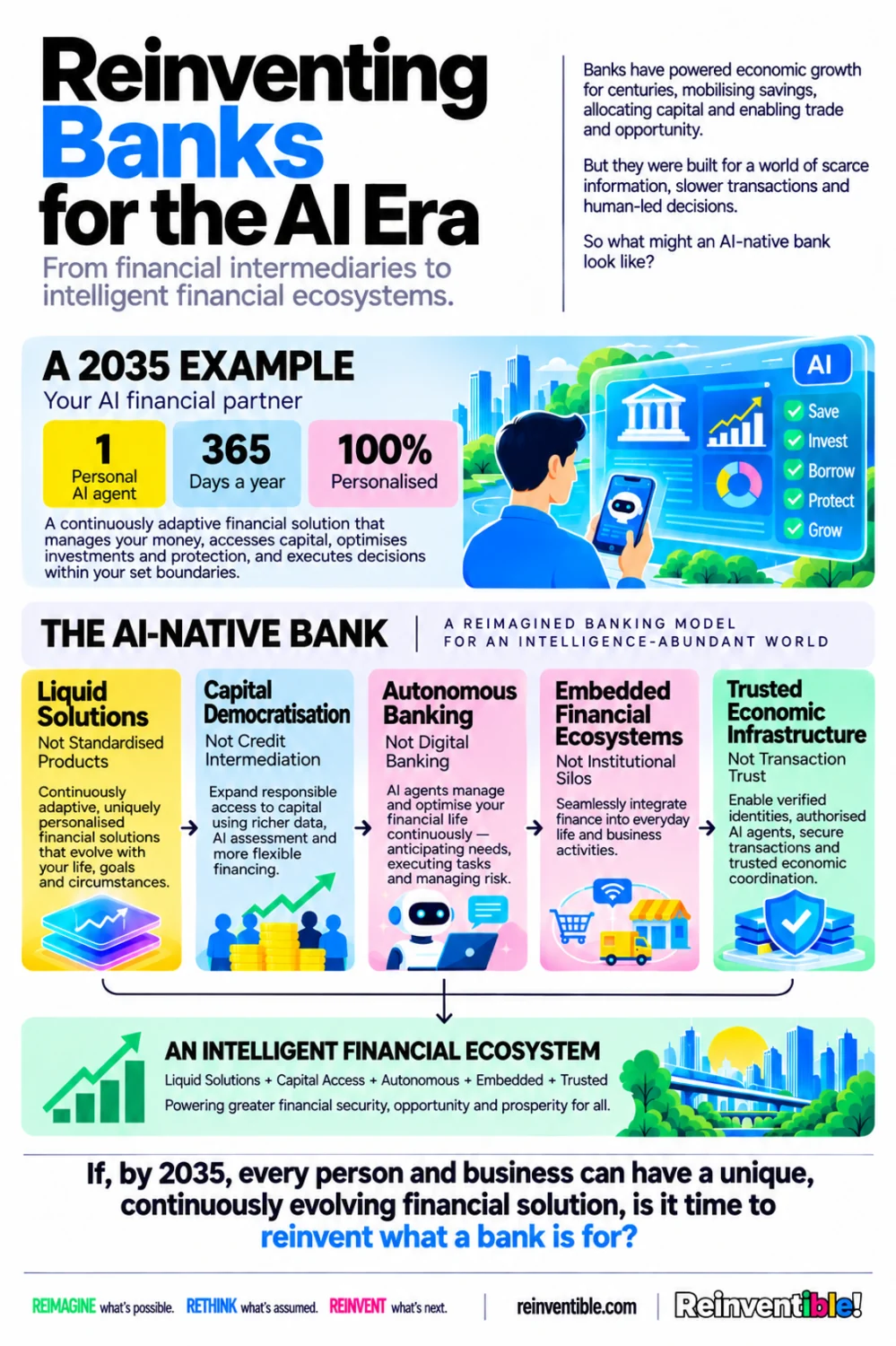
Five reinventions could create a new model of banking: an intelligent financial ecosystem that delivers continuously personalised financial solutions, expands access to capital, autonomously manages financial activities and enables trusted economic exchange.
Reinvention 1: Liquid Solutions, Not Standardised Products
Traditional banks manufacture standardised financial products.
Savings accounts. Mortgages. Credit cards. Personal loans. Investment funds. Insurance policies.
These products are generally designed around predefined structures, terms, conditions and customer segments.
Customers must select from available offerings and combine them to meet their changing financial needs.
Even structured financial products are typically designed in advance for particular investors or customer categories.
But why should customers have to adapt to financial products?
What if financial solutions could continuously adapt to customers instead?
AI makes it possible to imagine an entirely different product architecture.
Instead of selecting from a catalogue of relatively fixed products, every customer could have a uniquely configured financial solution.
It might combine savings, investments, credit, insurance and liquidity management into one coordinated financial arrangement.
Its composition would evolve as the customer's financial position, life circumstances, goals and risk preferences change.
A young professional might initially prioritise liquidity, debt management and wealth accumulation.
As their family grows, the same solution could place greater emphasis on housing finance, protection and education savings.
Approaching retirement, it could progressively shift towards capital preservation, income generation and longevity risk management.
The solution becomes continuously adaptive rather than a collection of static products.
I call these Liquid Solutions.
Here, liquid does not refer to the conventional financial definition of an asset that can easily be converted into cash.
It refers to financial solutions that are fluid, dynamically reconfigurable and uniquely personalised.
They could be assembled from modular financial components provided by different institutions, coordinated through AI and programmable financial infrastructure.
Changes would remain subject to contractual terms, customer permissions, suitability requirements and regulatory safeguards.
This could transform how banks manufacture, price, distribute and monetise financial services.
Instead of mass-producing financial products for millions of customers, banks could increasingly assemble millions of personalised financial solutions, each evolving over time.
The fundamental reinvention is from one product for millions of customers to a unique, continuously evolving financial solution for every customer.
Reinvention 2: Capital Democratisation, Not Credit Intermediation
Traditional banking channels capital from savers towards borrowers through institutional lending decisions.
Banks evaluate credit histories, collateral, income, cash flow and other indicators of repayment capacity.
This intermediation performs an essential economic function. But traditional credit assessment can disadvantage individuals and businesses with limited financial histories, insufficient collateral or unconventional income patterns.
A promising entrepreneur may struggle to obtain financing despite strong market demand.
A growing SME may lack the collateral needed to secure additional working capital.
A young professional with substantial future earning potential may have little established credit history.
AI could help change how economic potential is assessed and capital is allocated.
Instead of relying primarily on backward-looking financial records, intelligent financial systems could incorporate verified, consent-based information about economic activity, business performance, cash-flow patterns and future earning capacity.
AI could also match financing needs with a wider range of capital sources and structures.
A small business might access bank lending, private credit, revenue-linked financing or other regulated funding arrangements through one integrated system.
Entrepreneurs could potentially access capital based on stronger evidence of commercial viability rather than relying excessively on accumulated collateral.
Individuals with limited conventional credit histories could receive more accurate and inclusive assessments, provided models are demonstrably fair, explainable and appropriately governed.
This does not eliminate credit risk, guarantee funding or remove the need for prudent underwriting. New data can introduce bias, privacy concerns and misleading predictions.
But it could expand the range of people and enterprises whose economic potential can be responsibly financed.
The fundamental reinvention is from allocating capital primarily through traditional credit relationships towards democratising responsible access to capital and economic opportunity.
Reinvention 3: Autonomous Banking, Not Digital Banking
Digital banking has transformed how customers interact with financial institutions.
But digitisation generally shifts work from bank employees to customers.
Instead of visiting a branch, customers perform their own transactions through an app.
They still have to compare options, make decisions, manage accounts and initiate activities.
AI agents could fundamentally change this relationship.
Imagine delegating routine financial management to an authorised AI agent.
The agent continuously monitors your financial position, anticipates emerging needs and risks, evaluates opportunities, executes approved transactions and coordinates services across providers.
It could negotiate financing terms, optimise cash balances, manage recurring payments and recommend investment adjustments under agreed mandates.
It might identify deteriorating financial resilience before problems become severe or recognise a refinancing opportunity before you think to search for one.
The customer specifies objectives, constraints and boundaries. The AI handles much of the monitoring, analysis and execution.
This is more than digital banking with a conversational interface.
It is a shift towards autonomous financial management.
Of course, meaningful autonomy requires safeguards. Customers must retain control over permissions, risk limits and consequential decisions. Regulated institutions must preserve accountability, auditability and effective oversight.
But the opportunity is significant.
By 2035, banking could involve fewer customers manually operating financial apps and more authorised AI agents managing routine financial activities on their behalf.
Liquid Solutions define what customers receive. Autonomous Banking provides the intelligence that continually manages and adapts those solutions.
That distinction is fundamental.
Reinvention 4: Embedded Financial Ecosystems, Not Institutional Silos
Today, financial services are typically delivered through distinct institutions, products and channels.
Customers maintain relationships with banks, insurers, brokers, payment providers and other financial intermediaries.
Businesses must coordinate financing, payments, liquidity management and risk protection across multiple systems.
This fragmentation reflects historical institutional boundaries rather than the natural flow of economic activity.
AI could enable financial services to become more seamlessly integrated into the activities they support.
A home purchase could coordinate financing, insurance, payments and settlement within one connected workflow.
A supply-chain transaction could integrate procurement, trade finance, currency conversion, settlement and risk protection.
A small business could receive financing offers dynamically as its economic activities evolve.
Financial services would become increasingly embedded in commerce, employment, property and other economic ecosystems.
The competitive advantage would shift from owning every financial product to orchestrating the best combination of services.
Banks could become ecosystem orchestrators, infrastructure providers or specialised participants in networks coordinated by intelligent agents.
These ecosystems would also provide the modular financial capabilities from which personalised Liquid Solutions could be assembled.
The future bank may no longer be a destination customers visit, but a capability embedded wherever economic activity takes place.
Reinvention 5: Trusted Economic Infrastructure, Not Transaction Trust
Banks have traditionally established trust in financial transactions.
They verify identities, authorise payments, safeguard deposits, facilitate settlement, evaluate financial obligations and manage risks.
In an AI-native economy, these capabilities remain important. But the scope of economic trust could expand significantly.
Imagine millions of autonomous AI agents negotiating contracts, purchasing goods, managing assets and transferring funds.
How do we verify that an AI agent is legitimate?
How do we establish that it has authority to commit funds?
How do we prevent fraud, impersonation and unauthorised transactions?
Who is accountable when autonomous financial decisions go wrong?
Banks could evolve beyond transaction verification into providers of trusted economic infrastructure.
They could help authenticate economic identities, verify delegated authority, enforce financial safeguards, guarantee settlement and manage counterparty exposure.
They might also participate in interoperable networks that allow authorised AI agents to transact securely across institutions and borders.
Their strengths in risk management, capital, regulation and institutional trust could become valuable infrastructure for an agentic economy.
However, these opportunities would not belong exclusively to banks. Technology companies, payment networks, specialised trust providers and public digital infrastructure could compete for the same roles.
The strategic opportunity is to move from securing individual financial transactions towards enabling trusted economic activity across humans, organisations and autonomous AI agents.
The Big Reinvention: From Banks to Intelligent Financial Ecosystems
These five reinventions are not independent opportunities. They reinforce one another.
- Liquid Solutions reinvent the financial product itself, replacing static offerings with continuously adaptive, personalised arrangements.
- Capital Democratisation expands responsible access to financing and economic opportunity.
- Autonomous Banking provides the intelligence and execution capabilities to manage financial activities continuously.
- Embedded Financial Ecosystems integrate these capabilities into everyday economic life and connect financial solutions across institutions.
- Trusted Economic Infrastructure establishes the safeguards and institutional confidence required for increasingly autonomous economic exchange.
Together, they point towards a fundamentally different architecture for banking.
A traditional bank is organised around standardised products, institutional credit decisions, customer-initiated transactions and proprietary channels.
An AI-native bank could be organised around liquid financial solutions, democratised capital access, autonomous intelligence, embedded ecosystems and trusted economic coordination.
This creates uncomfortable questions for incumbent banks.
If every customer can have a uniquely configured financial solution, what happens to traditional product divisions?
If customers delegate financial decisions to independent AI agents, who will truly own the customer relationship?
If capital can be matched more intelligently with economic opportunities, how will traditional lending models compete?
If financial services become invisible and embedded, what happens to the value of branches, apps and proprietary distribution networks?
And if trust becomes critical infrastructure for autonomous commerce, which institutions will occupy that position?
Not every traditional banking function will disappear. Banks will still need capital, liquidity, risk-bearing capacity, strong governance and regulatory compliance.
But the way these capabilities are assembled, distributed and monetised could change profoundly.
The winners may not be the banks that deploy AI most aggressively within their existing operating models.
They may be the institutions that fundamentally rethink what banking should become.
The Question
For centuries, banks have manufactured financial products and delivered them through institutions that customers must navigate.
But what if AI enables us to reverse that relationship?
What if, by 2035, every person and business could have a unique, continuously evolving financial solution that intelligently accesses capital, manages financial activities and coordinates trusted services across an entire ecosystem?
The future of banking is not necessarily a smarter bank.
It may be a radically different relationship between people, intelligence, capital and trust, where financial solutions adapt continuously to us rather than requiring us to adapt to them.
That is the difference between transforming banks with AI and reinventing banking for the AI era.
Originally published in Charlie Ang's Intelligent Reinvention Memo newsletter on LinkedIn (Issue 64), part of his "Reinventing X for the AI Era" series.

Charlie Ang is an Intelligent Reinvention Strategist, corporate futurist and AI keynote speaker based in Singapore and speaking worldwide. He helps organisations and leaders reinvent, rewire and retool for the Age of Intelligence, and has been featured by the BBC, Financial Times, National Geographic and CNA.