 Charlie
Today's developmental and learning paradigms are NOT fit-for-purpose for the emerging hybrid-AI workforce. They were created for the analog and, later on, the digital age. Below is what replaces them.
Why are they reaching obsolescence? They were premised on the assumption that humans are performing the knowledge work.
With the ever-improving GenAI models and agents, this core tenet of work is breaking down. More and more, the bulk of today's knowledge work is and can be performed by AI, at a markup above the cost of electricity.
When the base foundation of work falls apart, all the structures built above it collapse too. Conventional workforce design, professional development approaches and workplace learning models are crumbling.
Professional Growth
The debate over the Generalist vs Specialist is now irrelevant. AI will be the ultimate generalist and specialist at the same time, in the near future.
The value of traditional human capability is being eroded fast. The average human may run faster than the first generation of automobiles but is hopelessly slow versus modern cars.
Instead of training to outrun cars, humans should learn to drive them to where we want to go. The same goes with AI. Not to try to out-learn them, but learn to "drive" them to where we want to go. Today's average workers, but not the new drivers of AI, will follow the fate of horses.
The "driving" skill we need is the Infinite Loop layer, built on top of existing career shapes. The ability to learn, apply, feedback and adapt, infinitely and rapidly. In other words, they learn with AI as they do, strengthening their cognitive agility, altitude and aptitude.
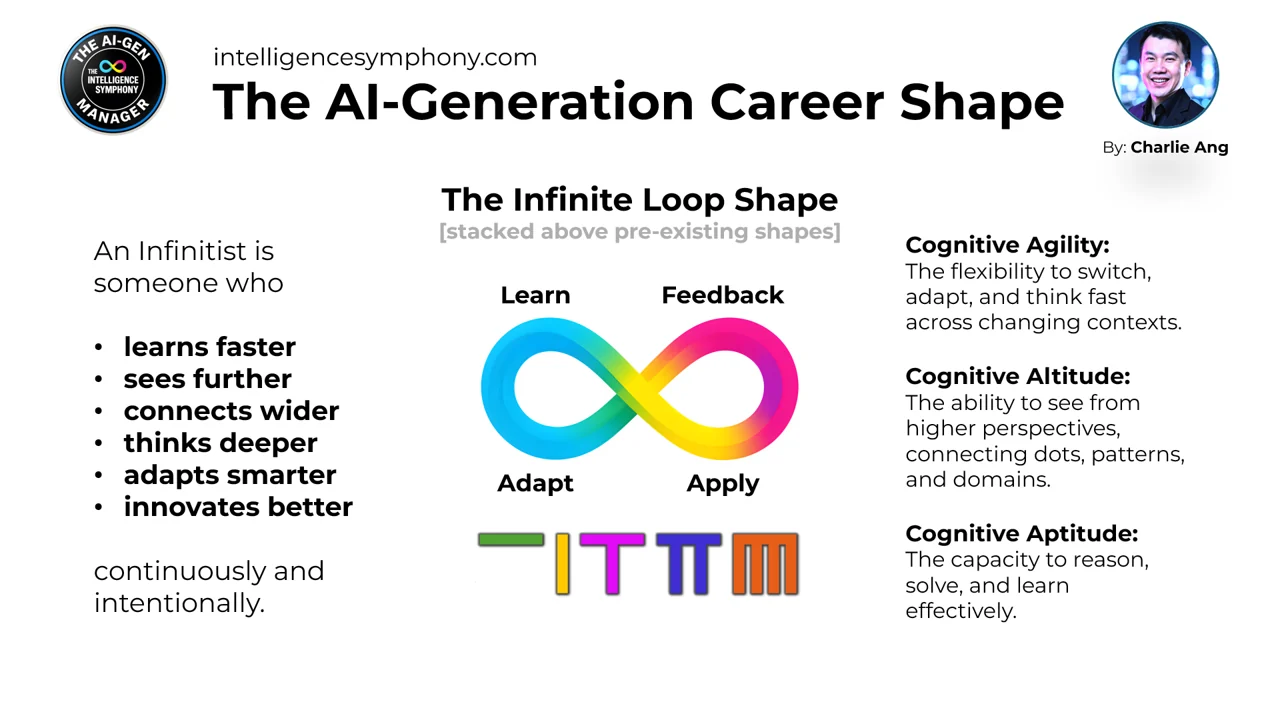
They have the "stem cell" quality so they can flexibly and quickly perform in any new job, role or project. They are the new "marine corps" of the workforce, deployable to many diverse needs and situations within the organization.
Those who intentionally develop the infinite loop will out-grow, out-perform and out-adapt those who don't, regardless of their starting point.
Skills Development
Today, the core assumption in question is: "Do people need to develop the full skill, when AI is increasingly able to perform the skill?"
My answer is that full skill will become less necessary but meta-skills will be the new advantage.
Just as meta-data is "data about data", meta-skill is "skill to use the skill" and not the full skill itself.
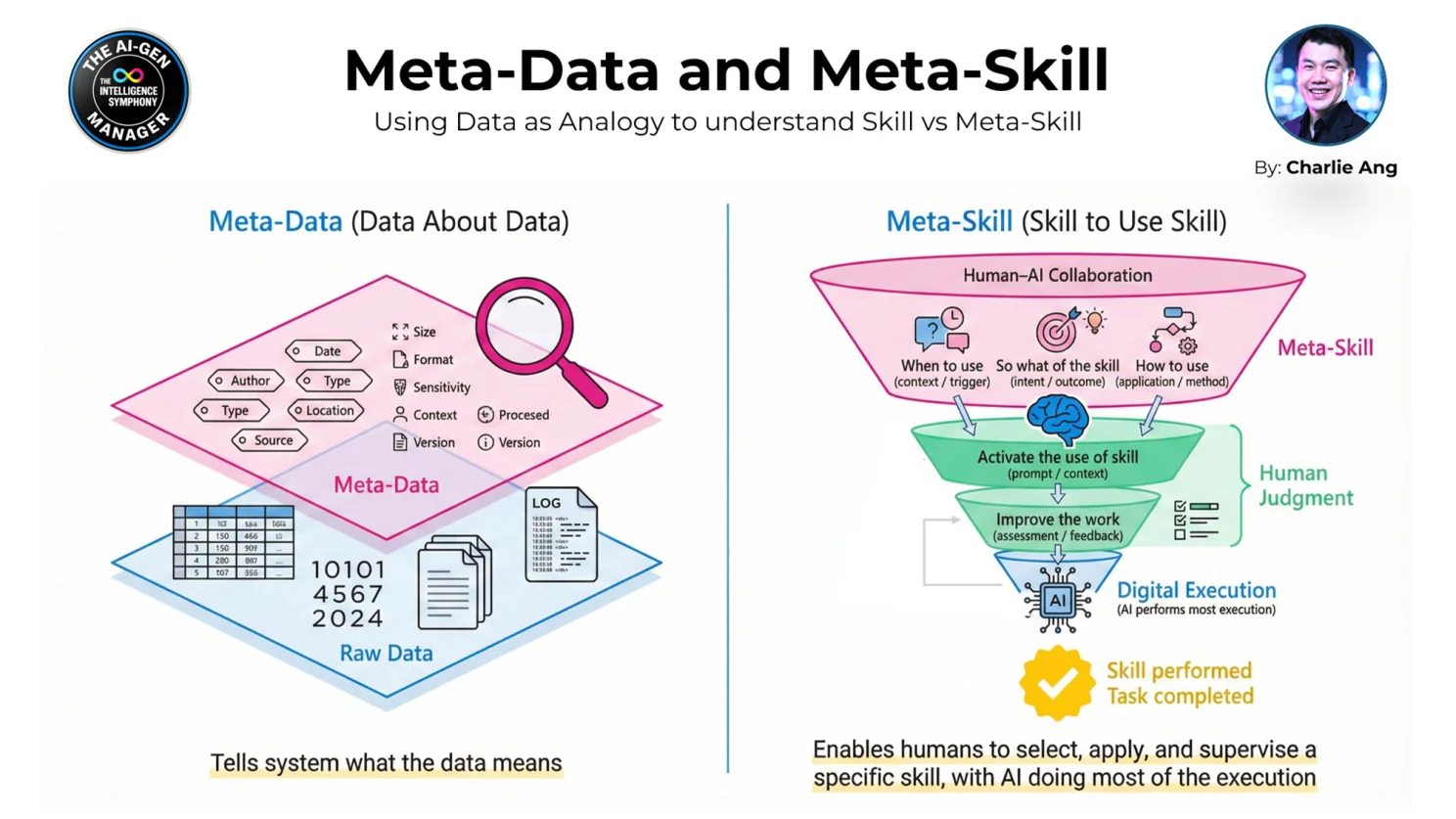
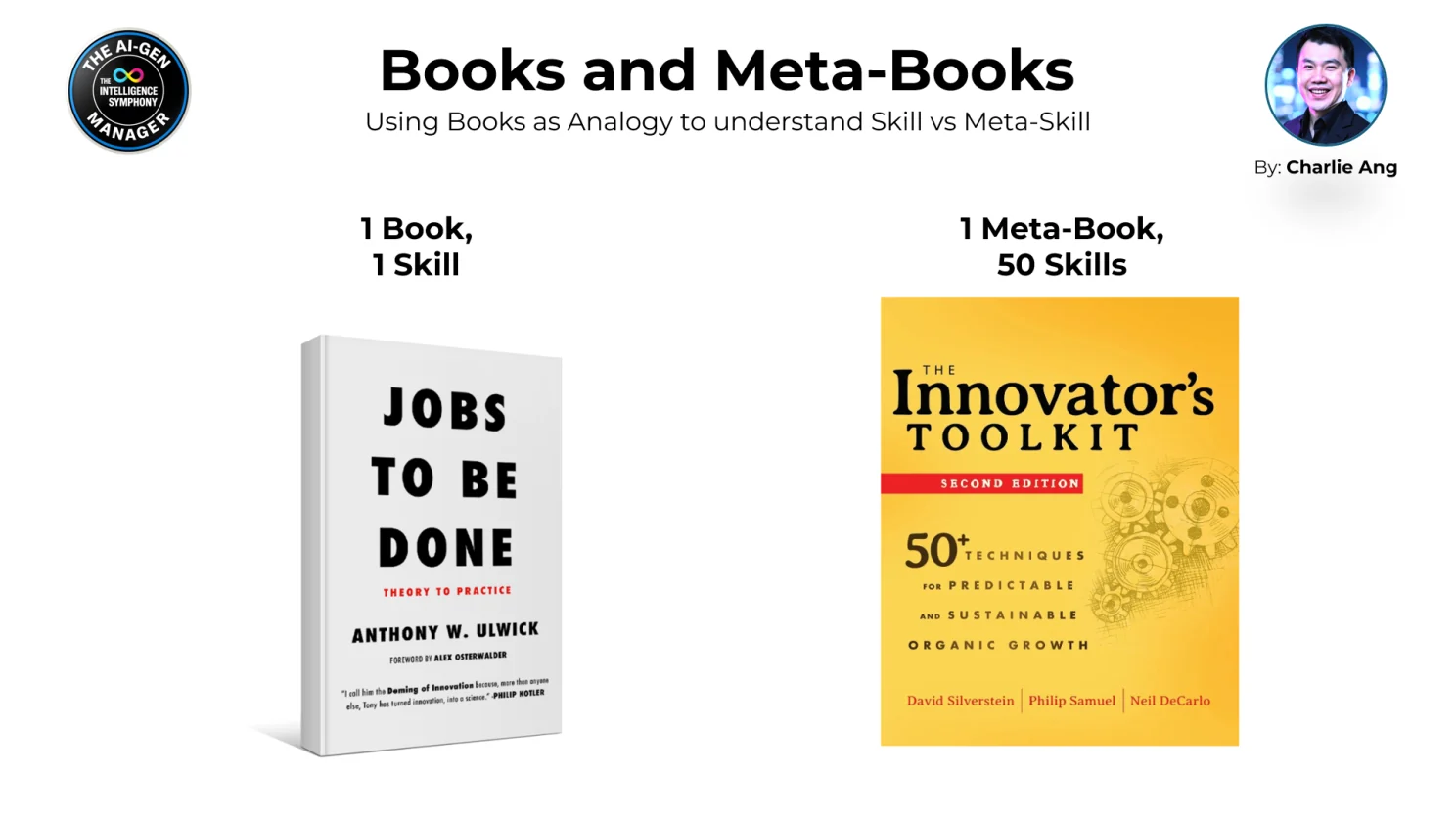
For the same amount of time and effort to learn a new skill, many (~5-10) meta-skills could be acquired instead. Coupled with the infinite loop mindset, the professional or entrepreneur will then have an always expanding plenitude of skills at her disposal, instead of only a few.
The creative collision of acquired skills nurtures a poly-disciplinary and uber-creative professional, who can create exponential impact at work that no human peer or AI equivalent could.
Workplace Learning
Hence, the current learning methodologies are nearing irrelevance. Too slow, too little and too costly for a time when major upgrades to GenAI models are released every few months.
Like the man who is training harder to out-run the early car, it will ultimately be self-evident and self-defeating.
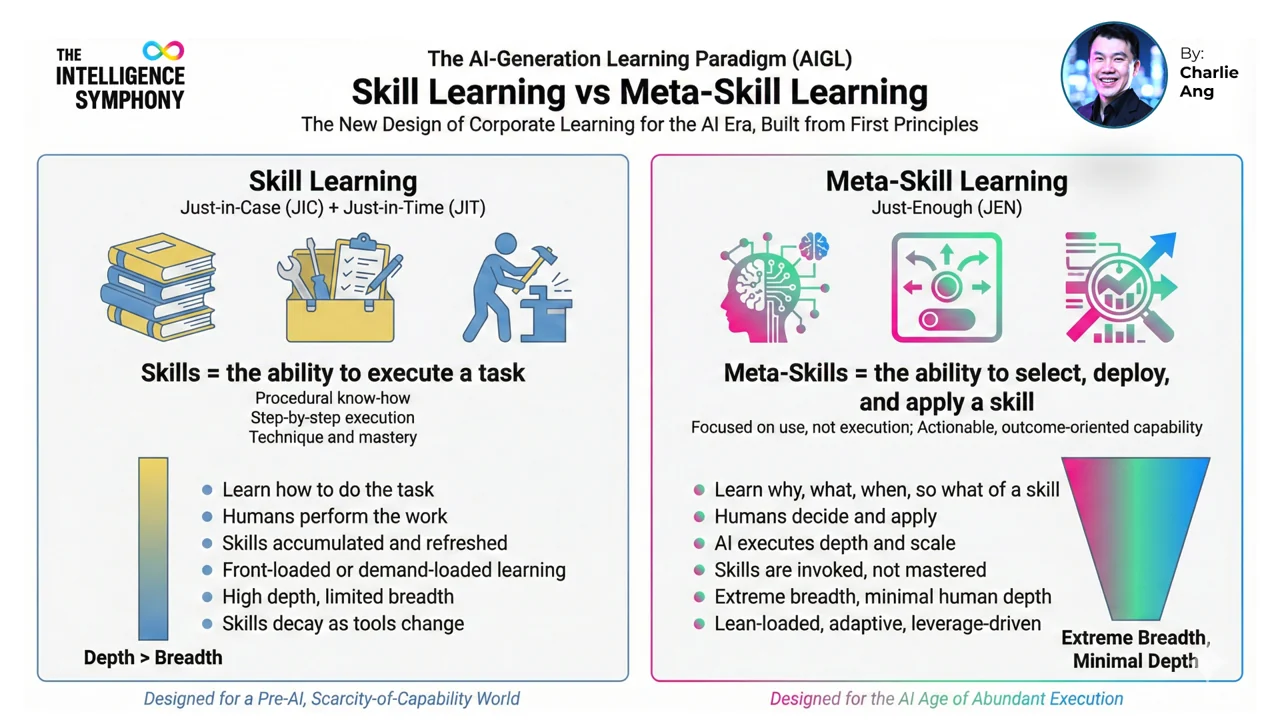
Based on the first principles above, I invented the Just-Enough model as fit-for-purpose for the AI era.
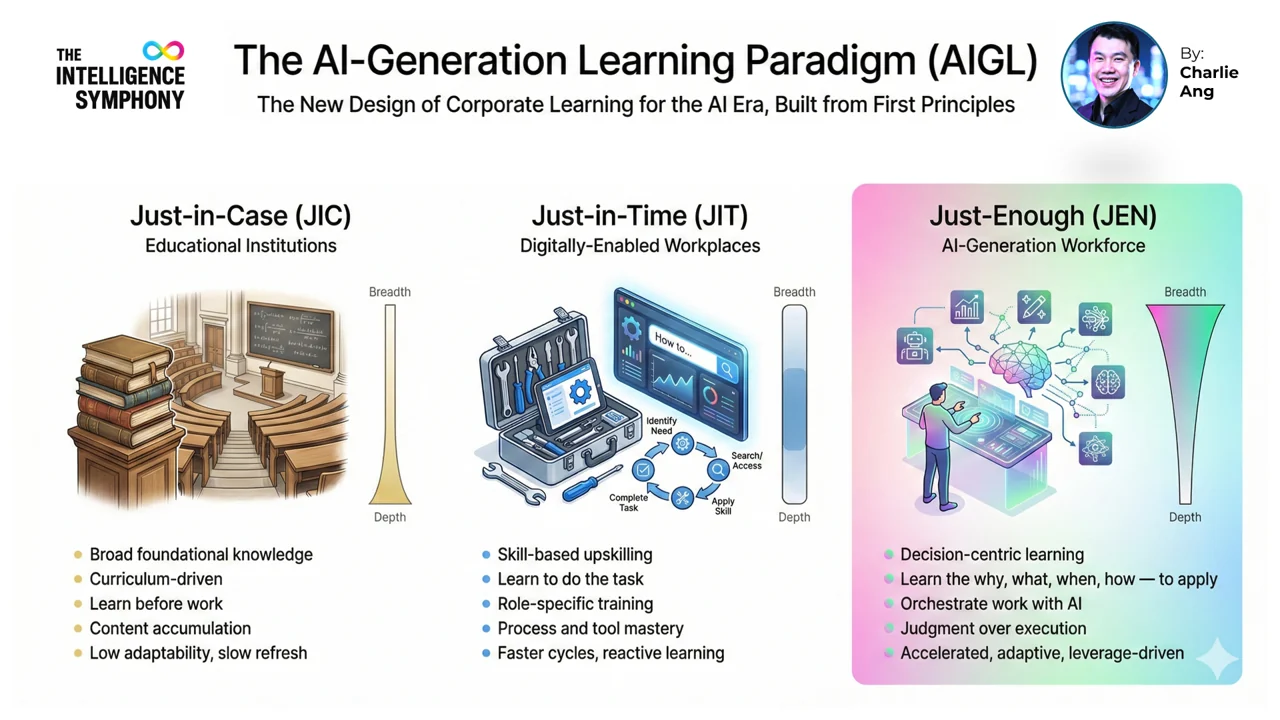
- Just-in-Case (JIC) is too heavily- and front-loaded. Many of the skills reach half-life not long after students graduate.
- Just-in-Time (JIT) is useful but inadequate to cope with the rising demands and complexity of the AI-centric workplace.
- Just-Enough (JEN) is a lean learning model with meta-skills (aka Minimal Viable Skill) as the basic unit of adoption. Emphasis is to broaden the top end of the skills portfolio, instead of developing narrow depth. Similar to other "Leans", such as lean production and lean innovation, the priority is to remove waste and channel resources to where the highest impact will be.
JEN is not anti-skills, it is post-skills.
Deep skills, skills and meta-skills, along with JIC, JIT and JEN, will have their place under the sun in the AI cosmology. The right skill depth and the right learning approach for the right need.
Prior to this, we lacked the design, language, and articulation of the new skills and learning paradigm tailored for the AI-rich environment. Not anymore.
Let's have this important conversation on how JEN/Meta-skills might be the future of professional learning and development for many managers in the AI-Generation Workforce.
Just-Enough learning and Meta-Skills acquisition are not just some grand theory. My students and I are putting it to practice, with two meta-skills being downloaded each week. They are not just amazed by the collection of new skills at their disposal but also the transformation of their professional minds.
Originally published in Charlie Ang's Intelligent Reinvention Memo newsletter on LinkedIn (Issue 41).

Charlie Ang is an Intelligent Reinvention Strategist, corporate futurist and AI keynote speaker based in Singapore and speaking worldwide. He helps organisations and leaders reinvent, rewire and retool for the Age of Intelligence, and has been featured by the BBC, Financial Times, National Geographic and CNA.