 Charlie
This time, I will leave the diagrams to do most of the talking, and will elucidate as we go along.
Over the past months, beautiful diagrams and elegant frameworks of Agentic AI have emerged. However, they are almost always tech-first: designed for a technically fluent audience.
But crucially, they missed out on the other half of the equation: “what does it mean for business” insights for the business audience. What are the emerging business models, business-tech ecosystems, value chains, profit pools and value propositions?
Another key difference: while many focus on day-to-day progress and piecemeal advancements, I am more concerned with the broader industry-wide system that will be established by 2030, metabolizing the intelligence-abundant world.
In technology management lingo, this is called a dominant design: the industry-wide standard that all players eventually converge upon. Think of IBM PCs for personal computing and iPhones for smartphones; after a certain point, all competitors start looking alike, using common standards, interfaces and parts.
Of course, predicting five years ahead comes with a margin of error, but I invite you to explore this speculative landscape with me.
The Big Picture
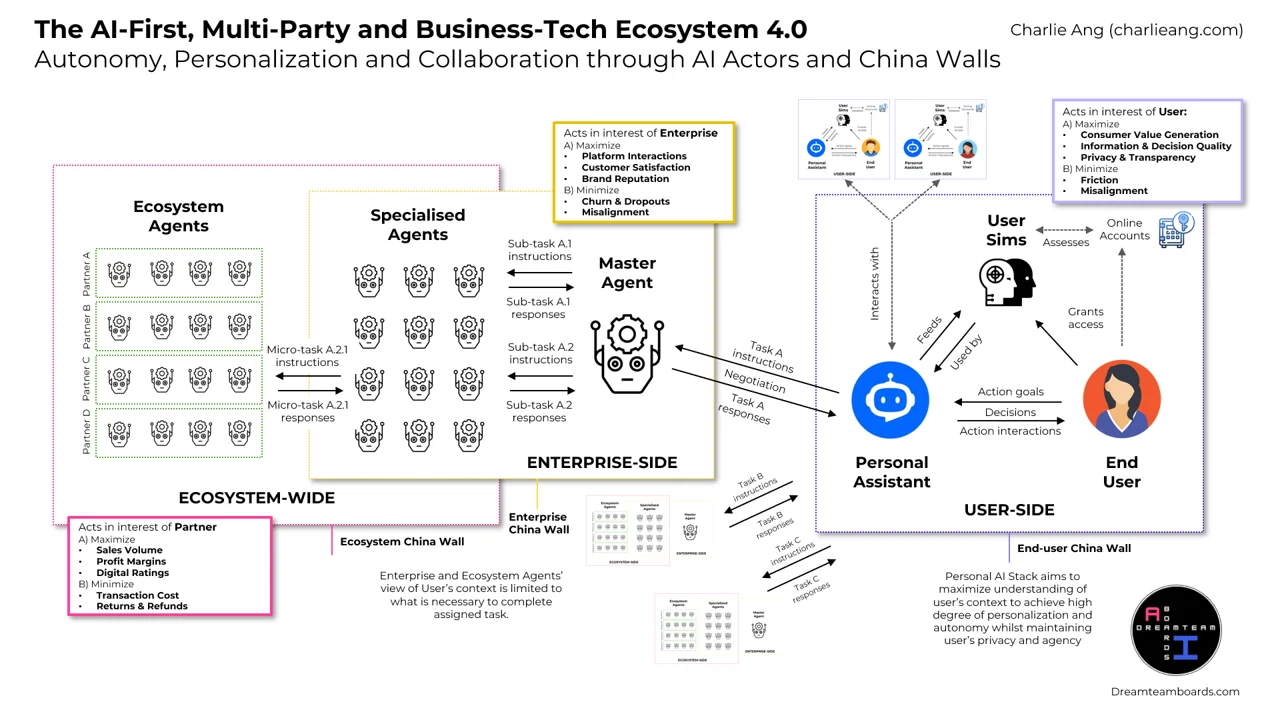
In this AI-first architecture, all actions start and end with the End User, with the Personal AI Assistant (PAIA) acting as her proxy, and User Sims serving as her data avatar.
- PAIA interacts with other PAIAs (e.g., coordinating family members’ schedules, deciding on dinner plans, making reservations).
- The PAIA’s main interface is with Master Agents of enterprises (e.g., an insurance provider like AXA, Prudential, or Allianz) or marketplaces (e.g. Amazon or Shopee).
- If needed, PAIA may engage multiple Master Agents to source the best offer.
- In some cases, the End User may bypass PAIA to transact directly with a Master Agent, especially when there’s an existing relationship or single-provider dependency (e.g., renewing an insurance plan).
Once a task is initiated, the Master Agent orchestrates “infantry” agents to execute and respond. Finally, the Master Agent circles back to the PAIA, closing the loop and possibly sealing a transaction.
The User-Side Equation
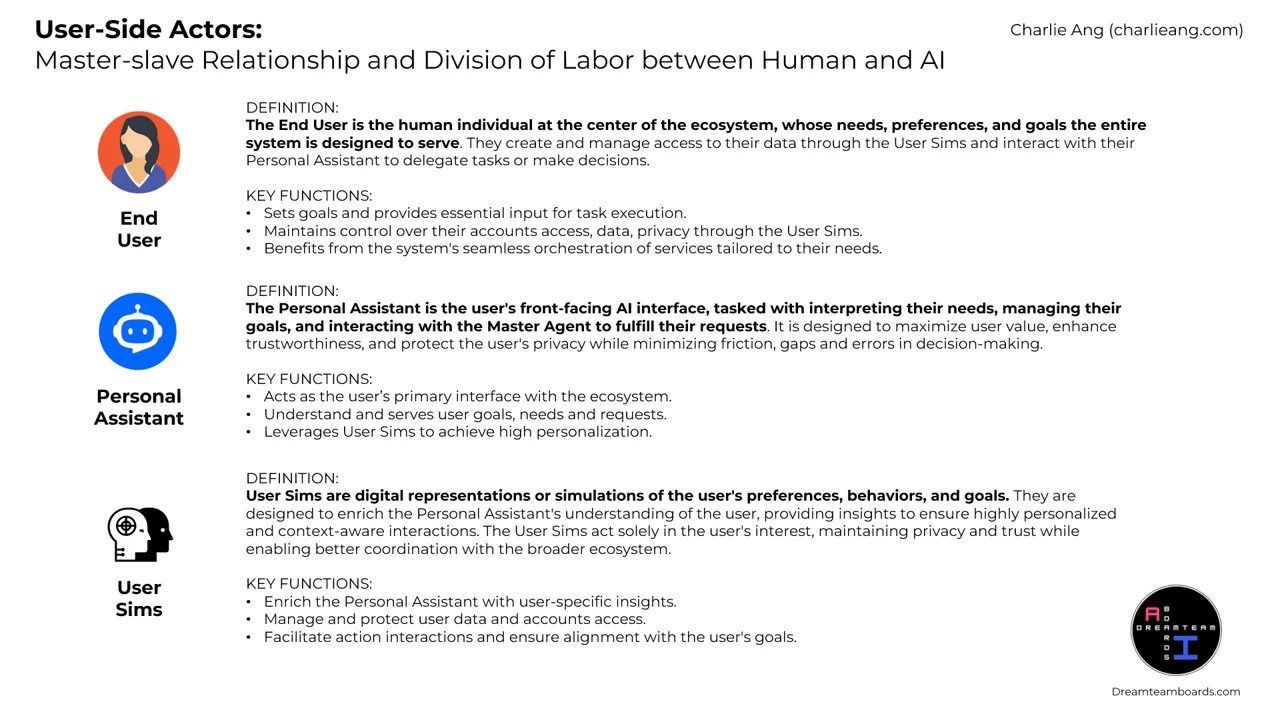
While End Users and PAIAs are the quintessential pieces of the puzzle, User Sims are an optional yet powerful layer.
User Sims provide an additional privacy and control mechanism, allowing users to:
- Switch to another PAIA provider
- Use multiple PAIAs simultaneously
- Interact directly with a Master Agent
- Withhold specific data from the PAIA
Without User Sims, the End User risks vendor lock-in, where their PAIA monopolizes their personal data and limits switching options. Microsoft’s paper on “Agents Are Not Enough” provides further basis for this additional role.
The Enterprise-Side Equation
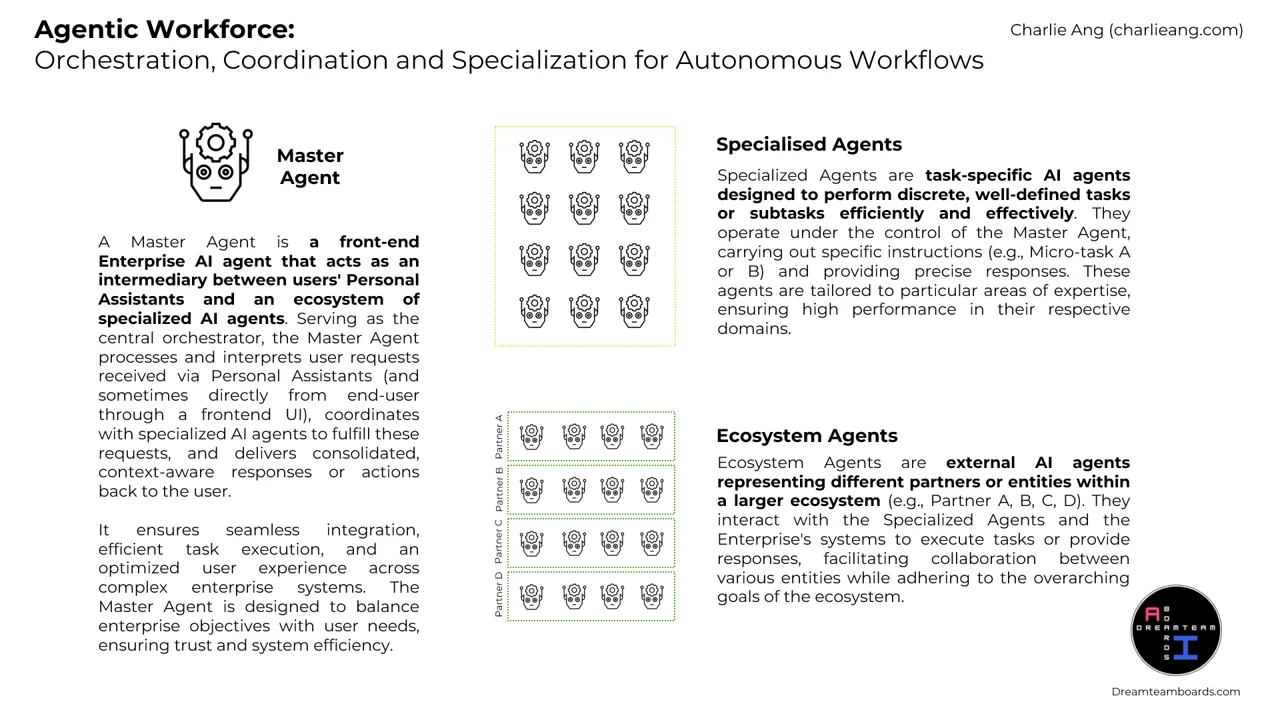
AI Agents function much like software and APIs: modular, rather than monolithic. Therefore, there will not be a one-size-fits-all, super AI agent that can do everything, but three classes of AI Agents to divide the labor.
Ecosystem Agents are optional if a task is self-contained and terminates within an enterprise. In broader multi-entity use cases, ecosystem agents enable seamless end-to-end transactional fulfillment that extends across the value chain.
For instance, a healthcare provider sourcing an out-of-stock prescription from a national drug distributor for an urgent consumer need or a travel platform coordinating with local adventure organizers to meet preferences of a travelling family.
Ecosystem agents have their own, often conflicting, goals that must be aligned with the larger enterprise goals in order to present the best offer to the customer. The ecosystem agent may prioritize profit margin while the enterprise wants to capture the sale and maximize stickiness.
If the price is not competitive or delivery is too slow for the user, the PAIA may opt to buy from another marketplace through a separate Master Agent. Hence, alignment is essential.
Trust as the Currency of the Intelligence Economy
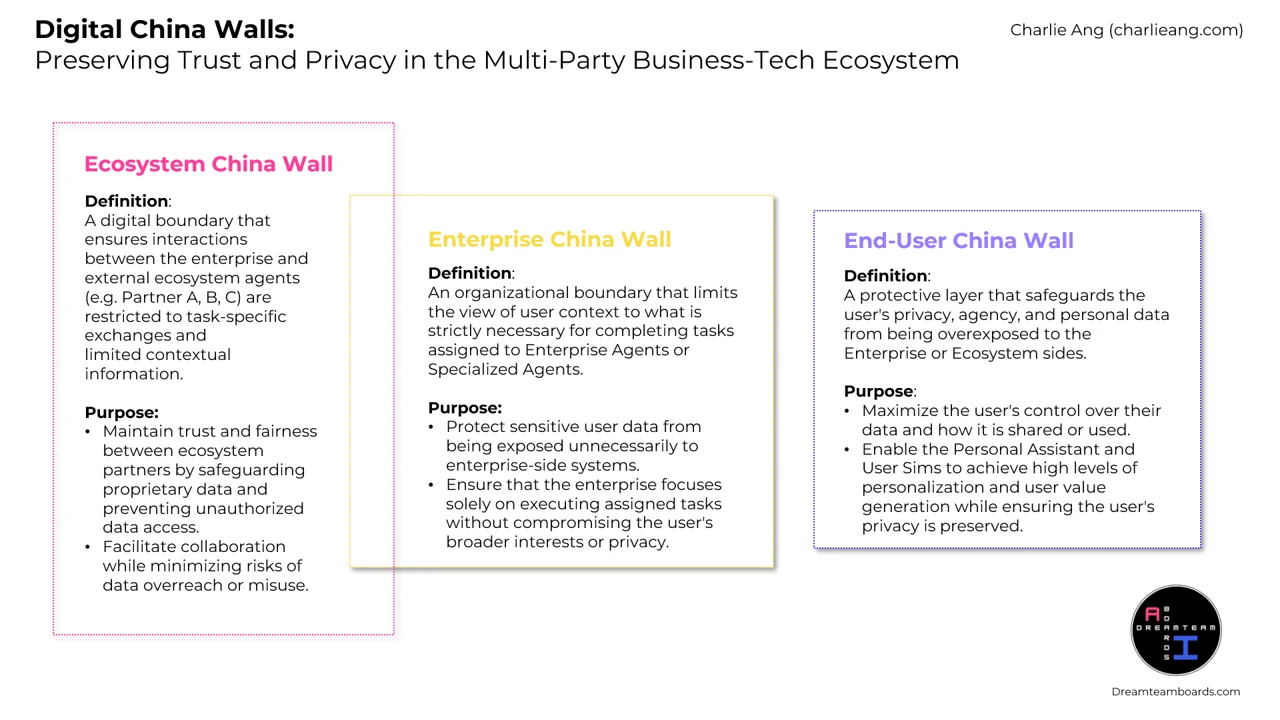
As personal agency and data are delegated to various AI entities in the full equation, a high-trust environment is pivotal to the user choosing autonomous execution by AI over self-service at websites, or simply another PAIA.
If the user does not trust the ecosystem enough to provide rich context of her needs, the PAIA has to constantly check back with the user at every step, defeating the intended benefits of autonomy.
Hence, trust is the new currency of the AI economy and must be designed integrally into the grand architecture.
How do we balance trust and autonomy? The solution is separate layers of China walls to drip feed and anonymize user data between AI entities on a need-to-know basis.
Implications for Business
The impact of this new business-tech ecosystem is profound and pervasive. I highlighted the all-important shifts in value creation and capture.
In a world where users trust their PAIAs more than they trust brands or even their own judgment, who owns the customer relationship?
Brands? Marketplaces? PAIAs? And what happens when the PAIA layer dominates consumer interactions and context?
Looking at the AI and data strategies of many corporations, I often wonder if they are investing in a mirage of a world that will not exist once this design becomes dominant.
Intelligence Symphonies, on the other hand, are anticipating and building for this radical shift.
Take heed if you are in any consumer-facing industry!
P.S. LLMs and Generative AI capabilities are not explicitly mentioned in the diagrams because they are embedded in all the AI entities.
Originally published in Charlie Ang's Intelligent Reinvention Memo newsletter on LinkedIn (Issue 8).

Charlie Ang is an Intelligent Reinvention Strategist, corporate futurist and AI keynote speaker based in Singapore and speaking worldwide. He helps organisations and leaders reinvent, rewire and retool for the Age of Intelligence, and has been featured by the BBC, Financial Times, National Geographic and CNA.