 Charlie
In 2025, the most important but unknown concept among corporate leaders and entrepreneurs is the Strategic Inflection Point. Here it goes:
“A strategic inflection point is a time in the life of a business when its fundamentals are about to change. That change can mean an opportunity to rise to new heights. But it may just as likely signal the beginning of the end.”
Andy Grove, former CEO of Intel, in the management classic, “Only the Paranoid Survive”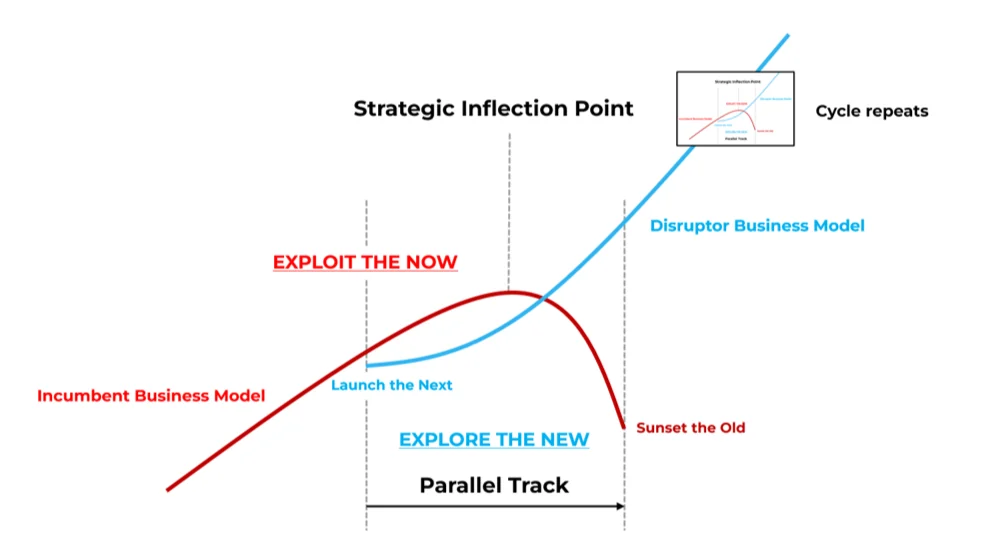
An inflection point is a 10x change to the external environment, caused by one or a combination of these drivers:
- game-changing technology
- business model innovation
- regulatory shifts
- consumer behavior changes
- demographic transition
Such 10x change could have one or more of these disruptive effects:
- eliminate an operating constraint (e.g. Airbnb: hotel without owning rooms)
- slash consumer prices (AirAsia, a budget airline: “Now everyone can fly”)
- shrink a product category (Coca-Cola and Pepsi: consumption of sugary carbonated drinks slumped, due to consumer health awareness and regulatory measures)
- divert major revenue sources (Universal Music: from record sales to streaming and concert revenues) or
- decimate an entire industry (Google and Facebook: vanquished physical news and entertainment media).
As a result, the industry economics, competitive landscape and rules of the game are rewritten, in favor of the disruptors and innovators. The industry has been “disrupted”, so to speak. And with it, the long-standing giants and the innumerable minions fell.
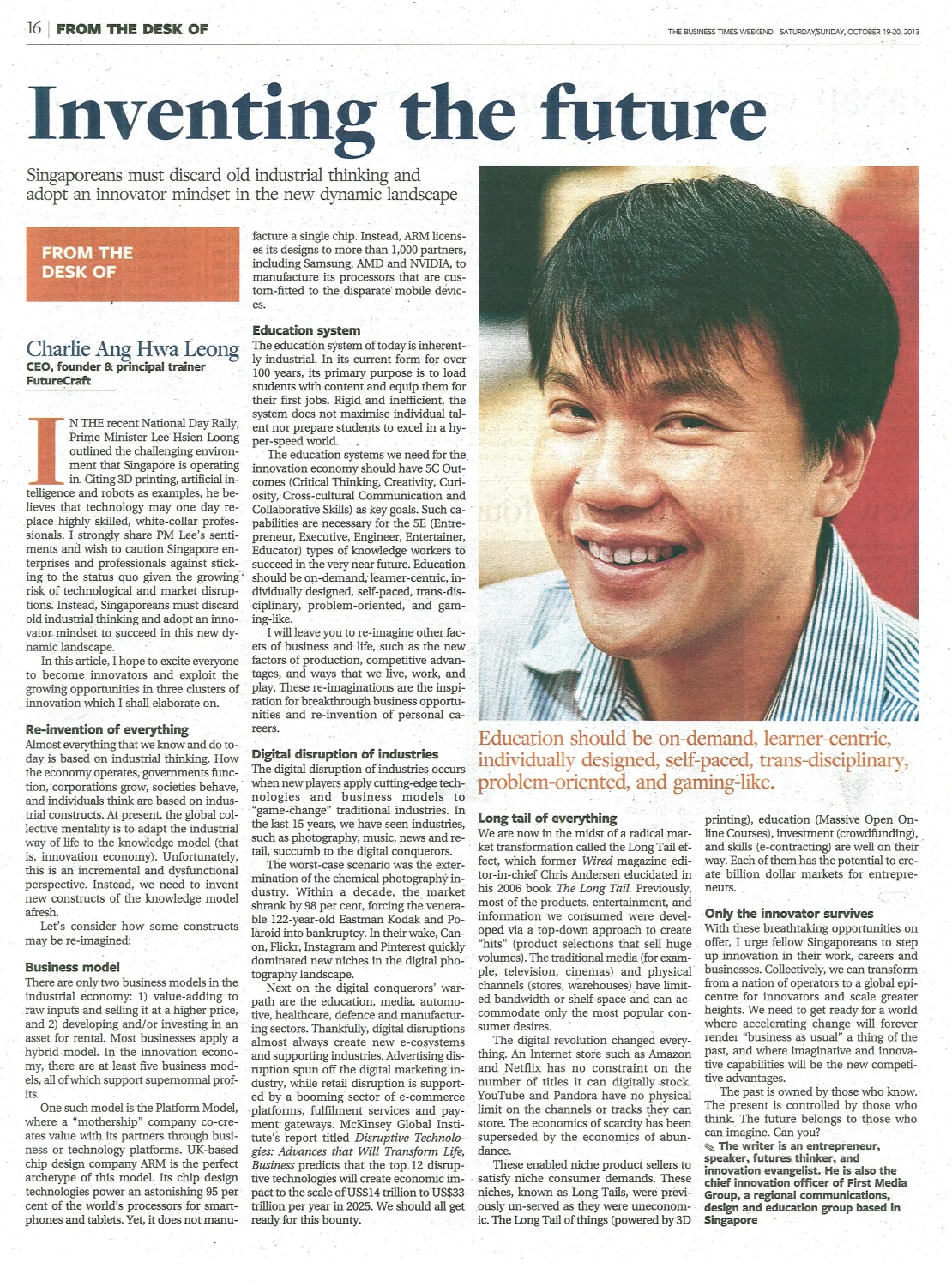
I warned as far back as 2013 on the need to reinvent for the digital revolution, particularly for B2C, consumer-facing sectors.
Retail Disruption: Really?
Since then, the mobile revolution has come and gone, wiping out old-time favorites like Sears, Toys “R” Us, Blockbuster, Borders, Circuit City, along with their national champion counterparts in respective markets and scores of mom-and-pop shop equivalents.
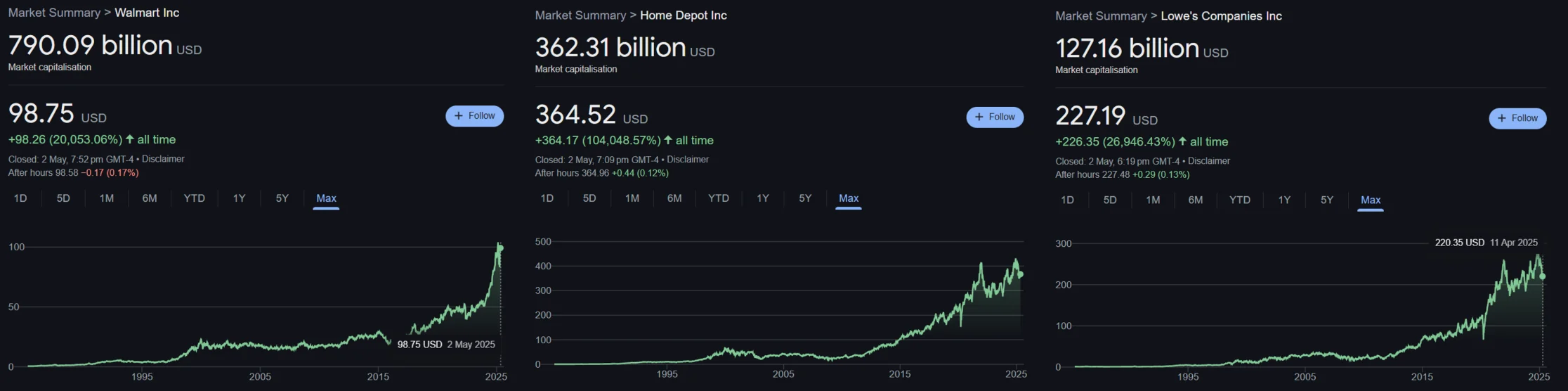
If you think these retailers’ demise was inevitable, think again. The likes of Walmart, Home Depot, Costco, Target and Lowe’s grew spectacularly during the same digital tsunami.
From 2000–2025, Walmart, Home Depot and Lowe’s market caps ballooned from US$237B to $790B, $100B to $362B and $25B to $127B respectively. They rode on the digital wave, instead of being swept away by it.
Disruption is NOT Destiny
Blockbuster could have created Netflix for movie distribution, EMI Music could have invented Spotify for music consumption and Kodak could have pioneered Facebook for sharing photos.
Had they succeeded, they could be 10–100x bigger than their peaks. Instead, they were condemned to the dustbins of history.
The same goes for Intel (ironically) and IBM (iconically). Now shadows of their former Goliath selves, they could have been the size of Nvidia and Amazon Web Services today, had they self-disrupted. They are elephants who cannot dance anymore.
“Whether you think disruption is destiny or opportunity, you are right.”
Charlie AngBe “Flix-able”
Most of us should not have heard of Netflix today. Why? Because in all probability, they should not have made it as a content streamer, never mind the consumer’s streamer of choice.
It first came to prominence as a mail order movie business. The founder Reed Hastings spotted the 10x change in the movie rental industry: the transition from bulky VHS tapes to super-thin, mail-able DVDs.
Together with the early Internet, DVDs enabled a radical business model of renting movies through mail boxes. 13 years after Netflix was founded, Blockbuster went bust in 2010.
By then, the next 10x change was in play. Broadband speeds were increasingly allowing high-quality video content streaming. Apple’s iTunes, TV-centric Hulu and pay-per-view Amazon Video (now Prime) were vying for the emerging streaming space.
Ordinarily, the incumbent would have rested on its laurels, or even doubled down on past successes. Instead, Hastings was on a crusade to self-disrupt its own mail order business. The stakes were high because they could be busted even faster than Blockbuster, with the tech giants eyeing its market.
In 2007, Netflix was the first to offer a subscription-based streaming service, running in parallel to its DVD business. For the next decade, it was a painful transition as it had to gradually “eat its own baby”: the DVD distribution business and infrastructure it had arduously built.
But this was not enough. It anticipated that major content owners such as Disney, Warner Bros and Paramount would not be satisfied with distributing their productions through an independent streamer like Netflix. They would create their own streaming service instead.
Netflix preempted their moves through upstream vertical integration to produce or secure its own, exclusive titles. House of Cards was its first production, released in 2013.
The rest is history. In 2025, they are the streamer of choice to our homes and mobiles. Its market cap exploded by nearly 200 times, from $2.5B to almost $500B in 18 years. Netflix has achieved the rare feat of successfully disrupting the same industry twice in as many decades.
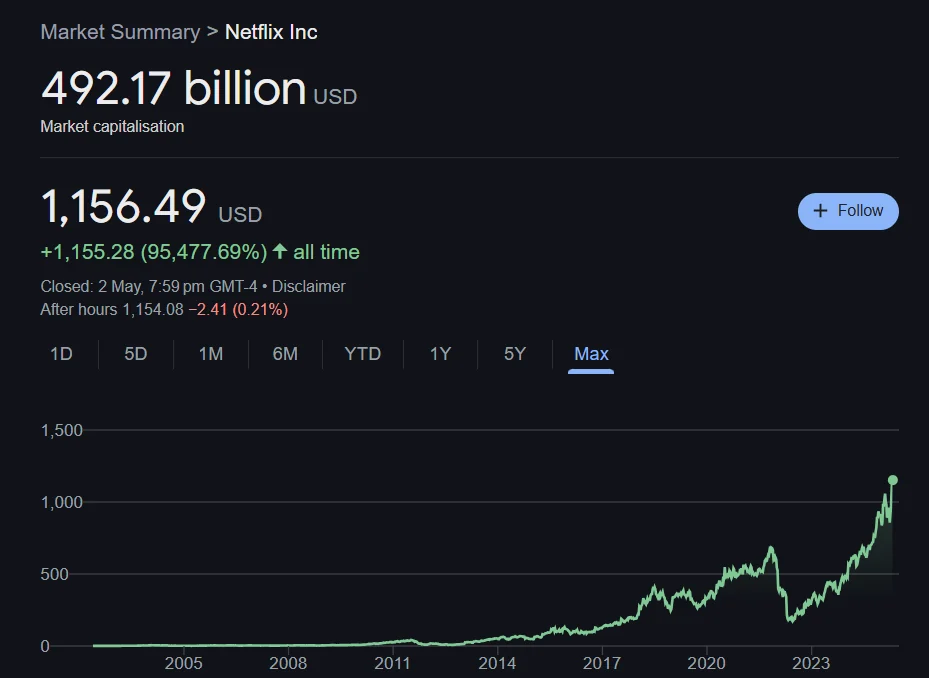
Hence, I was not at all surprised when they were rated #1 Business Transformation of the Decade. Netflix’s self-disruption story is not merely a business school case study, but a powerful inspiration that “disruption is not destiny but opportunity”.
In addition, it provides an effective blueprint for the deft execution of switching over from a disrupted to a newly innovated disruptor business. This is a valuable guide for all of us in navigating our respective strategic inflections.
Ambidexterity in Action
These successful anti-disruption companies did not happen by chance. They consciously practiced some form of ambidexterity, the organizational skill to explore new businesses while exploiting existing ones, without compromising either.
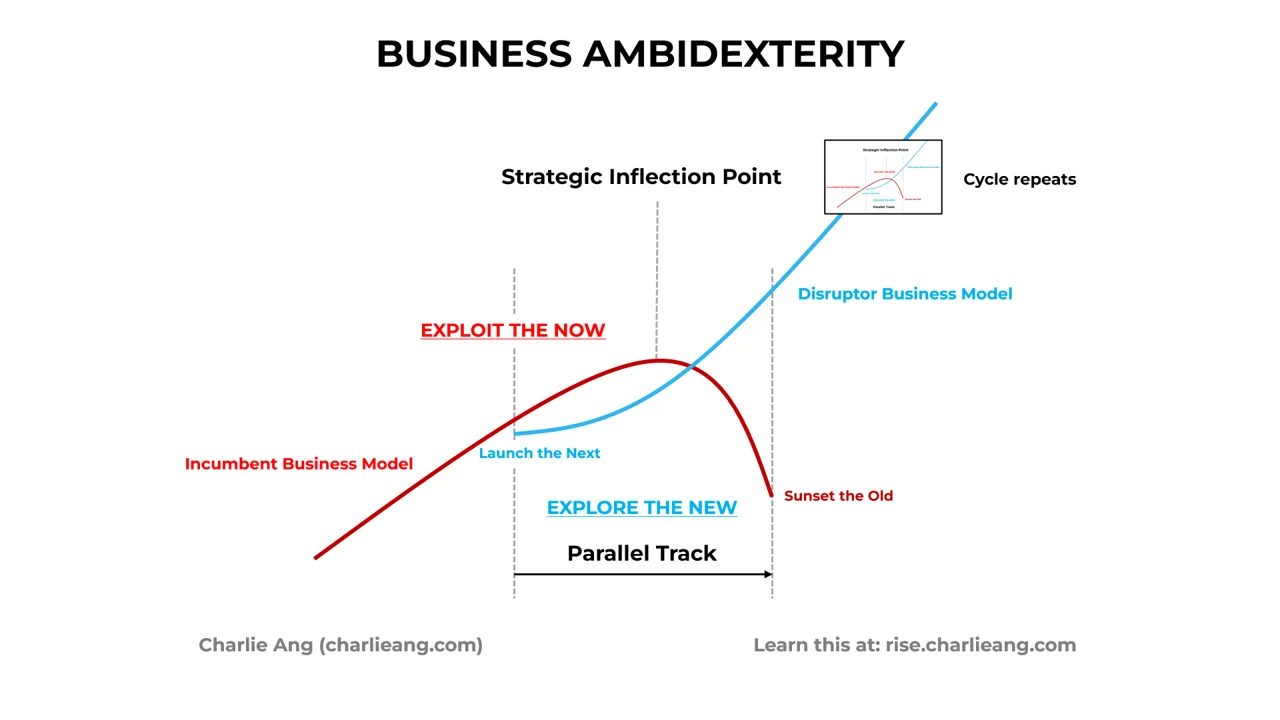
Discovering new and growing existing businesses are two different sets of foci, skills and investments. The leadership needs to be executive and entrepreneurial at the same time, allocating attention, committing resources and assigning priorities to both agendas.
The failed companies did not follow this pattern, opening the door for outside disruptors to take over the mantle (blue line).
AI is the 10x change for ALL industries
While the mobile revolution mainly targeted consumer-facing industries, AI is coming for all industries.
One of the, if not THE, biggest assumptions in business is that intelligence and expertise are scarce and costly (the human form, that is).
This mother of assumptions is on the verge of being upended by fully abundant and marginally free intelligence and expertise, available on demand.
AI will have ALL five disruptive effects on ALL industries in a few short years.
How would you “Explore the New” and “Exploit the Now” for your business, if indeed this mother of all assumptions is eliminated?
What would Reed Hastings do?
Ambidexterity was a bonus skill in past ages but is an essential capability in the present and future. The same principles can be applied to companies of all sizes in all industries.
Originally published in Charlie Ang's Intelligent Reinvention Memo newsletter on LinkedIn (Issue 13).

Charlie Ang is an Intelligent Reinvention Strategist, corporate futurist and AI keynote speaker based in Singapore and speaking worldwide. He helps organisations and leaders reinvent, rewire and retool for the Age of Intelligence, and has been featured by the BBC, Financial Times, National Geographic and CNA.