 Charlie
Over the past few decades, companies have invested heavily in operational optimization and digital transformation. Now, with AI, a new imperative is emerging: Intelligent Reinvention.
But what exactly distinguishes optimization, transformation and reinvention?
Are they merely different degrees of change, or do they represent fundamentally different levels of strategic ambition?
Three Levels of Strategic Ambition
Optimization, Transformation and Reinvention represent three distinct levels of strategic intent, each challenging a progressively deeper dimension of the existing business model.
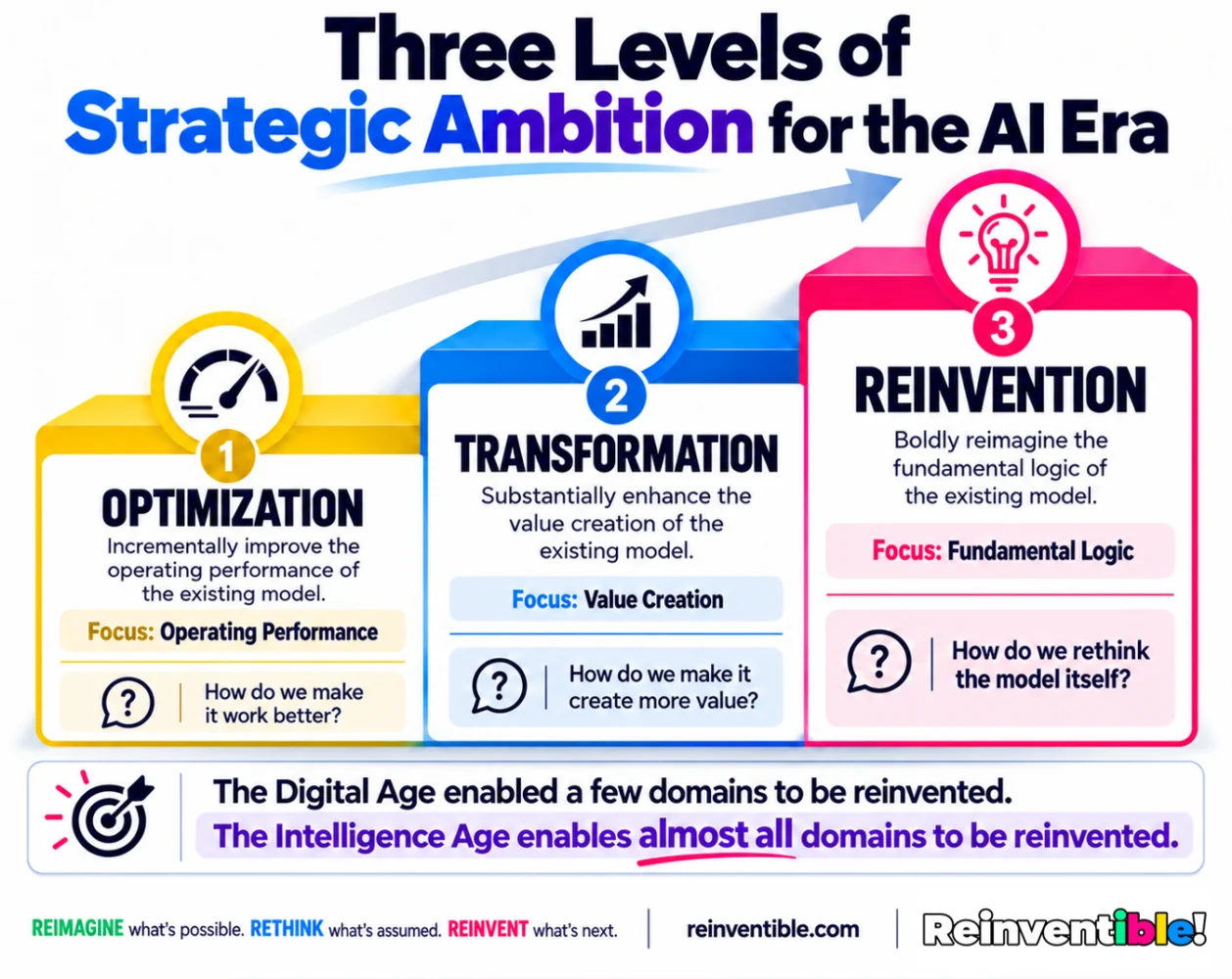
OPTIMIZATION
"Incrementally improve the operating performance of the existing model"
The focus is on improving efficiency, productivity, quality and effectiveness, making the existing business work better without fundamentally changing how it operates or creates value.
TRANSFORMATION
"Substantially enhance the value creation of the existing model"
The focus is on redesigning capabilities, processes, products, services and customer experiences to create greater value, while largely preserving the fundamental logic of the existing business.
REINVENTION
"Boldly reimagine the fundamental logic of the existing model"
The focus is on challenging foundational assumptions about how value is created, delivered and captured, potentially giving rise to entirely new business models, products, services and industries.
The distinction goes beyond the magnitude of change.
Optimization improves operating performance.
Transformation enhances value creation.
Reinvention reimagines fundamental logic.
All three are important and complementary. A reinvented business still needs to transform its capabilities and optimize its performance.
The critical question is which level of ambition the future demands.
| Level | Strategic intent | Taxi example | Fashion example |
|---|---|---|---|
| Optimization | Improve operating performance of the existing model | Better fleet management | Better fashion production |
| Transformation | Enhance value creation of the existing model | Mobile taxi booking | Zara's fast-fashion model |
| Reinvention | Reimagine the fundamental logic of the model | Uber's ride-hailing model | SHEIN's demand-responsive model |
To illustrate the difference, let's revisit a familiar industry that underwent reinvention during the digital era of the past two decades.
The Taxi Industry: Reinvention in the Digital Age
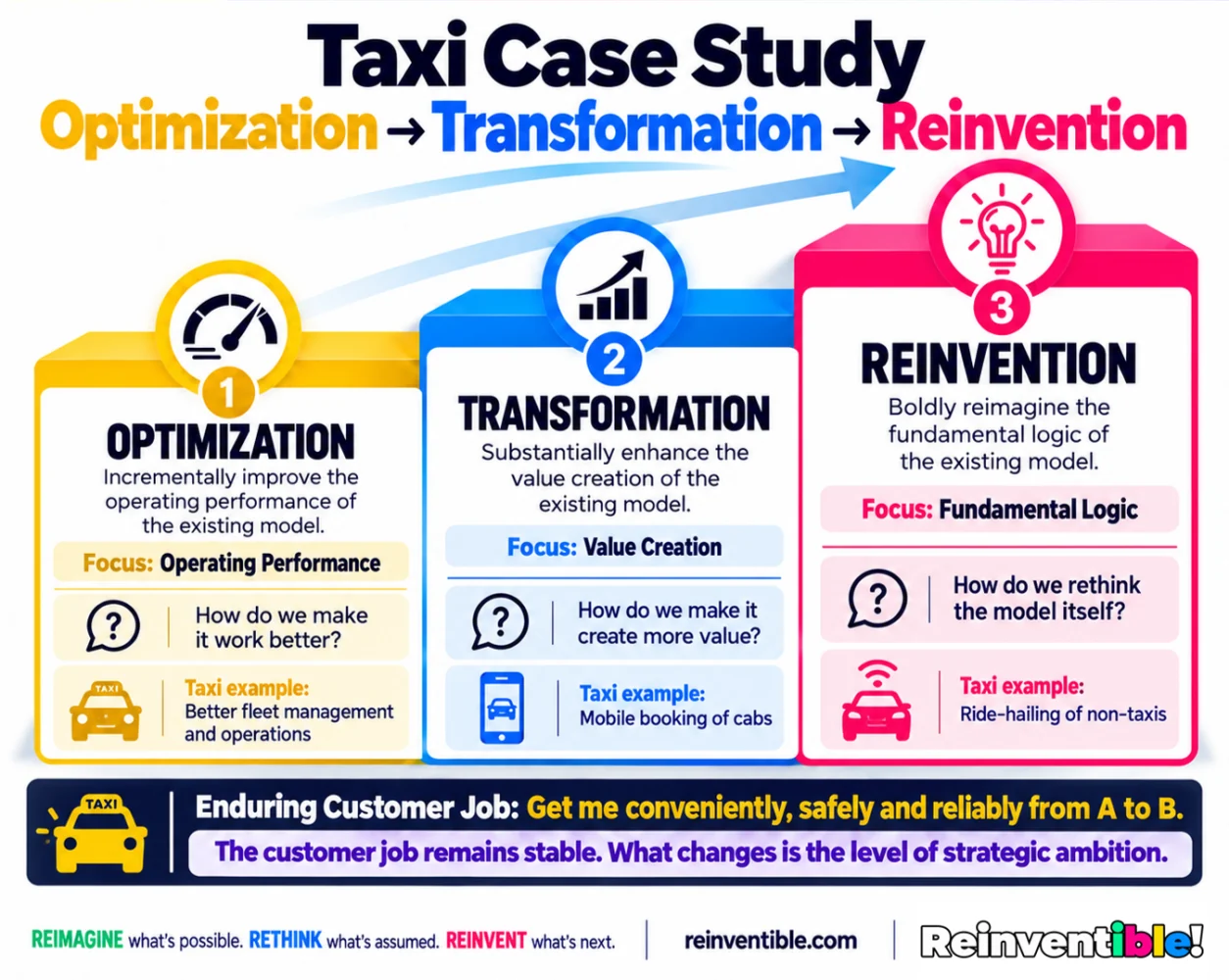
For decades, the taxi industry has served a simple and enduring customer job: Get me conveniently, safely and reliably from A to B.
Consider three different approaches to fulfilling that job.
OptimizationBetter Fleet Management
Traditional taxi companies improve driver scheduling, vehicle utilisation, dispatching and fleet management.
Passengers wait less. Drivers become more productive. Operating costs decline.
The taxi business becomes more efficient and competitive, but its fundamental model remains unchanged.
TransformationMobile Taxi Booking
Taxi companies introduce mobile apps that allow passengers to book taxis instantly, track their arrival, pay digitally and rate their journeys.
The customer experience improves substantially. Booking, dispatching and payment are transformed.
Yet the underlying model remains largely intact: licensed taxi operators continue to provide rides through conventional taxi fleets.
ReinventionUber's Ride-Hailing Model
Then came Uber's expansion into private-car ride-hailing.
What if passengers didn't necessarily need taxis?
What if eligible private-car drivers could also provide rides?
What if a mobility company didn't need to own or operate a conventional taxi fleet, but could orchestrate a marketplace connecting passengers with independent drivers?
Suddenly, the fundamental logic of the business changes.
The source of transport supply expands beyond conventional taxis. The economics shift towards a two-sided platform model. The boundaries of the industry are redrawn.
The customer job never changed.
People still wanted to get conveniently, safely and reliably from A to B.
What changed was the fundamental logic of how that job could be fulfilled.
Uber didn't invent the need for transportation. It demonstrated how a radically different business model could fulfil an enduring customer need.
And importantly, it achieved this using technologies that were already emerging in the Digital Age.
The Difference Is Not Technology. It Is Strategic Imagination.
All three approaches can use digital technologies.
A taxi company can use sophisticated software to optimize its fleet. It can introduce a mobile app to transform the customer experience. It can even integrate AI into virtually every aspect of its operations.
Yet none of these necessarily changes the fundamental logic of its business.
Reinvention results from challenging long-held assumptions and combining existing technologies, capabilities and business models in fundamentally different ways.
Digital transformation does not automatically lead to business reinvention.
The difference lies in the level of strategic intent and imagination.
This distinction becomes even more consequential as we move from the Digital Age into the Intelligence Age.
From the Digital Age to the Intelligence Age
Uber was one of several landmark examples of business reinvention enabled by the Digital Age, alongside Amazon in retail, Netflix in entertainment and Airbnb in accommodation.
Digital technologies transformed industries across the economy. However, some of the most visible business model reinventions emerged in domains where information, communication, transactions and coordination could be digitised and scaled.
The Intelligence Age promises something far more universal.
Digital technologies revolutionised how we process, transmit and connect information.
AI is revolutionising how we generate and apply intelligence itself.
And intelligence underpins virtually every human activity, profession and industry.
As intelligence becomes increasingly abundant, affordable and scalable, the opportunities for reinvention extend far beyond digital platforms and information-intensive businesses.
If the Digital Age enabled the reinvention of selected industries, the Intelligence Age could enable the reinvention of virtually every industry.
This is a fundamental expansion of what businesses can imagine and achieve.
And we are already seeing the beginnings of this shift in an industry as traditional and physical as fashion.
The Fashion Industry: Reinvention in the Intelligence Age
For generations, the fashion industry has served another enduring customer job: Help me discover and wear fashionable clothing that suits my tastes, needs and budget.
Traditionally, fashion brands operate through a familiar model: forecast trends, design collections, manufacture garments, distribute inventory and sell what has been produced.
Now consider three levels of strategic ambition.
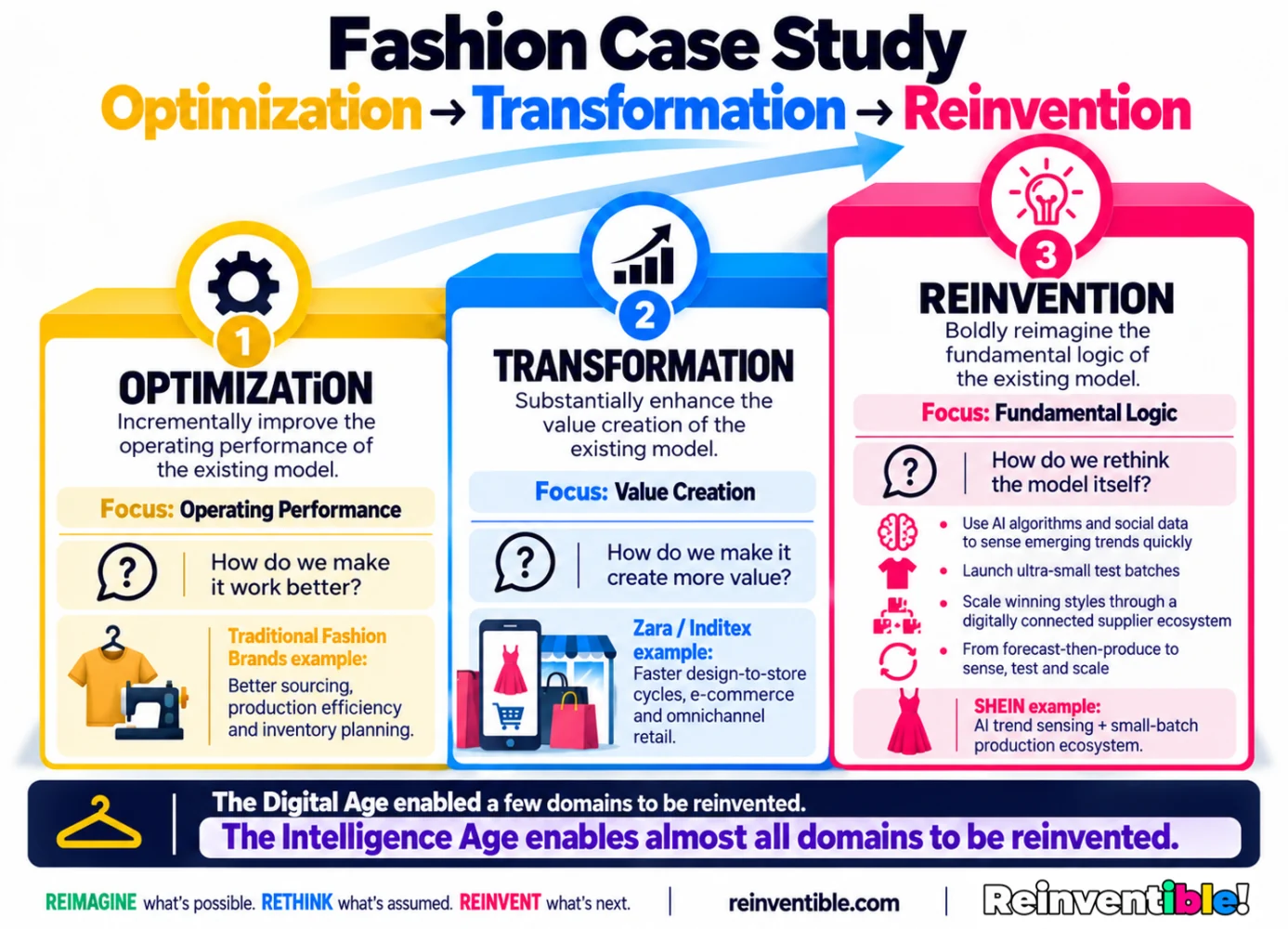
OptimizationBetter Fashion Production
Traditional fashion companies improve sourcing, manufacturing productivity, inventory management and supply chain efficiency.
They produce garments faster, cheaper and with fewer defects.
However, the underlying business logic remains unchanged: predict what customers want, manufacture inventory and then sell it.
TransformationZara's Fast-Fashion Model
Companies such as Zara, part of Inditex, transformed fashion through faster design-to-store cycles, closely integrated supply chains, continuous sales feedback and omnichannel retail.
Fashion becomes more responsive to changing trends. Customers enjoy fresher collections, faster availability and more convenient shopping experiences.
Yet the fundamental model remains largely intact: fashion companies design and produce collections for customers to choose from.
ReinventionSHEIN's Demand-Responsive Model
Then consider SHEIN.
What if fashion companies could use AI algorithms and digital signals to sense emerging consumer trends almost as they happen?
What if they could launch new designs in ultra-small production batches (of 100), test real customer demand and rapidly scale only the styles that prove popular?
What if an entire digitally connected manufacturing ecosystem could continuously adapt production to actual demand?
This is the fundamental shift represented by SHEIN's model.
Rather than committing heavily to large collections based primarily on forecasts, SHEIN combines intelligent trend sensing, small-batch testing, rapid scaling and instant replenishment.
Its digitally connected supplier ecosystem enables successful designs to be scaled quickly, while limiting initial commitments to unproven styles.
The production logic shifts from forecast, produce and sell to sense, test and scale.
AI and advanced algorithms help detect and interpret demand signals. Flexible manufacturing capabilities translate those signals into physical products at speed.
This goes beyond making factories more efficient or digitising fashion retail.
It challenges the traditional logic of how fashion products are conceived, produced and brought to market.
And once again, the enduring customer job remains unchanged.
Consumers still want fashionable and affordable clothing suited to their preferences.
What changes is the fundamental logic of how that need is fulfilled.
Of course, SHEIN's model also raises legitimate questions about the sustainability of ultra-fast and highly affordable fashion. Its wider consequences must also be considered.
Nevertheless, the strategic lesson is significant.
AI can enable the reinvention of even highly physical industries by fundamentally changing how demand, production and value creation are organised.
Now Imagine What Else AI Makes Possible
Uber demonstrated how digital technologies could fundamentally reinvent the logic of mobility. SHEIN illustrates how AI-enabled capabilities can challenge the traditional logic of fashion production.
Now imagine applying the same level of strategic ambition to healthcare, education, financial services, transport, manufacturing, logistics, agriculture and professional services.
As intelligence becomes increasingly abundant, affordable and scalable, long-standing assumptions about how value must be created, delivered and captured can be challenged across virtually every industry.
The greatest opportunity from AI may lie in reimagining businesses that were previously impossible or impractical, rather than merely improving or transforming those that already exist.
The Danger of Transforming Yesterday's Business
Many organisations are understandably focused on identifying AI use cases, improving employee productivity, automating workflows and transforming existing processes.
These are necessary and valuable investments.
But there is a strategic danger.
We could become exceptionally good at optimizing and transforming a business model whose fundamental logic is becoming obsolete.
Imagine a taxi company that had perfected its fleet management, digitised every customer interaction and automated its back-office functions, yet never questioned whether passengers had to be served exclusively by conventional taxis.
It could have become an outstanding digital taxi company while missing the opportunity to participate in an entirely different mobility business.
Or imagine a fashion company investing heavily in AI-powered forecasting and supply chain optimization, while never questioning whether producing large collections based on predicted demand was still the best way to serve customers.
It could become exceptionally efficient at the old model while competitors discover a fundamentally different one.
The same strategic risk now confronts businesses across virtually every industry.
From Digital Transformation to Intelligent Reinvention
The Digital Age gave rise to digital transformation and enabled breakthrough reinventions in selected domains.
The Intelligence Age raises the stakes considerably.
If digital technologies enabled some industries to be reinvented, AI creates the possibility for virtually every industry to be reinvented.
This is why I believe Intelligent Reinvention will become a defining strategic imperative of the coming decades.
It requires leaders to return to first principles, rediscover the enduring customer jobs they serve, challenge inherited assumptions and imagine fundamentally new ways of creating, delivering and capturing value.
Importantly, Intelligent Reinvention does not have to mean creating the next Uber or disrupting an entire industry. Reinvention can happen at any scale, even in our everyday work.
Instead of using AI to write reports faster, why not question whether routine reports are needed at all, and have AI surface critical insights and recommended actions when they matter?
Instead of using AI to take better meeting minutes, why not have it follow through on routine decisions and agreed actions?
What matters is not the size of the undertaking, but how boldly we reimagine the fundamental logic of what we do.
Even the smallest task can be reinvented for the AI era.
That is also the thinking behind Reinventible!, the world's first full-stack reinvention system for the AI era, which I created to help leadership teams rethink and reimagine their businesses, products, services, functions and operating models to become AI-native.
The starting point is not which AI technologies to deploy or which processes to automate.
It is a more fundamental question:
If we were creating this business from scratch today, knowing what AI makes possible, would we design it the same way?
If the answer is a definite yes, you may not have thought about it hard enough.
If the answer is a potential no, perhaps optimization and transformation alone are no longer enough.
The next strategic leap may require reinvention.
So, as your organisation prepares for the AI era, ask yourself:
Are we optimizing the performance of our existing business?
Are we transforming how our existing business creates value?
Or are we bold enough to reinvent the fundamental logic of what our business could become?
Originally published in Charlie Ang's Intelligent Reinvention Memo newsletter on LinkedIn (Issue 56).

Charlie Ang is an Intelligent Reinvention Strategist, corporate futurist and AI keynote speaker based in Singapore and speaking worldwide. He helps organisations and leaders reinvent, rewire and retool for the Age of Intelligence, and has been featured by the BBC, Financial Times, National Geographic and CNA.