 Charlie
Meta may be starting its biggest reinvention since Facebook became Meta.
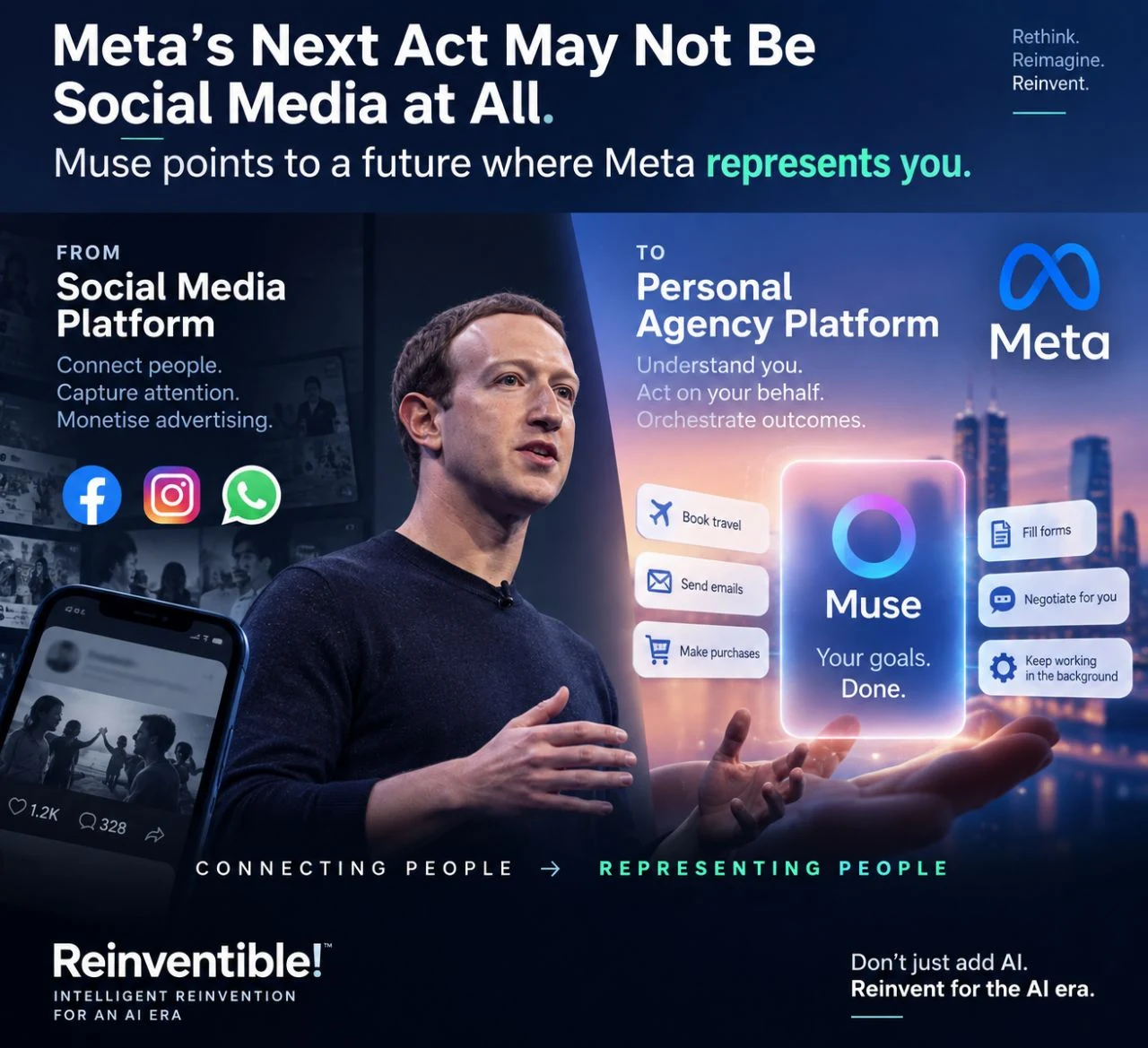
Meta just launched Muse, a new personal AI agent in the US.
Unlike a chatbot that mainly answers questions, Muse is designed to act. It can work across apps, send emails, book travel, fill forms, make purchases and keep working in the background.
Meta calls it a first step toward “personal superintelligence”.
But I think the bigger story is what Meta may be trying to become:
SOCIAL MEDIA PLATFORM → PERSONAL AGENCY PLATFORM
For two decades, Meta built platforms that connect people, capture attention and monetise that attention through advertising.
Muse points toward a different relationship.
Instead of:
You → Meta platform → content → advertiser
Imagine:
You → Muse → apps, businesses and services → outcome
You tell your agent what you want accomplished. It searches, compares, communicates, coordinates and acts for you.
That means Meta could start capturing something even more valuable than attention:
INTENT + CONTEXT + PERMISSION TO ACT.
The strategic shift is not simply from social media to AI.
It is from CONNECTING people to REPRESENTING people.
The wider ecosystem
And Muse becomes much more interesting when you look at Meta’s wider ecosystem:
Facebook and Instagram understand interests.
WhatsApp provides communication and distribution.
Meta AI provides intelligence.
Smart glasses could become the interface.
Business agents can represent companies.
Now imagine both sides connecting:
PERSONAL AGENT (represents the customer) ↔ META AGENTIC ECOSYSTEM ↔ BUSINESS AGENT (represents the company)
From attention to outcomes
Meta’s old engine was:
Attention → Ads → Clicks
A future engine could add:
Intent → Action → Outcomes
That could open revenue beyond advertising through consumer subscriptions, business-agent subscriptions, agent infrastructure and potentially transaction economics.
People do not fundamentally want to navigate apps.
They want outcomes.
If AI can represent both buyer and seller, the winning platform may not simply show information.
It may orchestrate what gets done.
Meta spent two decades building one of the world’s largest social ecosystems.
Muse may be the first major building block of its next one:
A PERSONAL AGENCY ECOSYSTEM.
The question may increasingly shift from:
“How much of our attention can Meta capture?”
to:
“How much of our lives will we trust Meta to act on?”
This is Intelligent Reinvention in action: not just adding AI to today’s business, but reimagining what the business itself can become when intelligence becomes abundant.
Don’t just add AI. Reinvent for the AI era.
Originally published as a post by Charlie Ang on LinkedIn, part of his "Reinventing X for the AI Era" series. This is an independent strategic analysis, not affiliated with or endorsed by Meta.

Charlie Ang is an Intelligent Reinvention Strategist, corporate futurist and AI keynote speaker based in Singapore and speaking worldwide. He helps organisations and leaders reinvent, rewire and retool for the Age of Intelligence, and has been featured by the BBC, Financial Times, National Geographic and CNA.