 Charlie
In 1996, Marvel filed for bankruptcy. The company behind Spider-Man, the X-Men and Captain America had been battered by a collapsing comic-book market and heavy debt. Its lenders eventually had more than $700 million in claims.
Yet Marvel possessed something enormously valuable: Characters people already loved.
The problem was how it captured value from them.
For years, Marvel largely published comics and licensed characters to other companies, including Hollywood studios.
Others financed the movies.
Others controlled the productions.
Others captured much of the upside.
Marvel began to see a much bigger opportunity.
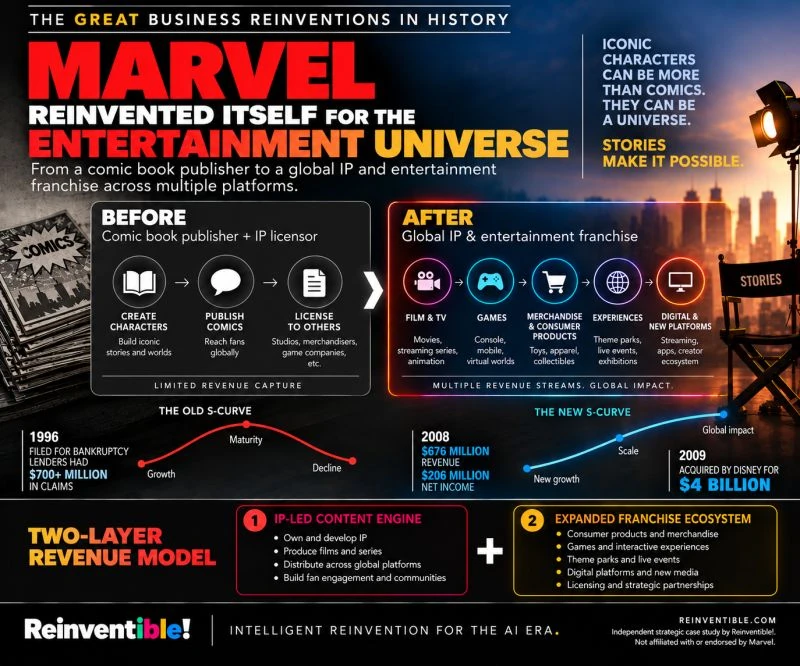
The Old S-Curve
Comic book publisher + IP licensor
Create characters → Sell comics → License characters to others
The characters were valuable.
But Marvel was often sitting upstream while others built billion-dollar businesses around them.
The Opportunity
What if Marvel stopped thinking of itself primarily as a publisher...
...and started thinking of itself as the owner of a universe of intellectual property?
Its characters could become the foundation for films, merchandise, licensing, games and eventually interconnected franchises.
The Reinvention
Comic book publisher + licensor
↓ Character IP + entertainment franchise company
The pivotal move came in 2005.
Marvel secured a $525 million financing facility to produce its own films, using the theatrical rights to a portfolio of characters as collateral.
It was an extraordinary bet.
Marvel was effectively financing its future using its own intellectual property.
Then came Iron Man in 2008. Followed by The Incredible Hulk, Thor, Captain America, Guardians of the Galaxy, The Avengers and others.
Marvel was no longer simply licensing characters to other studios.
It was producing and controlling its own films.
Individual characters became interconnected franchises.
Franchises became a shared universe.
So the new S-curve began.
The Result
By 2008, Marvel Entertainment generated:
- US$676 million revenue
- US$206 million net income
In 2009, Disney acquired Marvel for approximately: US$4 BILLION.
From bankruptcy to a $4 billion acquisition in just over a decade.
But the bigger reinvention was conceptual.
Marvel stopped seeing its characters as content to be published or licensed. It supplied valuable IP to Hollywood.
Marvel saw them as the building blocks of an expandable IP ecosystem. So, it built the capability to capture far more of the value itself.
Marvel's business wasn't comics. It was characters, stories and worlds that could compound across platforms.
The Reinvention Lesson
Sometimes reinvention is not about creating a new product - it is about moving to a more valuable position in the value chain.
Old S-curve → Reinvention → New S-curve
Originally published as a post by Charlie Ang on LinkedIn, part of his series on the great business reinventions in history.

Charlie Ang is an Intelligent Reinvention Strategist, corporate futurist and AI keynote speaker based in Singapore and speaking worldwide. He helps organisations and leaders reinvent, rewire and retool for the Age of Intelligence, and has been featured by the BBC, Financial Times, National Geographic and CNA.