 Charlie
This is one of 15 limiting beliefs of work in an intelligence-abundant world, in detail.
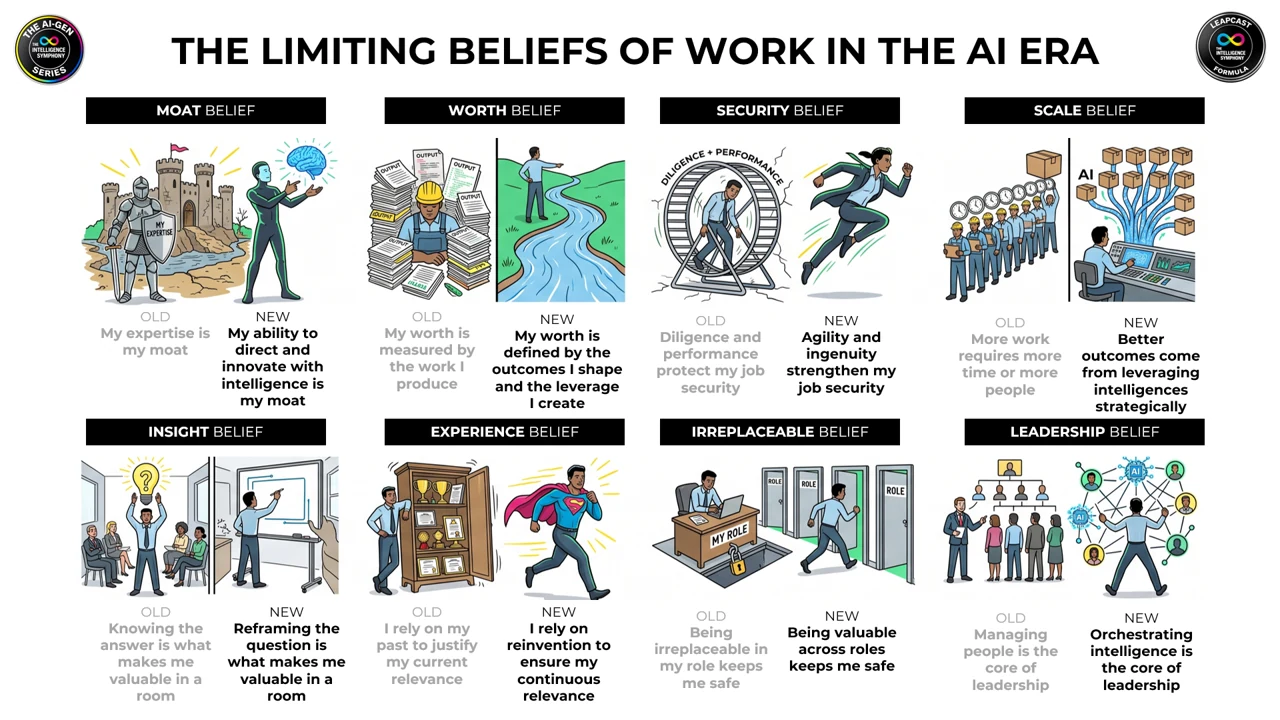
Belief 5: Insight Belief
Old: Knowing the answer is what makes me valuable in a room.
New: Reframing the question is what makes me valuable in a room.
Reframe: Answers are only as good as the question behind them. In a world where the rules keep changing, the question is everything.
Everyone in the Room Has the Answer. Nobody Is Asking the Right Question.
Why this was true
For most of professional history, the person with the answer owned the room. Expertise was demonstrated through recall, certainty, and the ability to respond with authority when a question was asked. The senior partner who knew the case law cold. The CFO who had the numbers in her head. The consultant who walked in with the answer already prepared. Speaking up without certainty was risky: it signalled you hadn’t done the work, hadn’t earned the right to the table. So professionals learned to wait, to prepare, to know before they spoke. That discipline was not just rewarded. It was the definition of professional credibility.
The historical context
This belief was built on information scarcity. When data was hard to access, analysis was slow, and expertise took years to accumulate, the person who already had the answer held genuine power. Information asymmetry was the foundation of professional authority. The doctor who knew the diagnosis. The lawyer who knew the precedent. The engineer who knew the specification. In each case, the answer was scarce, and scarcity made it valuable. Knowing was the moat. The room deferred to the person who had already done the work of finding out.
The moment it broke
When AI made answers abundant. Not just accessible, but instant, synthesised, and contextualised. The information asymmetry that underpinned professional authority collapsed. Any answer that can be retrieved, calculated, or synthesised from existing information can now be generated by AI faster than any human can recall it. The scarcity that made knowing valuable disappeared. And with it, the professional hierarchy built on who knows more. What remained scarce, and therefore newly valuable, was not the answer. It was the quality of the question that produced it.
Who is most at risk
Professionals who have built their authority and confidence on being the person with the answers. Subject matter experts who are most comfortable when they are explaining what they know. Senior professionals who have spent decades accumulating knowledge and now feel that knowledge is their primary contribution. Anyone who equates speaking up with having the answer, and stays silent when they don’t. In a world where the answer is no longer scarce, the professional who only contributes answers is contributing the least valuable thing in the room.
Negative Example
A chief strategy officer had spent twenty years being the smartest person in every room he entered. His preparation was legendary: he arrived at every meeting with data, precedents, and recommendations already formed. He was rarely wrong. He was always impressive. Then his organisation began using AI for strategic analysis. The data he used to arrive with was now available to everyone in the room before the meeting started. His answers were no longer differentiated; they were expected baselines. What the board started asking for instead was not better answers but better questions: challenges to the strategy, reframes of the problem, identification of what they weren’t seeing. He had spent twenty years perfecting the answer. He had never learned to question the question. He was the most prepared person in a room that had moved on.
Positive Example
A mid-level product manager had never been the most technically knowledgeable person on her team. She couldn’t out-code the engineers or out-analyse the data scientists. What she had always done, almost instinctively, was question the brief. Every time her team was handed a problem to solve, she would ask: are we solving the right problem? Is this the question the customer is actually asking? What assumption are we making that we haven’t tested? In the pre-AI world, this habit was valued but not decisive. In the AI world, it became her superpower. While the rest of the team used AI to answer questions faster, she used it to pressure-test whether they were asking the right questions at all. Her products consistently outperformed. Not because she had better answers, but because she had better questions.
The cost of holding on
You become the most prepared person in a room full of people who all have the same preparation. Your answers no longer differentiate you; they confirm you did the work that everyone now does with AI in ten minutes. Worse, by leading with answers you foreclose the questions. You lock the room into a frame that may be the wrong one. The professional who always has the answer is often the one preventing the room from finding a better question. That is not authority. That is drag.
The warning sign
You prepare for meetings by gathering answers, not by generating questions. You feel most confident when you know the most in the room. You feel exposed when asked something you don’t know, rather than curious. You have never walked into a high-stakes meeting leading with a question rather than a position. That preparation style was once your competitive advantage. It is now your blind spot.
The AI angle
AI is an extraordinarily powerful answer machine. Give it a question and it will retrieve, synthesise, and present the best available answer faster than any human can. Which means the quality of what AI produces is entirely dependent on the quality of the question it is given. A poorly framed question produces a brilliantly executed answer to the wrong problem. A reframed question opens up solution spaces that the original question would never have reached. The human’s irreplaceable role in an AI-augmented world is not to answer; it is to frame. The person who can look at a problem and ask the question nobody else thought to ask is the person who gets the most from AI, and the most from every room they walk into.
The first move
Before your next significant meeting, instead of preparing answers, prepare three questions. Not clarifying questions, but reframing questions. Questions that challenge whether the room is solving the right problem, addressing the right audience, or operating on the right assumption. Bring those questions instead of your usual deck of answers. Notice what happens to the conversation, and to your perceived value in the room.
When did you last walk into a high-stakes room and change what everyone was solving for, not by having a better answer, but by asking a better question?
The bottom line: AI has made answers the most abundant thing in any room. What remains scarce, and irreplaceable, is the ability to reframe the question entirely. In an AI-rich world, the person who changes what the room is asking is worth more than the person who answers what the room already asked.
Originally published in Charlie Ang's Intelligent Reinvention Memo newsletter on LinkedIn (Limiting Beliefs special series).

Charlie Ang is an Intelligent Reinvention Strategist, corporate futurist and AI keynote speaker based in Singapore and speaking worldwide. He helps organisations and leaders reinvent, rewire and retool for the Age of Intelligence, and has been featured by the BBC, Financial Times, National Geographic and CNA.