 Charlie
This is one of 15 limiting beliefs of work in an intelligence-abundant world, in detail.
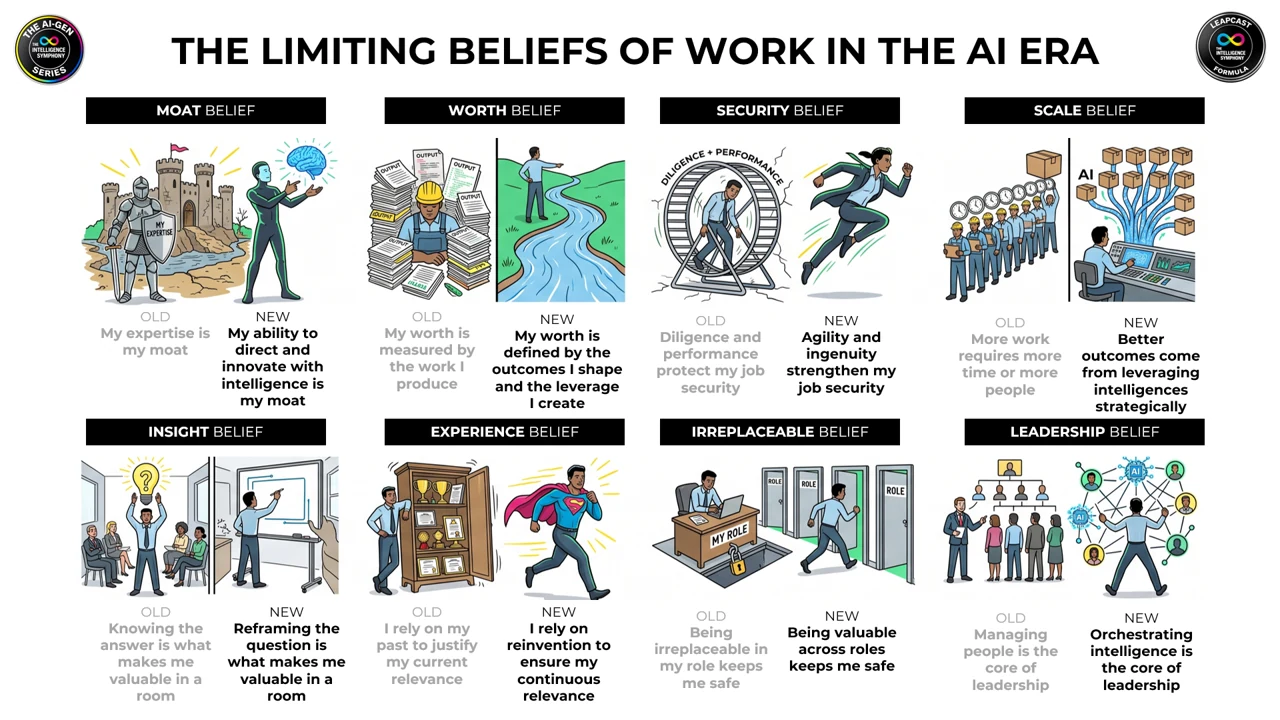
Belief 4: Scale Belief
Old: More work requires more time or more people.
New: Better outcomes come from leveraging digital intelligence more strategically.
Reframe: Work and people were the units we measured. AI didn’t just replace the inputs; it changed the equation altogether.
You Don’t Need More People. You Need a Better Equation.
Why this was true
For most of professional and organisational history, scale was a function of two things: time and people. If you needed more output, you either worked longer or hired more. This was not a limitation so much as a law. Human capacity was the ceiling. The best organisations optimised around it with better processes, smarter workflows, more efficient teams. But the fundamental equation never changed: more output required more human input. Entire management disciplines were built on this assumption. Headcount was the primary lever of ambition.
The historical context
The industrial era made this explicit: factories needed workers, output scaled with labour. The knowledge economy softened the equation but didn’t break it. A consulting firm needed more consultants to serve more clients. A law firm needed more lawyers to handle more cases. A marketing agency needed more creatives to produce more campaigns. Even with technology, the marginal unit of growth was almost always a human being. Budgets were headcount. Ambition was measured in team size. Org charts were the architecture of scale.
The moment it broke
When a single person with AI started producing what previously required a team. Not marginally more, but exponentially more. One strategist with the right AI stack can now research, analyse, synthesise, write, design, and iterate across a project in the time it used to take a team of five to complete the first phase. The constraint was never really time or people. It was the cost and friction of human execution. AI removed that friction. And in doing so, it didn’t just make teams more efficient; it made the old definition of scale obsolete.
Who is most at risk
Leaders and organisations who still equate ambition with headcount. Managers whose identity is tied to the size of their team. Professionals who believe they cannot take on more without more support. Entrepreneurs who delay building because they can’t afford to hire. Anyone whose mental model of scale still runs on the old equation (more output requires more people) is systematically underestimating what is now possible and overestimating what is still necessary.
Negative Example
A boutique strategy consultancy had been trying to grow for three years. Every time a significant new client opportunity appeared, the founding partner turned it down: not because the work wasn’t right, but because he didn’t have the team to deliver it. He kept hiring carefully, building slowly, protecting quality. Meanwhile a solo consultant in the same market, armed with AI tools for research, analysis, writing, and client communication, was taking on engagements that the boutique firm was declining. She wasn’t cutting corners. She was operating on a fundamentally different equation. The founding partner wasn’t wrong to be careful. He was wrong to assume that care required headcount.
Positive Example
A two-person content and communications firm was approached by a multinational to handle their thought leadership programme across five markets, a brief that would traditionally have required an agency of twenty. Instead of declining or over-hiring, they mapped the entire workflow and identified every task that AI could handle: research, first drafts, localisation, formatting, scheduling, performance analysis. They kept human judgment at the strategy, editorial, and client relationship layers. They took the brief. Delivered across all five markets. Billed at agency rates. Their margin was unlike anything a traditional agency structure could have achieved. They didn’t scale by adding people. They scaled by rethinking the equation entirely.
The cost of holding on
You keep saying no to opportunities you could say yes to. You keep waiting for the team you think you need before you attempt the work you could already do. You keep measuring your ambition in headcount rather than in leverage. And while you wait, others are doing more with less, not because they are cutting quality, but because they have updated their equation. The cost of this belief is not just efficiency. It is the compound loss of every opportunity declined, every ambition deferred, every project not attempted because the old rules said you weren’t ready.
The warning sign
You find yourself saying “we need more resource for this” before you have mapped what AI could handle. Your first response to a big opportunity is to think about who you would need, not what you would need. You equate the quality of an output with the number of people who worked on it. You feel uncomfortable taking on something significant without a team behind you. These instincts were rational once. They are now costing you more than you realise.
The AI angle
AI doesn’t just make individuals faster; it makes the relationship between input and output non-linear. In the old equation, doubling output required roughly doubling input. AI breaks that linearity. A single well-directed AI workflow can generate outputs that previously required teams, budgets, and timelines that are now simply unnecessary. This is not an incremental improvement. It is a structural shift in what one person or one small team can achieve. The professionals and organisations who internalise this shift earliest will have an advantage that compounds, because they are operating on a different curve entirely.
The first move
Take the last opportunity you declined because you didn’t have the resource. Map the workflow it would have required. Then go through each task and ask: could AI have handled this with the right direction? You will likely find that the human-essential tasks are fewer than you assumed, and that the gap between what you could have taken on and what you did take on was smaller than you thought. That gap is your starting point. Not to overcommit, but to recalibrate what is now within your reach.
The bottom line: In an AI-rich world, scale is no longer a function of how many people you have; it is a function of how intelligently you direct the resources available to you. The equation has changed. The only question is whether you have changed with it.
When was the last time you told a client, a colleague, or yourself that something would take longer than it should, and what would it look like if you mapped that workflow through AI first before giving a timeline?
Originally published in Charlie Ang's Intelligent Reinvention Memo newsletter on LinkedIn (Limiting Beliefs special series).

Charlie Ang is an Intelligent Reinvention Strategist, corporate futurist and AI keynote speaker based in Singapore and speaking worldwide. He helps organisations and leaders reinvent, rewire and retool for the Age of Intelligence, and has been featured by the BBC, Financial Times, National Geographic and CNA.