 Charlie
This is the prologue of The Fellowship of the Ring, LOTR.
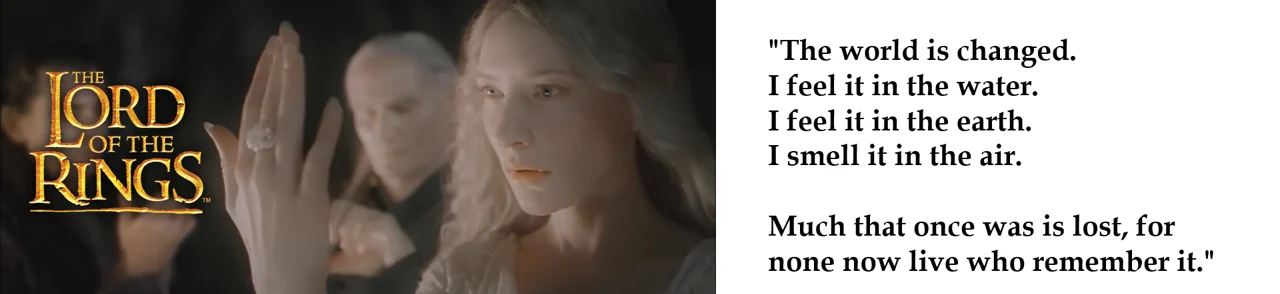
Galadriel was lamenting the beginning of the Third Age of Middle-earth and the resurgence of darkness.
Words which are equally apt for the world in 2025.
We are now in the Third Age of the Post-Cold War period. Some call this the Post-post-Cold War era.
First Age: The Flattening and Globalizing World
In the First Age (1990–2014), the world became flatter, more countries democratized and national borders for trade, immigration and investments were systematically demolished.
People, money and goods flow more freely and intensively.
Companies prioritize performance, efficiency and rapid expansion to seize this golden window of opportunity.
But, resilience was not on top of mind. Hence, many firms did not survive the Asian Financial Crisis (1997–1998), Dot-com Bust (2001–2002) and Global Financial Crisis (2007–2009).
These doomed companies were fragile.
That is the Flattening and Globalizing World. And, it turned out to be a brief honeymoon period.
Second Age: The Shifting and Fragmenting World
In the Second Age (2015–2024), international distrust brewed, popular discontent escalated and superpower rivalries intensified.
The hand brakes were pulled on uninhibited integration, movement and flows between countries.
Brexit, Trump’s shock presidential victory, COVID mayhem, Huawei and TikTok restrictions, BRICS expansion and the Russia-Ukraine War were indicative of the reversing tides.
Companies turned more cautious, wary of rising friction, emerging threats and black swan events.
The playbook of the past requires urgent updating. So, companies built in more resilience into their business strategies and structures.
That is the Shifting and Fragmenting World. In hindsight, we know that it was the transitional and reversal period.
Third Age: The Contested and Dangerous World
In 2025, the Third Age has arrived. The rule-based world order created after the 2nd World War is crumbling.
The international trading regime, global financial system, reserve dollar hegemony, regional security frameworks and national sovereignties are undermined frequently and with impunity.
Order is threatening to descend into disorder, systems into anarchy and norms into exceptions.
The win-win prosperity equation is eroded by negative-sum calculus.
The unenviable and inevitable result is the sharp and sustained surge of turbulence, complexity and uncertainty in the operating environment.
In this Contested and Dangerous world, resilience is necessary but insufficient.
The upgrade that companies need is the Antifragile approach.
Resilience means to return to its former state after a shock…
…while Antifragility enables a stronger and better state after impact.
If you think that is counter-intuitive, or even impossible, think of our physical selves.
Our brains expand after every novel experience, learning journey and difficult encounter and our muscles grow and strengthen after intense gym workouts. They are naturally antifragile.
In business, antifragility is not an abstract concept. It can be implemented and manifested at the five levels of Mindset, Leadership, Strategy, Systems and Practices of the organization.
Companies that embrace it will be able to transform risks into opportunities, challenges into growth and constraints into advantages.
In fact, they relish uncertainty and chaos because they could gain advantage over their competitors after every shock or crisis.
Huawei: Antifragility in Action
One of the best contemporary demonstrations of corporate antifragility is Huawei. By 2020, it overtook Samsung and Apple to be the world’s largest phone maker and raced ahead of Nokia and Ericsson in 5G supremacy.
But its existence came into serious doubt after successive rounds of harsh Western restrictions (handset sales, 5G infrastructure, advanced chips, Google services, etc).
The company was caught in the heavy cross-fire of the US-China tech war. While lesser companies would have caved in, Huawei defied geopolitical gravity.
It developed its proprietary tech stack, including HiSilicon Kirin chips (as alternative to Qualcomm Snapdragon), HarmonyOS (Google Android), EDA chip design software (Cadence), DUV process (ASML EUV), BeiDou Integration (US GPS), and XMAGE camera (Leica).
These culminated in the Mate 60 Pro 5G phone, stunning the world, analysts and consumers alike.
This sanction-defiance act of self-developing, vertically-integrating and indigenously-sourcing critical components previously supplied by the West was deemed impossible, until it happened.
Similarly, while 5G deployment was blocked in advanced Western-friendly markets, it pivoted to populous Asian, African and Latin American markets.
As difficulties piled up in consumer telecoms space, it expanded into cloud services, autonomous vehicles, smart cities, and industrial 5G.
Just today, Reuters reported that Huawei is planning mass shipments of its 910C AI chips to substitute Nvidia H20 demand from next month.
Huawei turned decoupling from crisis to opportunity. As many Chinese speakers know, “crisis” in Chinese is 危机 (wēijī), encompassing both “danger” (危, wēi) and “opportunity” (机, jī). Huawei embodies that.
Today, with quasi tech independence, Huawei’s survivability and growth are more assured than pre-decoupling. This is antifragility in practice.
In an industry afflicted with a history of boom and bust companies and a civilization with repeated rise and fall of imperial dynasties, Huawei Founder Ren Zhengfei embraces a survival-first mindset, as reflected in his quotes:
- “Huawei’s survival depends on preparing for disasters before they strike.”
- “Winter is inevitable. Your coat must be ready by summer.”
- “Assume the worst-case scenario will happen, then adapt.”
- “A company that fears death will live longer.”
- “Huawei’s bottom line is to survive. Only by surviving can we strive for development.”
Ren Zhengfei’s “Tao of Huawei” ethos draws from Chinese philosophical traditions:
- Laozi’s Daoism: Flexibility, going with the flow, water overcoming rock.
- Sun Tzu’s Art of War: Know yourself and the enemy, win without fighting.
- Confucianism: Loyalty, respect for order, harmony in organization.
Huawei’s antifragile core permeates the five levels of the organization. It is not mere rhetoric but drives decisions and actions at every level and employee.
Its survival-first mindset breeds long-term thinking, strategic flexibility, extreme adaptability, and market diversification. And tangibly translated into leadership, strategies, systems and practices:
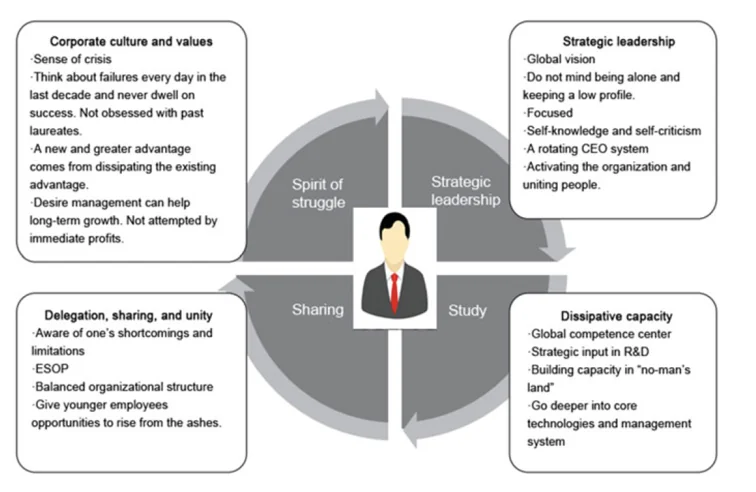
For instance, its employee ownership model (99% of shares owned by 100,000 employees, 1% by founder) fosters deep loyalty and unity in difficult times. Its R&D investment of over 20% of revenue (amongst the highest of any company in the world) ensures sustained tech innovation and corporate reinvention.
Antifragility was a bonus skill in past ages but is an essential capability in the present and future. The same principles can be applied to companies of all sizes in all industries.
Originally published in Charlie Ang's Intelligent Reinvention Memo newsletter on LinkedIn (Issue 12).

Charlie Ang is an Intelligent Reinvention Strategist, corporate futurist and AI keynote speaker based in Singapore and speaking worldwide. He helps organisations and leaders reinvent, rewire and retool for the Age of Intelligence, and has been featured by the BBC, Financial Times, National Geographic and CNA.