 Charlie
How did a gaming-chip company become the engine room of the AI revolution?
Stephen Witt’s The Thinking Machine is the story of Nvidia, Jensen Huang, and one of modern business’s most consequential transformations.
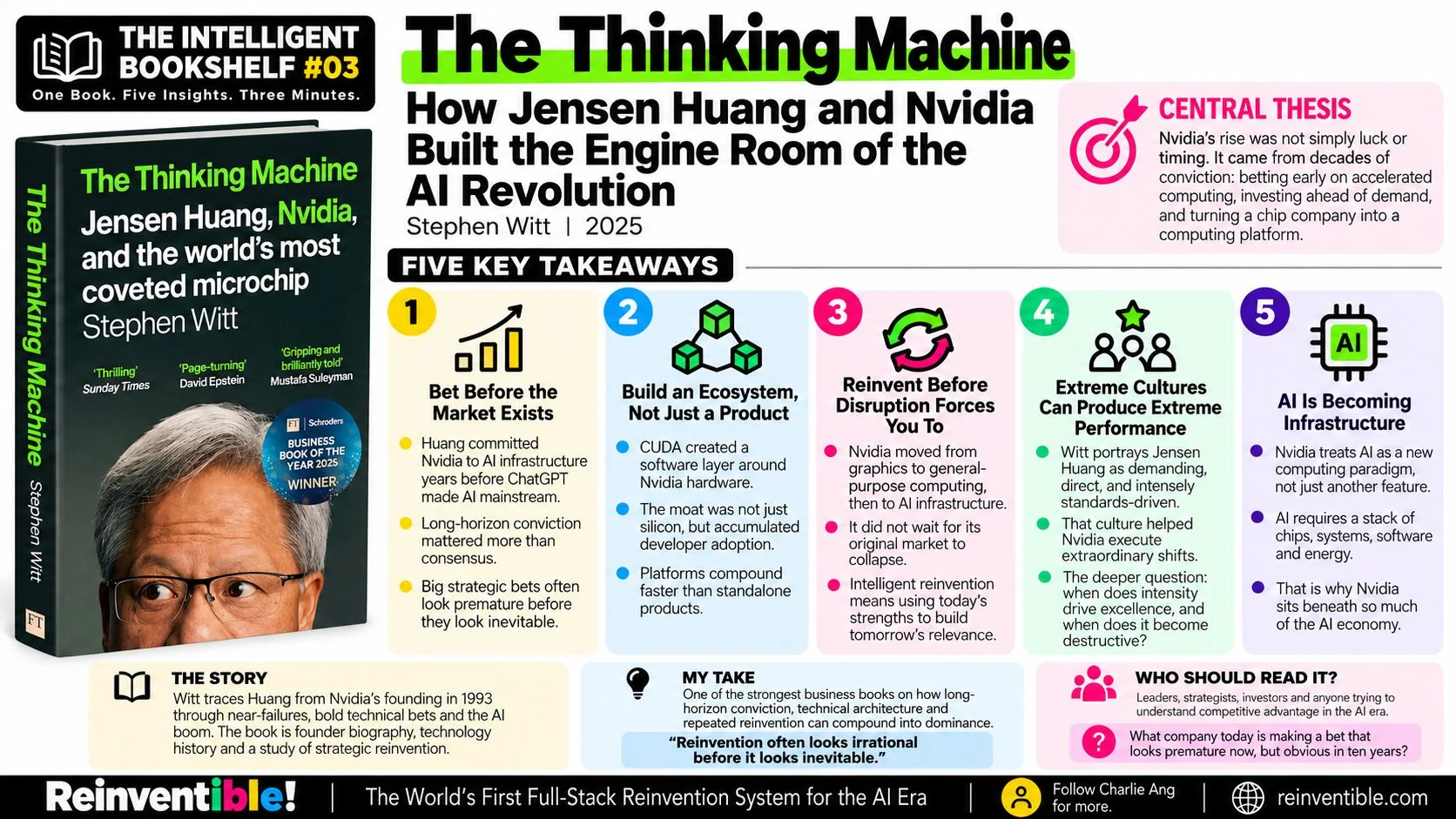
💡 The Central Thesis
Nvidia’s rise was not simply luck or timing.
It came from decades of conviction: betting early on accelerated computing, investing ahead of demand, and turning a chip company into a computing platform.
The deepest lesson: strategic foresight only matters when you are willing to commit before consensus arrives.
🔑 Five Key Takeaways
Takeaway 1: Bet Before the Market Exists
Huang committed Nvidia to technologies before their payoff was clear. The biggest was AI.
Nvidia invested in machine-learning infrastructure years before ChatGPT made AI mainstream.
Takeaway 2: Build an Ecosystem, Not Just a Product
CUDA gave developers a software layer for programming GPUs, creating an ecosystem around Nvidia hardware.
The moat was not just silicon. It was accumulated adoption.
Takeaway 3: Reinvent Before Disruption Forces You To
Nvidia moved from graphics to general-purpose computing, then to AI and the infrastructure of the intelligence economy.
It did not wait for its original market to collapse. That is strategic reinvention: using today’s strengths to create tomorrow’s relevance.
Takeaway 4: Extreme Cultures Can Produce Extreme Performance
Witt portrays Huang as demanding, direct and obsessed with speed and standards. That helped Nvidia execute extraordinary shifts.
But when does intensity drive excellence, and when does it become destructive?
Takeaway 5: AI Is Becoming Infrastructure
Nvidia does not treat AI as another software feature. It treats AI as a new computing paradigm requiring a new infrastructure stack.
That is why Nvidia sits beneath so much of the AI economy.
📖 The Story
Witt traces Huang from immigrant childhood to Nvidia’s founding in 1993, through near-failures, technological bets and the explosion in AI demand.
It is founder biography, technology history and an explanation of how a niche graphics company became strategically indispensable.
💭 My Take
One of the strongest business books on how long-horizon conviction, technical architecture and repeated reinvention can compound into dominance.
Its most important lesson:
Reinvention often looks irrational before it looks inevitable.
📚 Who Should Read It?
Leaders, strategists, investors and anyone trying to understand competitive advantage in the AI era.
What company today is making a bet that looks premature now, but obvious in ten years?
One book. Five insights. Three minutes.
Originally published as a post by Charlie Ang on LinkedIn, part of his series The Intelligent Bookshelf.

Charlie Ang is an Intelligent Reinvention Strategist, corporate futurist and AI keynote speaker based in Singapore and speaking worldwide. He helps organisations and leaders reinvent, rewire and retool for the Age of Intelligence, and has been featured by the BBC, Financial Times, National Geographic and CNA.