 Charlie
What if AI's greatest danger is who controls it?
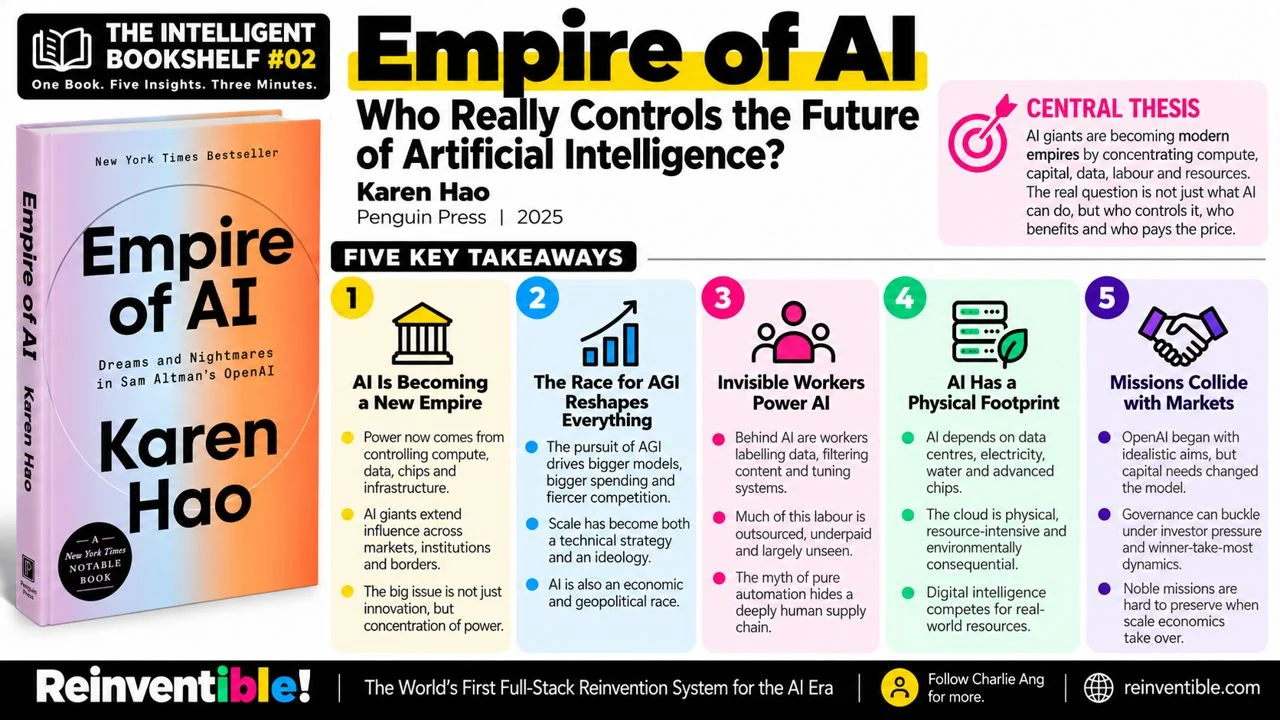
💡 The Central Thesis
In Empire of AI, journalist Karen Hao examines OpenAI's rise and the growing concentration of power in AI.
AI giants resemble empires, accumulating data, capital, labour and resources while promising progress.
🔑 Five Key Takeaways
Takeaway 1: AI Is Becoming a New Empire
Like historical empires, AI giants accumulate resources and extend influence across borders.
But their power comes from controlling compute, data, talent and infrastructure rather than territory.
Takeaway 2: The Race for AGI Reshapes Everything
The pursuit of Artificial General Intelligence drives larger models, massive investments and fierce competition.
Hao questions whether endless scaling is the best path towards beneficial AI.
Takeaway 3: Invisible Workers Power AI
Behind sophisticated AI are workers labelling data, moderating harmful content and training systems.
Many work in lower-income countries for low wages, revealing the human costs of automated intelligence.
Takeaway 4: AI Has a Physical Footprint
AI depends on energy-intensive data centres, water, advanced chips and global supply chains.
The cloud has real environmental costs.
Takeaway 5: Noble Missions Collide with Markets
OpenAI began as a nonprofit committed to developing AI for humanity's benefit.
But escalating costs and competition drove commercialisation and greater secrecy.
Even idealistic organisations can be reshaped by economic pressures.
📖 The Story: The Five-Day Battle for OpenAI
In November 2023, OpenAI's board fired CEO Sam Altman, citing concerns about his candour.
Microsoft backed him. Hundreds of employees threatened to resign.
Five days later, Altman returned.
The episode exposed the limits of independent AI oversight.
Who controls AI when billions are at stake?
💭 My Take
Hao offers a necessary counterweight to AI optimism.
But we must distinguish AI's transformative potential from the industrial model dominating its development.
Concentrating compute and capital may be commercially rational, but is it socially desirable or inevitable?
Will AI democratise intelligence or concentrate economic power further?
The future of AI shouldn't merely be about building more powerful intelligence, but distributing its benefits more widely.
📚 Who Should Read It?
CEOs, technology leaders, policymakers and investors.
Will AI become humanity's greatest equaliser or an instrument of concentrated power?
One book. Five insights. Three minutes.
Originally published as a post by Charlie Ang on LinkedIn, part of his series The Intelligent Bookshelf.

Charlie Ang is an Intelligent Reinvention Strategist, corporate futurist and AI keynote speaker based in Singapore and speaking worldwide. He helps organisations and leaders reinvent, rewire and retool for the Age of Intelligence, and has been featured by the BBC, Financial Times, National Geographic and CNA.