 Charlie
Companies do not operate in a vacuum but in the larger operating context. Intelligence Symphonies, in particular, do not innovate for the world of today but for the shifting goalposts of what is to come tomorrow.
I will provide the broadest context possible, the world we will live in.
I have been using the term “the intelligence-abundant world” to denote the world where AI is pervasive in everything and is everywhere around us. It most accurately and positively captures the future I envision.
Not “AI-first” nor “AI-powered”, as they are too technology-centric. AI is what engineers build in black boxes; intelligence is what human users perceive on the outside.
Why does this topic even matter? If you are able to better imagine the intelligence-abundant future and pivot your direction towards it today, you will be ahead of the curve over 99% of the general population.
Why? Because most people’s heads are still stuck in the information-abundant and apps-rich environment we reside in today.
It is the failure to imagine and to interpret the signals from the path ahead. They risk innovating for a world that will no longer exist. So, this issue is an antidote for getting “unstuck”.
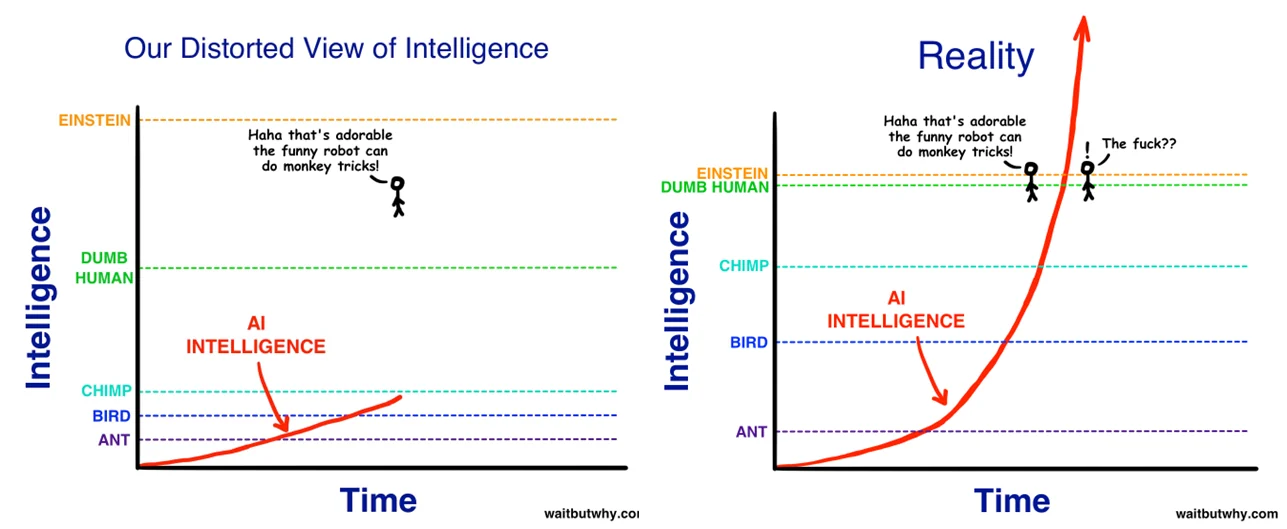
Our distorted view of intelligence
Almost everyone I know, including AI experts, was shocked by ChatGPT when it debuted. Not me.
Why? Because I didn’t have a distorted linear view of Intelligence and I comprehend digital’s exponential behavior. Don’t fall into the same trap again when we think about AI’s capabilities in 2030.
Consider this:
- Last year’s ChatGPT version has an estimated IQ of 155, or top 0.1% of the human population.
- The world’s preeminent technology futurist Ray Kurzweil predicts Artificial General Intelligence (AGI) by (not “in”) 2029. Bill Gates acknowledged Ray as “the best at predicting the future of artificial intelligence”.
- Hundreds of billions of dollars will be invested in Super AI Data Centers to enable intelligence-on-the-tap, analogous to power plants producing electricity as a utility. The US, EU, Saudi Arabia, alongside various Big Techs, have recently announced these mega commitments.

The intelligence-abundant world by 2030
With these advancements, we are headed to the intelligence-abundant world by 2030. We are poised to see a multifold explosion in aggregate intelligence in the world; most of it will be non-biological.
Inversely, human intelligence will decline to 50%, 25%, 10% or perhaps even 1% of the aggregate intelligence over time. If so, human intelligence will be a super-niche industry.
Our first line of financial advisor, general physician, personal tutor, shopping assistant, travel planner, golf instructor, wellness coach, relationship guru and performance strategist will all reside in your mobile phone and devices. Probably for free or at a small cost.
In my 2017 Straits Times article “Preparing for Singapore 4.0”, I postulated that:
“By 2030, hyper-connected, autonomous and intelligent technologies are ubiquitous – in factories, offices, schools, hospitals, highways and homes, they form self-functioning systems that operate the world without real human intervention.”
There will not be a waking moment when intelligence is not beside us, unless we choose to turn it off. Some people may, most would not. This is akin to our mobile habits today.
No one will be using the Internet per se, because we will be living in it. The only medium to give machines instructions is a native human language, as intelligent machines become more like us.
In this future, there will be no assumptions in our respective worldviews that will be left untouched. Whether it is on society, economy, politics, religion or closer to our focus, business.
The mother of assumptions
Guess what? The mother of assumptions in business is about to be uprooted.
That human-level expertise is scarce and expensive.
Businesses are organized, production chains are designed and profit/loss accounts are calculated based on this assumption. Not in 2030, when expertise becomes almost free.
The outcome? From the same article:
“The technology superpowers – Apple, Amazon, Google and Alibaba – continue to spread their disruptive prowess across all industries, defeating long-time Fortune 500 corporations and digitizing old industries entirely. They become a new class of companies known as the tech-industrial conglomerate, worth upwards of US$5 trillion and collectively responsible for 20 per cent of global production.
Small businesses everywhere are not spared, with 95 per cent failing to survive the digital revolution. In its place, a new breed of techno-enterprises will blossom. Highly networked, dynamic and elastic, these cloud-powered micro-organizations can scale according to real-time market dynamics.”
In essence, the form factor of companies with their heads above the waterline will be radically different. What I refer to as The Intelligence Symphony, the 6th generation company.
I reckon that virtually all business books, management courses and leadership theories will require an overhaul. And every problem, unsolvable in the past, will be reframed as an AI problem.
Your Unfair Advantage
We can debate the timeline of what might happen when but the direction of travel is irrefutable.
From this moment on, look for answers on how your company and/or you can flourish in the intelligence-abundant world. That could be your unfair advantage.
Originally published in Charlie Ang's Intelligent Reinvention Memo newsletter on LinkedIn (Issue 7).

Charlie Ang is an Intelligent Reinvention Strategist, corporate futurist and AI keynote speaker based in Singapore and speaking worldwide. He helps organisations and leaders reinvent, rewire and retool for the Age of Intelligence, and has been featured by the BBC, Financial Times, National Geographic and CNA.