 Charlie
In the yesteryears, companies that applied the same mindsets and methods of the analogue era to design and invent for the digital era got analog pigs with digital lipsticks. Doomed to fail from the outset.
- Blockbuster + website does not equal Blockbuster's Internet-native mail order rental system.
- Mobile phones with 3G couldn't compete with Apple's mobile-native computing iPhones.
- Taxis with web booking systems were outplayed by Uber's real-time digital marketplace of drivers and passengers.
- The likes of IBM, Sun Microsystems and HP who sold boxes to Fortune 500 clients fell victim to Amazon Web Services, which redefined the economics of computing with a cloud-native business model.
Today, companies that apply the same mindsets and methods of the digital era to design and invent for the AI era will get digital pigs with intelligent lipsticks. Doomed to fail from the outset.
Why?
Metaphorically, because extending old-generation products and business models with new-generation capabilities for a new-gen economy is akin to bringing a knife to a gunfight. Guns did not just change how we fight and who wins but totally disrupted the conduct of war, the distribution of power and destinies of nations.
Literally, because existing solutions are built with old technologies, based on old assumptions, optimized for the old world for customers with old consumption habits. There is simply too much "old", heavy baggage to carry along to the marketplace of the new revolution.
I call this: "Retrofit-ive Innovation" or retrofitting old solutions for the new landscape.
Here are ten good reasons why this is a bad idea:
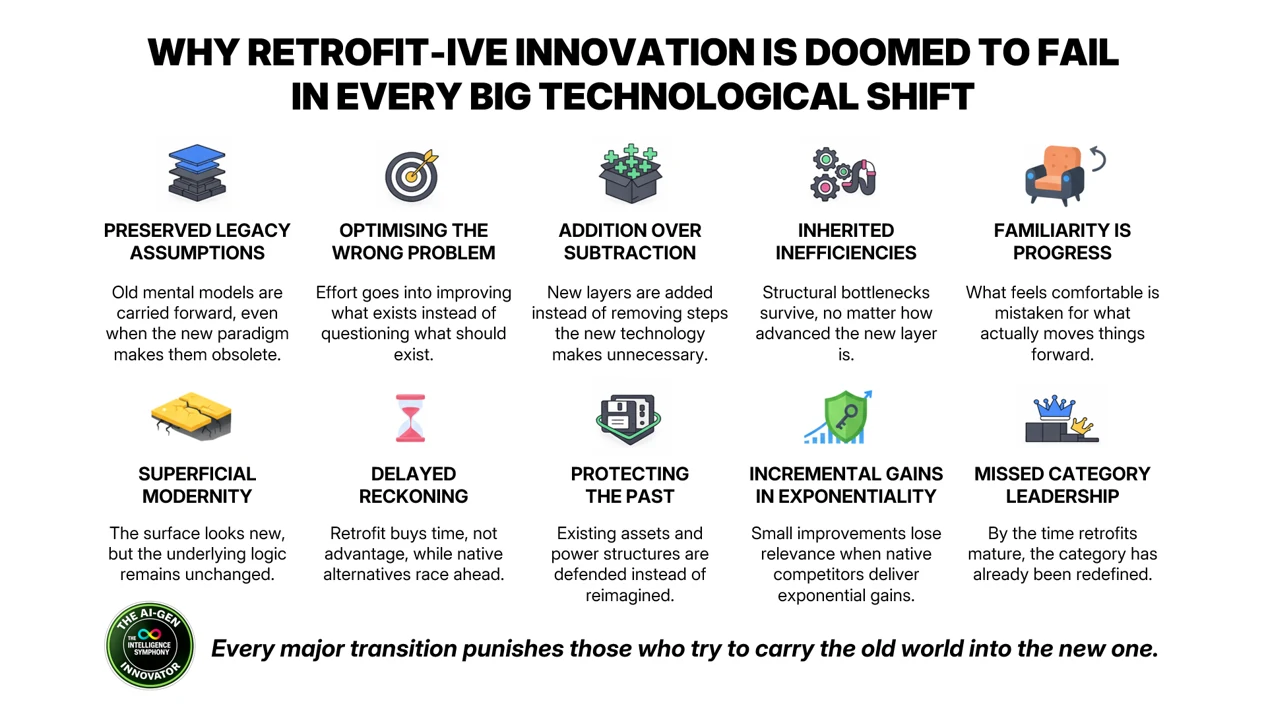
If Retrofit-ive Innovation is such a bad idea, why do strategists, creators and designers still overwhelmingly do it?
Firstly, because it is easy and natural; it's the default mode. They know of nothing else.
Secondly, because of lack of imagination. This cannot be under-estimated, as in many domains, "we have always done it this way" is not measured in years, but in decades, or even in centuries. There are many deep layers of accumulated baggage we have to unload, before we can re-imagine the world in new ways, like a Martian on earth.
I wrote in a previous edition that most businesses will fail due to failures of imagination in the AI era:
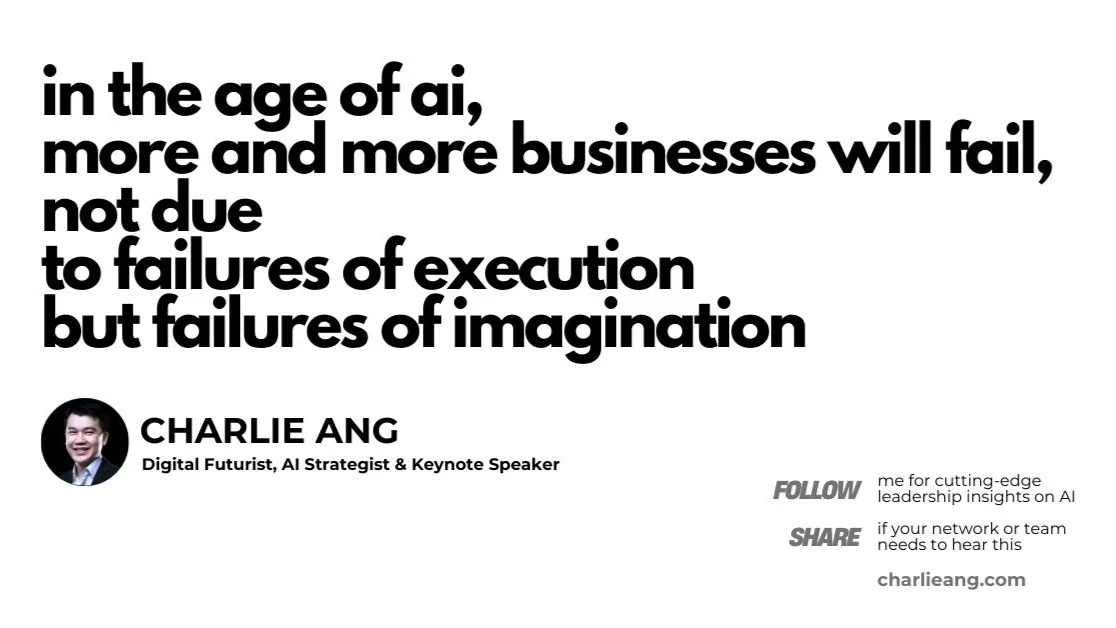
"Re-inventive Innovation" is not optional in the age of intelligence abundance
Everything is up for re-invention when the cost of intelligence drops to near-zero. Yet, most companies are merely innovating at the edges of breakthrough possibilities.
Re-inventive Innovation is inventing natively for the new-gen landscape. New market economics, growth strategies, technological capabilities, competitive sets, value chains and customer needs.
It is not a mere design job but a trans-disciplinary effort that synthesizes futures, strategy, transformation, innovation, product, technology, talent and culture into a new worldview.
It is hard and complex!
Well, not anymore. If you use the right tools for the right job.
The 4 Core Skills of Innovation in the AI Era
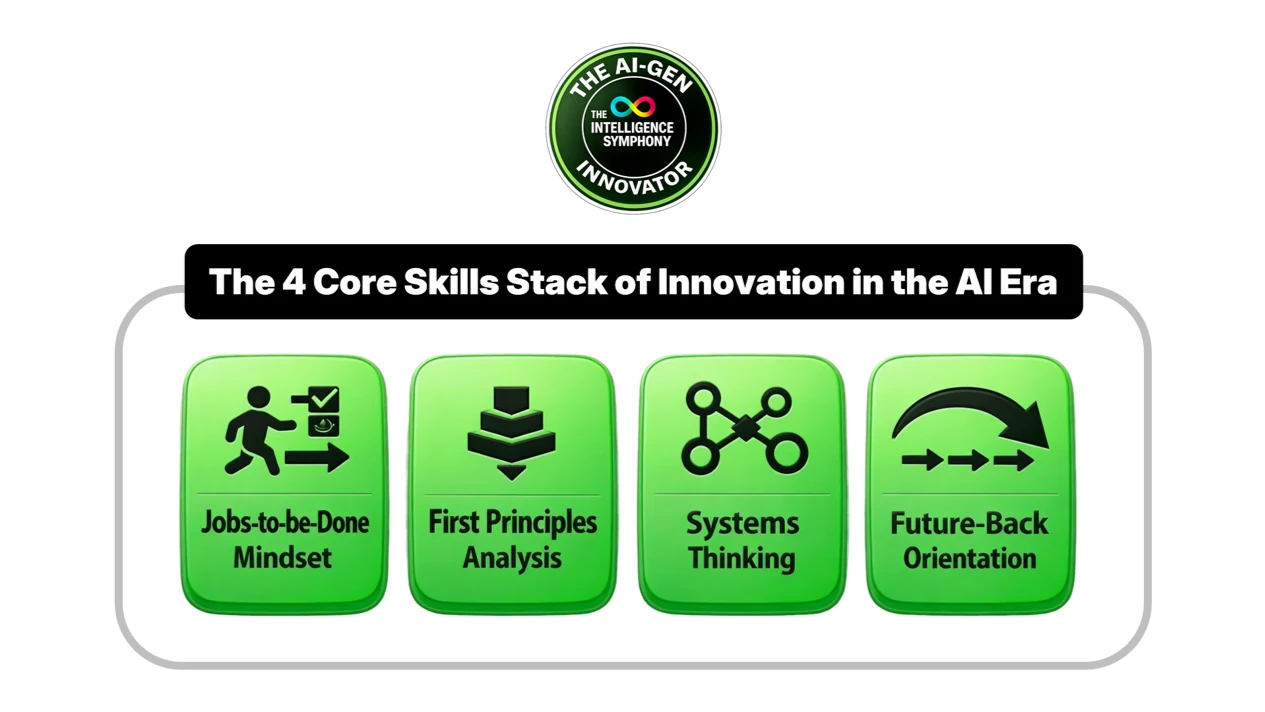
Why the 4 Core Skills of Innovation Crack the Code
Retrofit-ive Innovation fails not because companies lack intelligence, talent, or resources, but because they are using the wrong tools for the new era.
Every technological epoch demands a new way of seeing, framing, and inventing.
Analog → Digital required abandoning physical assumptions.
Digital → AI requires abandoning digital assumptions.
The mistake most organisations make is carrying forward yesterday’s innovation logic into today’s discontinuity.
That is why these four skills matter. Together, they form a reinventive operating system for innovation.
Skill 1: Jobs-to-Be-Done: Discovering the Real Customer Needs
Definition: Comprehend the true progress customers seek and innovate products and processes that help them make progress.
Why retrofit-ive innovation fails: Most innovation starts from the product, feature, or solution already on the table.
JTBD forces a reset.
It asks:
- What progress is the customer actually trying to make?
- What problem are they hiring a solution to solve?
- What outcomes matter, independent of existing tools?
This is why:
- Blockbuster failed while Netflix succeeded.
- Taxi booking apps lost to Uber.
- Feature-stuffed phones lost to the iPhone.
They optimised how the product worked, not what job the customer truly needed done.
JTBD breaks the spell of legacy offerings and creates permission to invent something fundamentally different.
Skill 2: First Principles Analysis: Re-inventing from Scratch
Definition: Strip a problem down to its basic truths, questioning every assumption, and then build solutions upward from those core foundations.
Why retrofit-ive innovation fails: Legacy systems are built on layers of assumptions:
- Cost structures
- Technical constraints
- Organisational roles
- Business models
- Regulatory workarounds
First Principles thinking strips everything down to what must be true now, not what used to be true.
It asks:
- What are the irreducible truths of this problem today?
- What constraints no longer exist?
- What becomes possible when intelligence is cheap, fast, and abundant?
This is exactly how:
- AWS redefined computing economics
- Uber removed dispatch entirely
- iPhone collapsed device categories into one
FP thinking removes historical gravity, without which reinvention is impossible.
Skill 3: Systems Thinking: Designing the System Beyond the Product
Definition: Develop a higher-level, systems view of a problem, business model, company, or ecosystem in order to solve, optimize, or orchestrate change.
Why retrofit-ive innovation fails: Most teams optimise components, not systems.
They improve:
- A feature
- A workflow
- A department
- A channel
But technological shifts don’t just change products, they reconfigure entire systems:
- Value chains
- Power structures
- Marginal economics
- Who captures value vs who is disintermediated
Systems Thinking allows innovators to see:
- Second-order and third-order effects
- New winners and losers
- Where value moves, not where it used to sit
This is why incumbents selling “better boxes” lost to cloud platforms that re-architected the system of computing itself.
Without systems thinking, innovation remains cosmetic.
Skill 4: Future-Back: Inventing From Where the World Is Going
Definition: Start from a vision of the future and reason backward to identify the steps, innovations, and transformations required to reach it from today.
Why retrofit-ive innovation fails: Most innovation is present-forward:
Start with today’s product → Add new capabilities → Ship faster
Future-Back reverses the direction.
It asks:
- If we start from a world where AI is ubiquitous, cheap, and autonomous…
- What would this industry look like?
- What would no longer exist?
- What would customers expect by default?
Only then do you work backward to design what must be built now.
This is how companies avoid:
- Building bridges to nowhere
- Optimising dying business models
- Competing in categories that won’t exist in five years
Future-Back thinking prevents incrementalism in an exponential era.
Why These 4 Skills Enable Re-inventive Innovation
Individually, each skill is powerful.
Together, they form a reinvention engine:
JTBD frees you from legacy products
First Principles frees you from legacy assumptions
Systems Thinking frees you from local optimisation
Future-Back frees you from short-termism
This combination allows organisations to:
- Design natively for the new era
- Invent new economics, not just new features
- Reframe industries, not just compete within them
Using these four skills, everything can be re-invented, including your product, business model, value proposition, workflow, team and even, job role.
Learn and apply this Skills Stack and it will be your new competitive advantage in the AI Era.
Originally published in Charlie Ang's Intelligent Reinvention Memo newsletter on LinkedIn (Issue 42).

Charlie Ang is an Intelligent Reinvention Strategist, corporate futurist and AI keynote speaker based in Singapore and speaking worldwide. He helps organisations and leaders reinvent, rewire and retool for the Age of Intelligence, and has been featured by the BBC, Financial Times, National Geographic and CNA.