 Charlie
What might be amongst the next bastions of human intelligence? This is not an academic question. Getting this right can totally re-condition how you think about your leadership advantage, build your business and strategize your career in the age of AI.
Human Expertise is solved
Digital intelligence is increasingly commoditizing human expertise. The bulk of expertise that took decades for a domain expert to acquire through education and experience is now accessible to the average person capable of interrogating LLM chatbots.
The value proposition of experts in the marketplace has been severely compressed; perhaps by 80-90%. The expert's value has collapsed to context setting, goals establishment, strategic judgment and final polishing, particularly for complex edge cases.
(In many professions, this quality assurance function has been the role of the senior experts when assigning cases to junior experts and young professionals. It is no surprise that AI impact and value erosion are felt at the base of pyramid first, starting from entry-level jobs.)
Is Creativity the answer?
Most people will answer that our edge is human creativity. I have heard this answer repeated umpteen times by speakers, panelists and writers over the years. As though there is a divine law stipulating that creativity must be the sole property of humans, for now and for ever.
If you also believe that creativity will remain your advantage over AI, this is your wake-up call.
First, what is creativity? A reductionist definition is the ability to generate a multiplicity of novel options to a problem.
How does creativity occur? I concur with Steve Jobs' explanation:
“Creativity is just connecting things. When you ask creative people how they did something, they feel a little guilty because they didn’t really do it, they just saw something... That’s because they were able to connect experiences they’ve had and synthesize new things. And the reason they were able to do that was that they’ve had more experiences or they have thought more about their experiences than other people. Unfortunately, that’s too rare a commodity. A lot of people in our industry haven’t had very diverse experiences. So they don’t have enough dots to connect, and they end up with very linear solutions without a broad perspective on the problem. The broader one’s understanding of the human experience, the better design we will have.”
Steve JobsTo paraphrase him, creativity is about collecting many "dots" and then connecting the "dots".
Creativity by humans is a slow and arduous organic process, taking a long time to accumulate diverse experiences and waiting for the perfect epiphany moment to manifest.
Today, AI has collected infinitely more dots and can connect them infinitely faster and at infinitely greater scale for any problem than any individual.
Yes, it may still lack human sensitivity and empathy. Yes, it will need human judgment and choice. That's where we come in. But creativity, as we know it, has essentially been solved.
DeepMind's AI solved protein folding, a problem that had stumped biology for 50 years. In 2020 it predicted the 3D structure of proteins with near-experimental accuracy. By 2022 it had mapped over 200 million protein structures, essentially the entire known protein universe, and released them all for free.
What took a trained structural biologist months of lab work per protein, AlphaFold did in minutes. Across every protein known to science. At once. The reason it could do this is exactly the point.
It had ingested more dots than any human could read in a thousand lifetimes, every published protein structure, every genomic sequence, every related paper, and it connected those dots across a solution space no human mind could navigate at that scale.
No single researcher could have done this. No team. No institution. The problem was not unsolvable. It was just too large for human pattern-matching to find the answer in a useful timeframe. That is the real shift.
It is not just that AI is faster. It is that AI operates at a scale of connection that is categorically outside human reach. The dots exist. Humans simply could not hold enough of them at once to see the pattern.
So, with expertise and creativity now available to all of us, at speed, scope, scale and near-zero cost, what is our next human advantage?
And the Next Frontier is...
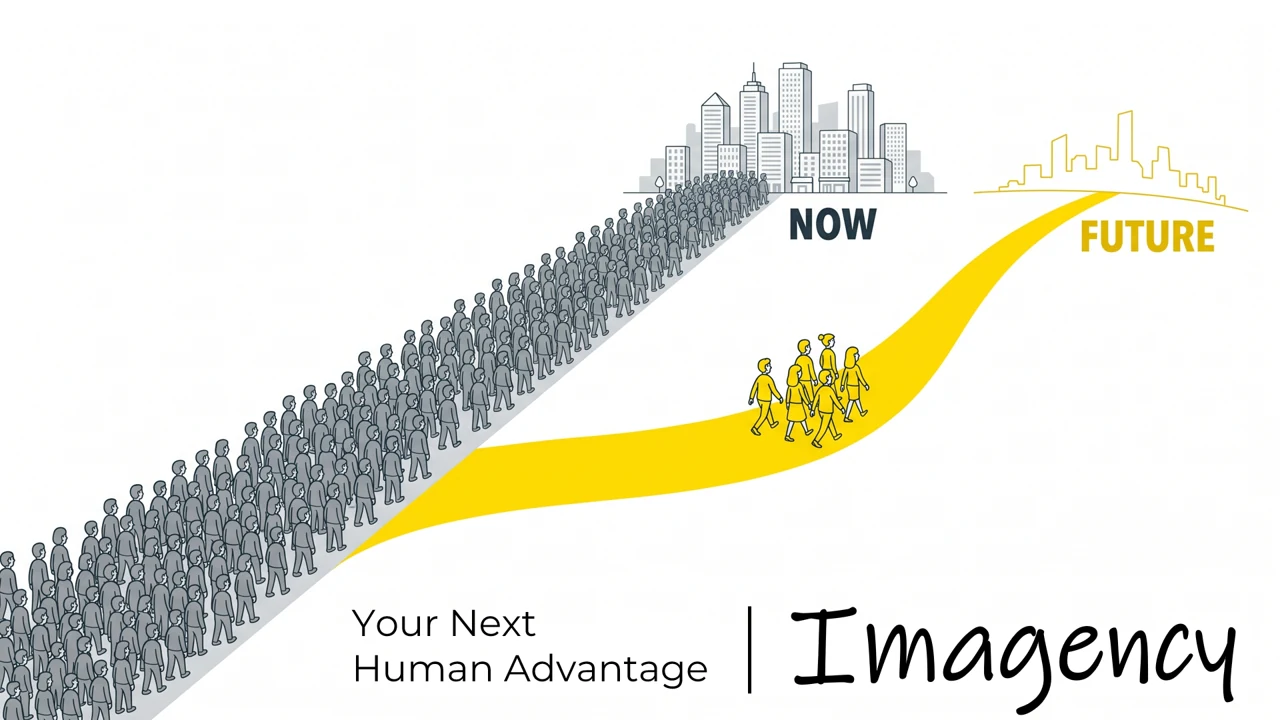
I call it Imagency. It is the fusion of two words: Imagination and Agency.
Expertise + Creativity
↓ Imagination x Agency
AI has shifted the frontier of competition from Expertise + Creativity to Imagination x Agency. Moving ahead, companies and workers will be competing with their peers at the quality of their Future Imagination and the strength of their Human Agency.
At the frantic rate of AI disrupting and reconfiguring the economy and workforce, it is no longer the smartest nor the most creative who survives. It is those who can reimagine the future most accurately and exercise human agency to get there first.
Unfortunately, in this ever more winner-takes-all economy, fast-moving winners will take an outsized share of the spoils while few places remain for the mass laggards.
In an age where the goalposts keep moving, can you score at where the goalpost will be, and not where it is now?
Ask yourself:
Future Imagination
- Can your company visualize the future industry landscape and customer demands (more accurately than competitors) and craft its play-to-win strategy to thrive in the AI-supercharged environment?
- Can you reimagine how your role and advantage will shift and reposition your career strategy in tandem to earn your relevance in the hybrid human-AI workforce? Superior imaginative capabilities will become one of the most coveted skills and important advantages of organizations and individuals, moving forward.
Human Agency
- Can your organization harness its collective will and effort to reinvent itself and work towards its play-to-win strategy?
- Can you exercise personal willpower and agility to re-invent yourself and follow through with your AI-friendly career strategy? Intense human agency is required, because transforming to the future version of your organization or yourself will be hard, painful and continuous.
If you are still competing at the level of expertise and creativity, and not imagination and agency, you may be missing the forest for the trees. Lost in the current noise about AI and not wise in the future ways of AI. Like the vast majority.
Take a breather and stand back. Look deeply at what the forest is trying to tell you and listen intently at what the signals are whispering to you. Focus your attention at what the future might be and detach it from what the present looks like. And act accordingly.
Originally published in Charlie Ang's Intelligent Reinvention Memo newsletter on LinkedIn (Issue 48).

Charlie Ang is an Intelligent Reinvention Strategist, corporate futurist and AI keynote speaker based in Singapore and speaking worldwide. He helps organisations and leaders reinvent, rewire and retool for the Age of Intelligence, and has been featured by the BBC, Financial Times, National Geographic and CNA.