 Charlie
I delivered a one-hour keynote on “Goodbye Digital Transformation, Hello Intelligent Terraformation” to Micron (America’s top memory chip maker) yesterday. In the Q&A, I answered a common burning question that surfaced: “What are the ethical signposts we should use when deploying AI?” (paraphrased).
A typical AI ethics expert would list out a set of guardrails, such as transparency, fairness, accountability, privacy, trustworthiness, explainability, and so on. These are all well and good, and necessary. Useful guiding principles when designing and deploying AI systems.
Good, but with limitations
- The set of principles is institutional speak that does not intimately relate to us as individual humans. Somewhat cold, mechanical, and detached.
- These precepts are instructive more to the system designers than to the end users, akin to a practical Developer’s Guide. The average consumer would not be familiar with AI ethics, let alone which set of ethics is adopted by their provider. It is neither their field of study nor day job as consumers.
- Is there a commonly accepted set of principles that is truly universal and can transcend major civilizations? For instance, do they implicitly encode Western Enlightenment assumptions and bias? Ethics are, after all, the expression of moral worldviews, civilizational values, and historical experiences. Western Enlightenment rationalism, Confucian social harmony, Indian dharmic pluralism, Islamic divine moral law and African Ubuntu humanism do not share the same assumptions about what is ethical. Western AI ethics assumes liberal democracy. Chinese AI ethics assumes moral collective paternalism. Indian AI ethics assumes constitutional pluralism amid diversity. Islamic AI ethics assumes divine law as sovereign. African AI ethics assumes communal interdependence.
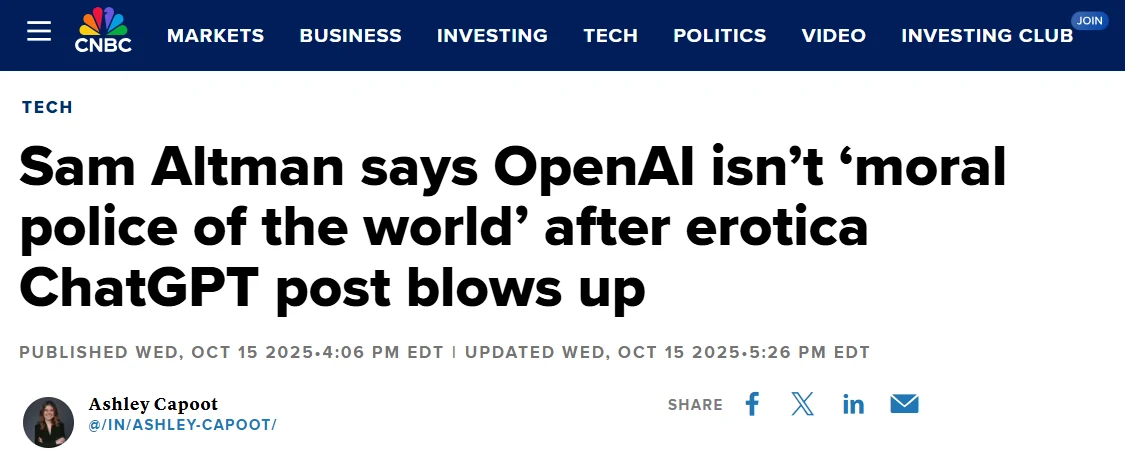
- There are moral dilemmas that fall between the cracks where the AI ethical code fails to provide useful guidance. Take OpenAI's deliberation on whether to allow erotica content in ChatGPT.
They tell us how to build AI responsibly, but not how to develop or use AI empathically.
As institutional frameworks, they do not embed empathy, love or compassion, because such qualities are difficult to implement, quantify, or audit.
We need to do Jobs-to-be-Done Analysis
How Might We create a single, short and memorable:
- Golden Rule that can transcend civilizations and cultures?
- Rule of Thumb that guides creators and consumers alike?
- Axiom that touches the very core of human heart and conscience?
Let's think Multi-Civilizational
The ancients have already solved this. Each major civilization has its own version of the Golden Rule: "Do not do to others what you do not want others to do to you":
- Western: “Do unto others as you would have them do unto you.”, Luke 6:31, The Bible
- Chinese: “Do not impose on others what you do not wish for yourself.”, Confucius, Analects 15:23 (5th c. BCE)
- Indian: “This is the sum of duty (dharma): do not do to others what would cause pain if done to you.”, Mahabharata, Anusasana Parva 113.8 (4th c. BCE)
- Islamic: “None of you truly believes until he loves for his brother what he loves for himself.”, Prophet Muhammad (Hadith, Sahih al-Bukhari & Muslim)
- African: “When I am good to you, I am good to myself.”, Shona wisdom saying
In First Principles thinking, this is a universal truth.
The main reason why the Golden Rule is so powerful is because it is empathic by nature. To adhere to it, we must step into the other person's shoes. It deeply touches the hopes, joys and pains of what it means to be human. Humanity is at its core.
My Golden Rule of AI
Ancient wisdom has provided part of the universally acceptable answer; what remains is to adapt it to AI.
Here it is:
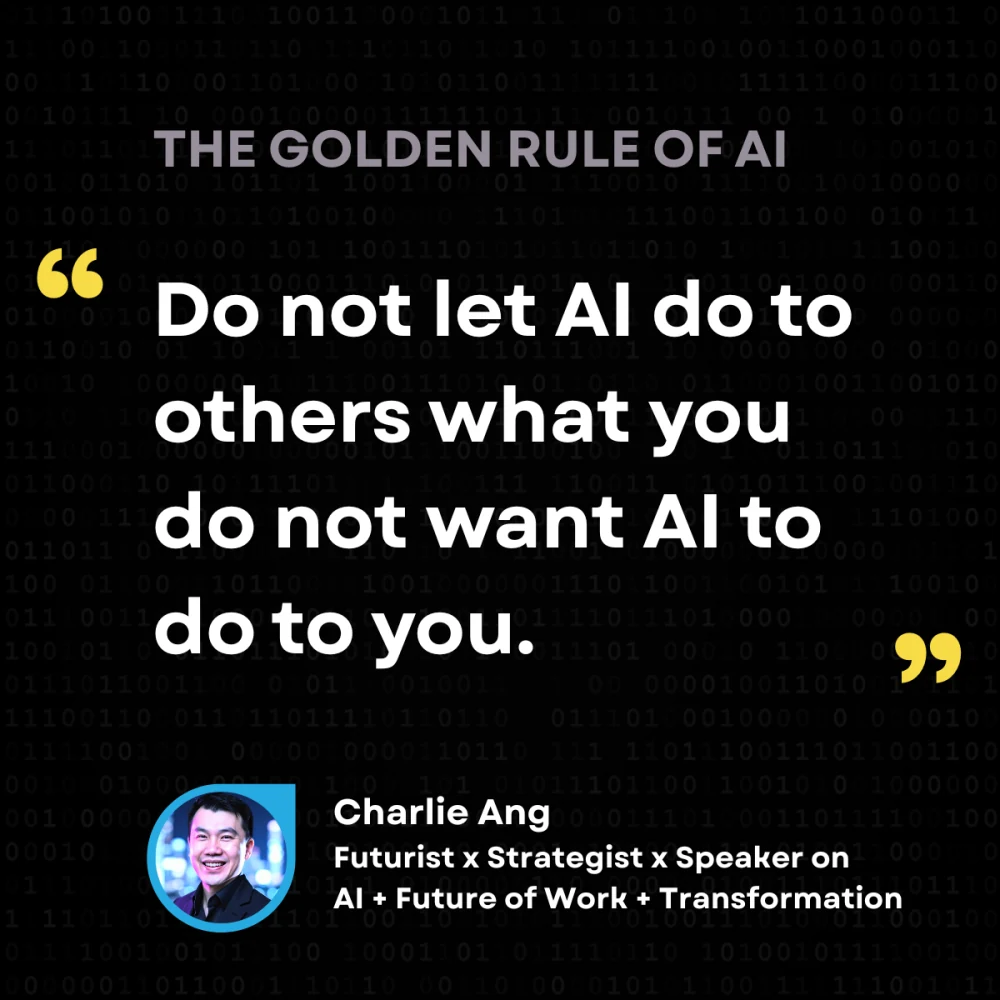
“Do not let AI do to others what you do not want AI to do to you.”
Charlie Ang's Golden Rule of AIIt is short and sticky and more encompassing than existing AI principles.
AI systems can scale to billions of people. The point for builders is not to customize AI for everyone but to exercise genuine care and consideration for those at the receiving end, as if you are in their shoes and living in their broader context. Context could mean their civilizational values, religious views, cultural norms, and economic circumstances, going beyond national laws and standard principles of AI use.
In daily use, this translates as:
- Don't build AI products that you would not let your children or grandmother use (assuming these products are targeted at their segment). Don't be the same leaders who build social media platforms that intoxicate children and then ban their own children from using them.
- If your company must automate work with AI agents and redeploy people due to competitive pressures, do it in the way that is acceptable and fair to them, as if you are one of those affected.
- As an employer procuring an AI screening solution, choose one that minimizes discrimination and biases, as if you were an under-represented or unfairly considered minority.
- Avoid using AI platforms that cause undue harm to society in pursuit of profit, as a responsible member of the society.
- When you see someone using an unsafe AI tool or consuming questionable AI-generated content unwittingly, educate or warn them.
As the last two scenarios illustrate, AI's Golden Rule can extend ethics beyond the builders and providers of such systems to ordinary people as well. As AI pervades the whole of society and encroaches into our daily lives, it is one rule that can guide both creators and consumers, as well as both our professional and personal lives.
This AI Golden Rule as the First Principle also provides decision-makers a conscience without imposing one civilization's cultural morality on another. After all, "One person’s virtue is another person’s vice".
Coming back to Sam Altman's erotica dilemma. From this lens, the choices for OpenAI are between not having this feature (i.e. the lowest common denominator), limiting it by age, customizing it according to market, and / or opting users out by default.
If you need a single rule of thumb to guide your daily AI use, whether in your professional or private lives, remember this AI Golden Rule.
Please share this rule if you like it so we can get it adopted widely.
This article is written using a multi-civilizational perspective, moral-ethical reasoning, a jobs-to-be-done mindset and first principles analysis. They are 4 of the 8 Meta-Cognitive Skills of Leadership in the AI Age.
Originally published in Charlie Ang's Intelligent Reinvention Memo newsletter on LinkedIn (Issue 29).

Charlie Ang is an Intelligent Reinvention Strategist, corporate futurist and AI keynote speaker based in Singapore and speaking worldwide. He helps organisations and leaders reinvent, rewire and retool for the Age of Intelligence, and has been featured by the BBC, Financial Times, National Geographic and CNA.