 Charlie
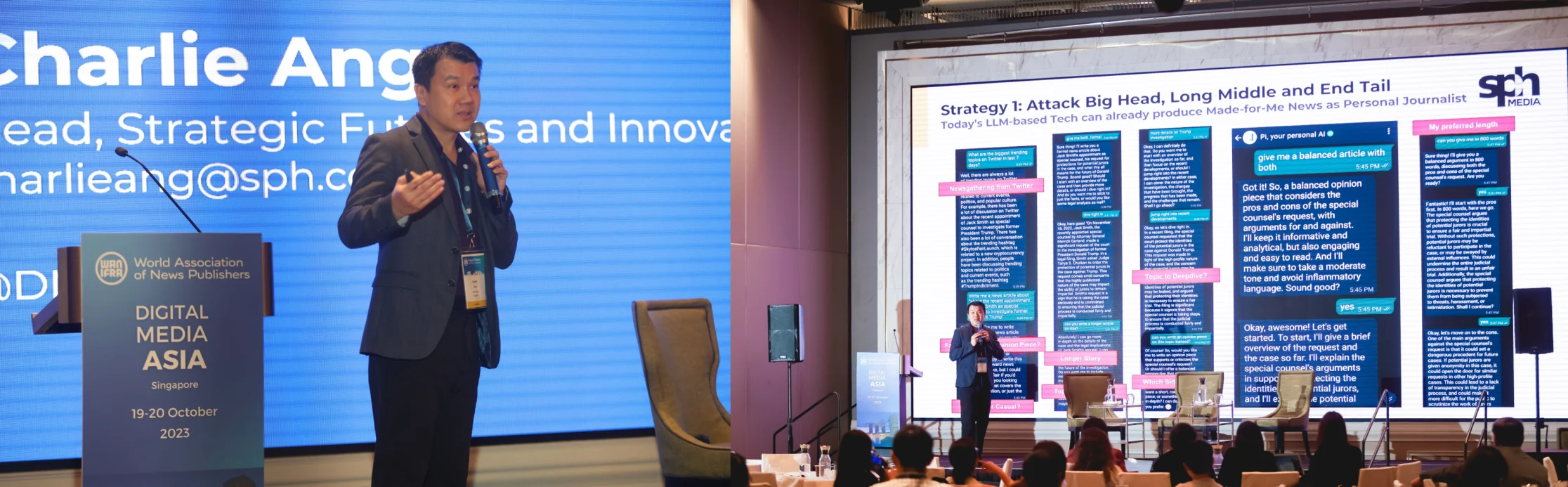
In October 2023, I delivered the closing keynote at the Digital Media Asia Conference, organized by the World Association of News Publishers (WAN-IFRA). My topic was “The Future of News Media in the Age of AI”. At that time, ChatGPT had been out for nearly a year, but its most disruptive impact was still poorly articulated, let alone fully understood. Even till now.
The real disruption goes far beyond news media. It extends into content, marketing, and services: industries built on mass distribution and broad segmentation. If you operate in any of these fields, the AI shift will fundamentally alter the way you create, sell, and deliver value.
In this issue, I will extend my thesis from News Media to the broader Content, Marketing and Services space, under the expanded title of my keynote.
The Big Flip in Content
The content publishing industry did not exist before 700 CE. Contrary to popular belief, printing was not invented by Johannes Gutenberg in the 1440s. Printing first appeared in China using the woodblock method, and the oldest known printed book, the Diamond Sutra, dates back to 868 CE. This innovation was made possible by the combination of two breakthroughs: printing itself and paper, which was also invented in China around 200 CE.
Before printing, communication was restricted to one-to-few interactions, whether through verbal exchanges or hand-copied manuscripts. The invention of printing revolutionized knowledge distribution, transforming it into a one-to-mass multiplier that democratized information at an unprecedented speed and scale.
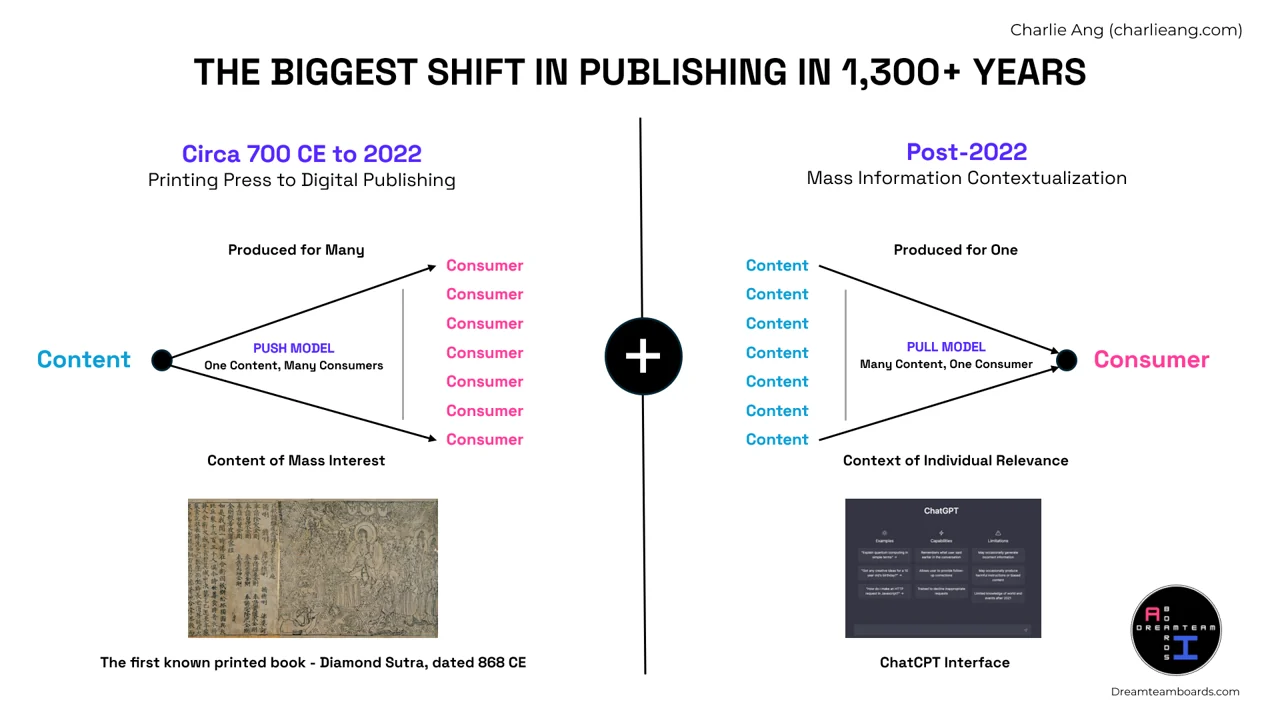
ChatGPT represents the biggest revolution in publishing since the birth of the industry. For most users, it was their first direct encounter with AI. However, what many overlooked was the fundamental shift in publishing: for the first time in history, content was being produced individually for each consumer. Not for a group of people. Not for a segment of consumers. For one person.
Content was once king; now, it has to play the queen to King Context.
GenAI has completely flipped the 1,300-year-old “one-to-mass” publishing model on its head, to a “mass-to-one” paradigm. Consumers no longer settle for generic “Made-for-We” content. They demand personalized “Made-for-Me” content. Content publishers will still have an essential role moving forward, but increasingly, the value will have to be shared, and they will have to fight for attention, with AI-centric content contextualizers.
Large Language Model (LLM) chats are infinitely more useful than Google searches, not because they function as better search engines, but because they contextualize knowledge for the individual user. Google aggregates content from publishers, but it does not contextualize it, forcing users to self-bridge the gap between generic information and personal relevance.
The lack of content contextualization leaves value on the table. Consider the consequences of uncontextualized information: buying the wrong product, selecting an ineffective medical treatment, going on an incompatible date, attending an irrelevant training course, accepting the wrong job offer, or choosing a sport unsuitable for your child. The cost of these misguided decisions is a direct result of content failing to align with the user’s specific context.
The Holy Grail of Marketing
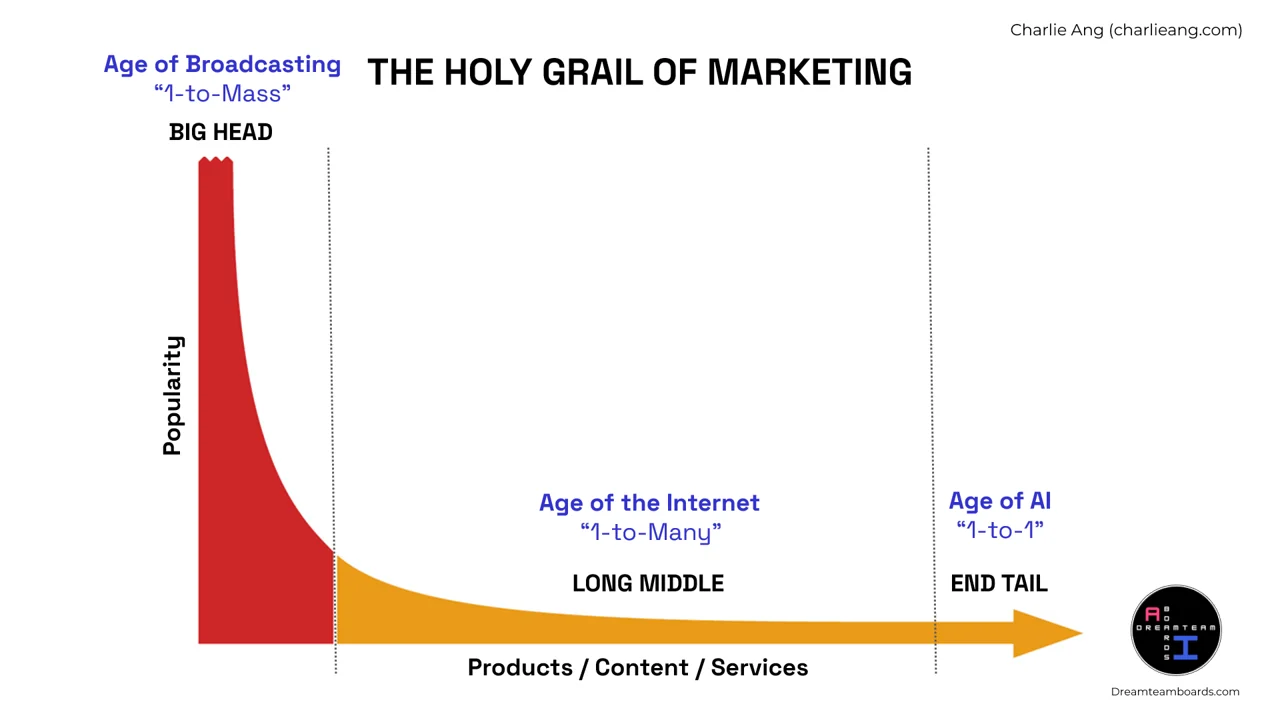
In the same vein, marketing was one-to-mass during the broadcast era of television, radio, and newspapers. The Internet age proliferated one-to-many marketing, through targeted advertising and niche messaging to micro-segments. In the AI era, marketers will finally achieve the holy grail of one-to-one marketing: the End Tail of One, where each customer receives a marketing experience uniquely crafted for them, in real time.
The pace of adoption will depend on when the benefits of hyper-personalization outweigh its costs. When that tipping point is reached, marketing as we know it will fade. It will no longer be about pushing messages. It will be about AI curating, anticipating, and delivering seamless, hyper-relevant experiences to satisfy the needs and whims of every individual.
The Service Package of One
Whether it’s a family trip to Disneyland, subscribing to a SaaS solution, booking a hotel room, or opening a bank account, we are typically offered off-the-shelf service packages with standard pricing. This is yet another example of lazy, segment-based targeting and pricing, where broad categories take precedence over individual needs.
Take hotel booking as an example. What if I arrive in the city past midnight? Under the current model, I would still be required to pay for a full night’s stay, even though I’m only using the room for a fraction of the time. In the future, AI-driven conversational chatbots will dynamically adjust pricing based on my actual arrival and departure schedule, along with other specific preferences, such as a high-floor room or a specific view.
This is the Package of One: a fully personalized service model.
Hotels that fail to adopt bespoke service and pricing customization will inevitably lose business to those that do. Personalization reclaims value that was left on the table. Happier customers, a more profitable business.
The natural question then arises: How can a hotel manage the operational complexity of mass personalization while still maximizing profitability? The answer lies in the next-generation intelligent enterprise system that integrates customer experience, dynamic pricing, service inventory, workforce management, and operational planning.
The Future Immutability of Content, Marketing, and Services
In the future, content, marketing, and services will no longer be separate functions. They will merge into a single, intelligent ecosystem that redefines the customer journey: from brand awareness to discovery, purchase, fulfillment, and post-sale engagement.
These processes can no longer operate in isolation. They must collapse into a unified function, optimized in real time for each individual customer.
Imagine a typical hotel experience in the future:
Instead of searching through listings, a traveler engages a hotel group’s AI conversational interface. The AI asks about preferences, budget, and special requests, dynamically making recommendations for local hotels, suggesting upsells, and calculating the best rate based on real-time availability and demand. The traveler receives a fully customized package, optimized for arrival time, length of stay, and amenity preferences. Upon arrival, the hotel’s smart check-in system recognizes the guest immediately. The room is pre-configured to match past stay preferences: preferred temperature, lighting, minibar selections, and pillow type.
Throughout the stay, the AI concierge proactively recommends dining options, spa bookings, or gym reservations, based on real-time preferences and needs. When it’s time to leave, the AI handles checkout, splits charges as needed, applies loyalty points automatically, and follows up with a personalized rebooking offer.
This is not a hypothetical future. This is the inevitable direction of business transformation, not just in hospitality but just about any service industry. Be it financial services, airlines, transport, tourism, healthcare, lifestyle, wellness, food & beverage, sports, or live entertainment.
The 6th generation, AI-first companies, known as the Intelligence Symphonies, will lead the way.
Originally published in Charlie Ang's Intelligent Reinvention Memo newsletter on LinkedIn (Issue 9).

Charlie Ang is an Intelligent Reinvention Strategist, corporate futurist and AI keynote speaker based in Singapore and speaking worldwide. He helps organisations and leaders reinvent, rewire and retool for the Age of Intelligence, and has been featured by the BBC, Financial Times, National Geographic and CNA.