 Charlie
In the age of intelligence abundance, companies must transform at full speed or risk sliding into sudden obsolescence. The digital graveyards are littered with once-indomitable household names that were caught napping.
Transformations are as much about culture as they are about strategy.
Culture transformation should precede strategic transformation; otherwise the latter will fall flat. The right culture is the tailwind for strategy formulation and execution, while the wrong culture is the headwind.
There are four cultural syndromes that are leading predictors of which companies will and will not make the cut in this AI round.
The Four Horsemen of Disruption
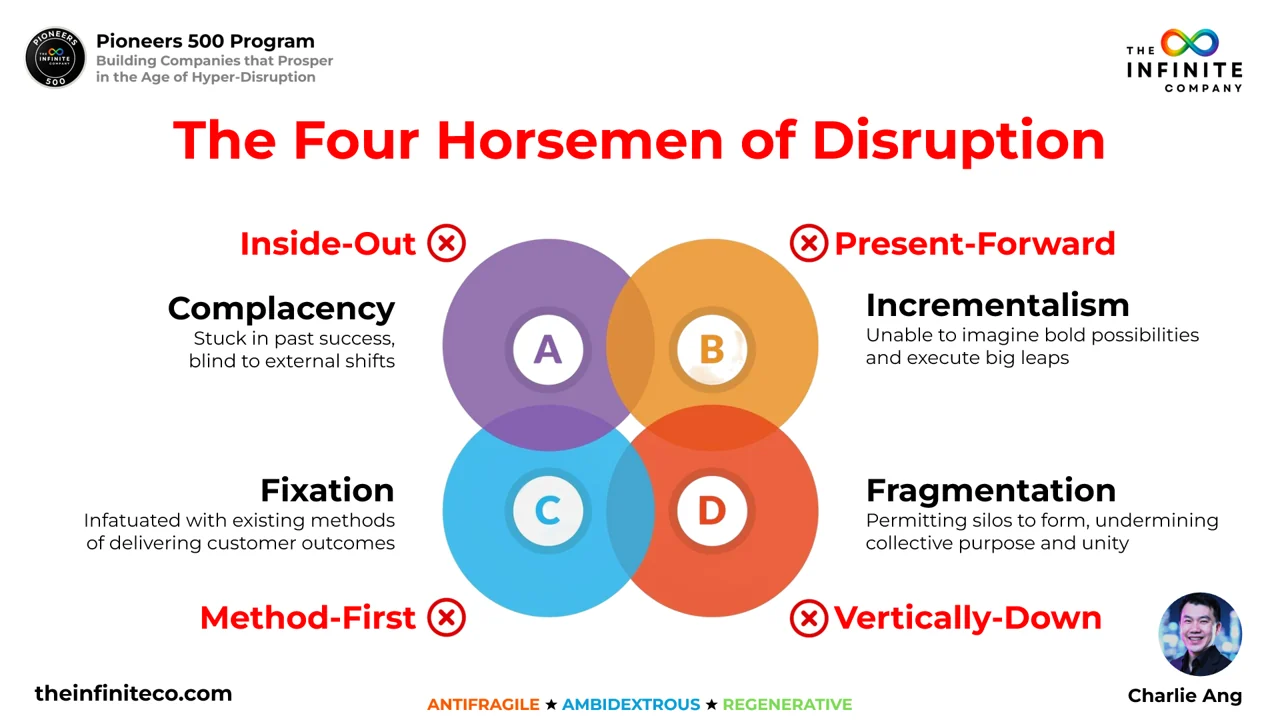
Companies that exhibit one or more of these overlapping afflictions are at high risk.
Horseman 1: Complacency
Symptoms: Firms with long histories of success that survived past disruptions. Past glories lull them into thinking “this time is no different”, “we have seen it all before” or “we have loyal customers willing to pay a premium for our products”.
Leaders who navel-gaze, lose sight of external developments, and miss the ball at game-changing junctures.
Horseman 2: Incrementalism
Symptoms: Companies lacking adventurism and imagination. They have never reinvented their business because their industry was shielded from prior waves of disruption. Good at evolutionary product improvements and cost reductions, but untested in bold reinvention.
Leadership teams who strategize from today outward, leaving them blindsided by industry and technological discontinuities when they hit.
Horseman 3: Fixation
Symptoms: Businesses suffering from functional, cognitive or structural fixedness. They cannot see beyond existing products for existing customers, nor pioneer new solutions for new needs. They end up as defensive plays, sacrificial lambs waiting for disruptors to walk through the door.
Product teams that fall in love with their own products instead of being obsessed with customer outcomes.
Horseman 4: Fragmentation
Symptoms: Companies with competitive internal cultures, fragmented power structures and hardened operating silos. Senior executives guard their turf and prioritize fiefdoms over organizational goals. Time and energy are wasted on infighting and politics, sapping focus from whole-of-organization transformation.
Organizational silos that cascade from top to bottom of hierarchy, splintering corporate goals into competing agendas.
Conclusion
Fallen giants such as Sears, Intel, Circuit City, NEC, Philips, Casio, JVC, Blockbuster, Kodak and Borders all suffered from these chronic blockers to some degree, impairing their ability to innovate boldly and rapidly.
Trust me, these horsemen are more common than rare in organizations of every size.
Whilst waiting for the full AI stack to mature and the intelligence constellation to align, this is the opportune window to reset culture and get fit for the long sprint ahead.
How do you override these four horsemen?
Originally published in Charlie Ang's Intelligent Reinvention Memo newsletter on LinkedIn (Issue 25).

Charlie Ang is an Intelligent Reinvention Strategist, corporate futurist and AI keynote speaker based in Singapore and speaking worldwide. He helps organisations and leaders reinvent, rewire and retool for the Age of Intelligence, and has been featured by the BBC, Financial Times, National Geographic and CNA.