 Charlie
From Western-centric global order to a pluralistic, balanced and cooperative international system fit for the 21st century.
The world is becoming multipolar. But the international system remains largely designed for a world that no longer exists.
The modern international order was shaped by two defining historical moments: the aftermath of World War II in 1945 and the end of the Cold War in 1991.
The first produced the United Nations, the Bretton Woods institutions and a security architecture heavily influenced by the victorious powers. The second ushered in an era of unprecedented American predominance and the global expansion of Western political, economic and institutional models.
Both arrangements delivered important benefits. They also embedded historical power asymmetries, institutional privileges and assumptions about political legitimacy that are increasingly contested.
Today, China has re-emerged as a major centre of economic and geopolitical power. India is asserting its global influence. The Global South is demanding greater representation. Regional powers are pursuing more independent strategies.
The expansion of BRICS illustrates these shifting dynamics. Yet the rise of new powers does not automatically produce a fairer or more stable international system.
Multipolarity describes how power is distributed. It does not tell us how that power should be exercised.
A multipolar world can become more balanced, representative and cooperative. Or it can descend into rival blocs, competing spheres of influence, arms races and great-power confrontation.
The critical question is therefore not simply who will dominate the next international order.
It is whether we can reinvent the international system so that domination itself becomes less necessary, less attractive and less feasible.
To answer this, we must return to first principles.
The Old Model: An International System Built on Historical Power
Much of today's international architecture reflects five inherited assumptions:
- Power determines privilege. The strongest states enjoy disproportionate influence over international decisions, institutions and enforcement.
- Western experience provides the default model. Political concepts and governance arrangements shaped significantly by European and American history are frequently presented as universally applicable.
- Security comes from superior power. Military dominance, alliances and deterrence are treated as central instruments of international stability.
- Global governance depends on established institutions. Organisations created for earlier geopolitical realities remain the principal mechanisms of international coordination.
- Cooperation requires convergence. Deeper international integration is often associated with harmonising rules, institutions and political or economic practices.
These assumptions are increasingly inadequate.
The United Nations itself acknowledges that global institutions must adapt to contemporary geopolitical realities. Its 2024 Pact for the Future commits members to more representative global governance and Security Council reform.
But institutional reform alone is insufficient.
We must rethink the underlying logic of the international system, not merely redistribute seats around the same table.
Imagine the International System in 2035
Imagine a world where the United States, China, India, Europe and multiple regional powers coexist without any single civilisation or political system claiming exclusive authority to define humanity's future.
Countries retain different political philosophies, institutional arrangements and development pathways.
A liberal democracy, a constitutional monarchy and a meritocratic one-party state do not need to become politically identical to participate in a functioning international system.
Instead, they coexist under shared obligations concerning sovereignty, peaceful dispute resolution, international commitments and fundamental human dignity.
Global institutions reflect contemporary economic and demographic realities rather than the balance of power in 1945.
International cooperation operates through flexible networks and overlapping institutions. Different countries lead different initiatives according to their capabilities, interests and legitimacy among participants.
Great powers compete economically and technologically, but cooperation on climate change, pandemics, financial stability and AI safety continues even amid geopolitical rivalry.
Smaller states can pursue strategic autonomy rather than being forced into exclusive geopolitical camps.
No country enjoys unrestricted rights to intervene in another's affairs simply because it possesses greater military, economic or ideological power.
And no civilisation claims a monopoly over the political arrangements best suited to every society.
This is not a world without conflict or competition.
It is a world designed to manage both without requiring universal political conformity or permanent geopolitical dominance.
What first principles could make such a system possible?
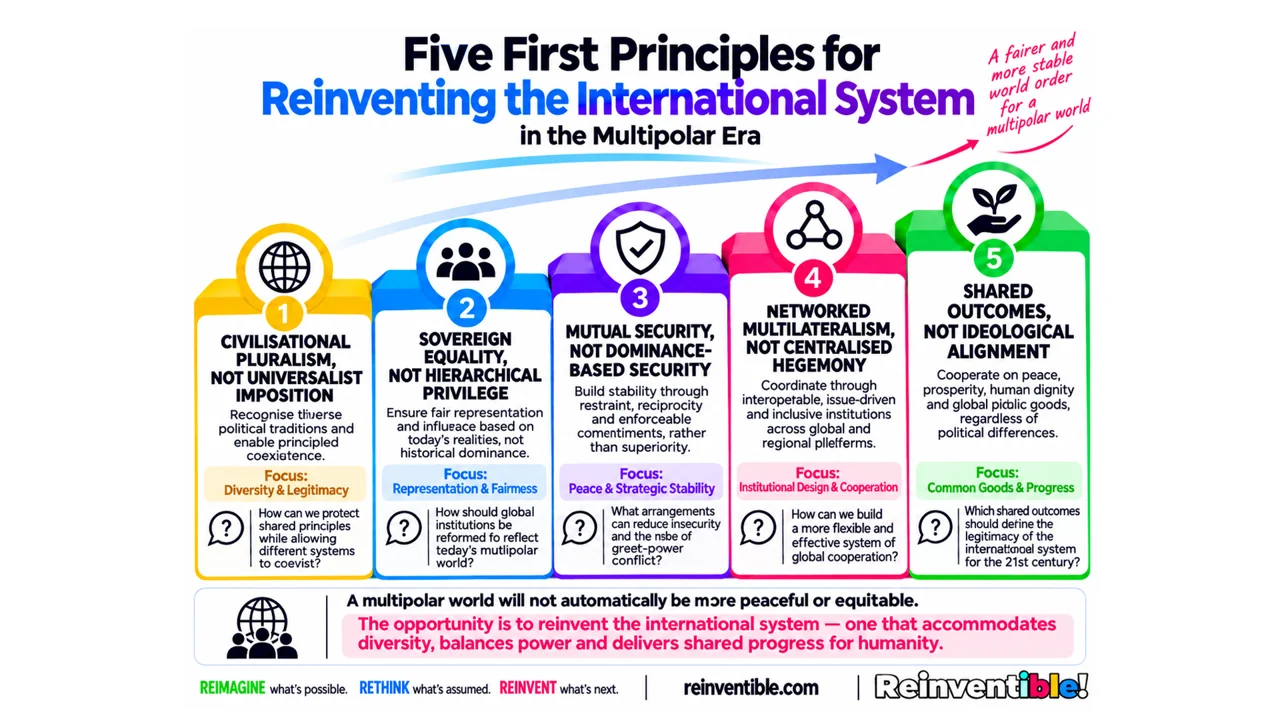
Principle 1: Civilisational Pluralism, Not Universalist Imposition
Legitimacy and diversity
Every civilisation possesses its own historical experiences, social philosophies, values and institutional traditions.
Western liberal democracy emerged from particular historical circumstances, just as China's Confucian-influenced statecraft, India's pluralistic traditions and other political systems evolved through different civilisational trajectories.
These traditions are not static or internally uniform. Nor should historical distinctiveness provide immunity from scrutiny.
But we must challenge the assumption that one civilisation's historical evolution represents the inevitable destination for all others.
Political legitimacy can draw on different combinations of electoral consent, constitutional accountability, institutional competence, public participation and demonstrated performance.
That does not make every government equally legitimate, or every practice acceptable.
It means distinguishing genuinely shared principles of human dignity from particular institutional prescriptions.
A reinvented international system should establish common obligations while allowing substantial diversity in how societies organise political authority.
From demanding political uniformity to enabling principled coexistence across different civilisational and institutional models.
Principle 2: Sovereign Equality, Not Hierarchical Privilege
Power and representation
If the international system exists to govern relations among sovereign states, why should some states enjoy institutional privileges permanently denied to others?
The UN Charter recognises sovereign equality. Yet the Security Council's permanent membership and veto structure institutionalise the geopolitical settlement of 1945.
Major international financial institutions also contain voting arrangements that give disproportionate influence to certain economies.
Sovereign equality need not mean identical voting power in every institution. Different responsibilities, contributions and exposure to risks can justify differentiated roles.
But those differences should be transparent, reviewable and proportionate, rather than inherited indefinitely.
A reinvented system would:
- Reform the UN Security Council to improve representation, especially for Africa and other underrepresented regions.
- Rebalance global financial governance according to contemporary economic realities.
- Constrain the arbitrary exercise of great-power privileges.
- Strengthen meaningful representation for small and middle powers.
From permanent entitlements rooted in historical dominance to legitimate influence grounded in representation, responsibility and accountability.
Principle 3: Mutual Security, Not Dominance-Based Security
Peace and strategic stability
A central paradox of international relations is that one nation's pursuit of greater security can make another nation feel less secure.
Military expansion, alliance enlargement, strategic encirclement and technological superiority may reassure one side while increasing fear and insecurity on the other.
This is the classic security dilemma.
In a multipolar world, attempts to achieve absolute security through overwhelming dominance can generate precisely the instability they seek to prevent.
A reinvented security architecture must acknowledge that enduring security is relational.
It should prioritise:
- Reciprocal threat reduction and military transparency.
- Crisis communication and confidence-building mechanisms.
- Arms control across nuclear, cyber, space and AI-enabled warfare.
- Regional security arrangements that account for the legitimate concerns of multiple parties.
- Credible collective responses to aggression, without granting any great power unrestricted spheres of influence.
Mutual security does not require trusting every rival. Deterrence and defensive alliances remain necessary where threats are real.
But sustainable peace requires more than superior military capabilities.
It requires arrangements under which states have fewer incentives to threaten one another.
From pursuing security primarily through superiority over others to building security through credible restraint, reciprocity and enforceable commitments.
Principle 4: Networked Multilateralism, Not Centralised Hegemony
Institutions and coordination
Why should effective international cooperation depend on one dominant power, one institution or one rigid geopolitical alignment?
Different global challenges require different participants, expertise, capabilities and institutional arrangements.
Climate change requires broad international coordination.
AI safety requires cooperation among governments, technology developers, scientific institutions and civil society.
Regional security challenges demand regional knowledge and participation.
Trade, finance and infrastructure benefit from institutions capable of connecting diverse economic systems.
A reinvented international system would function more like an interconnected network than a rigid hierarchy.
The United Nations would remain a central source of universal legitimacy and international law, while regional organisations, specialised institutions and issue-specific coalitions would undertake complementary responsibilities.
Participation could vary by issue without requiring exclusive geopolitical allegiance.
Yet networked cooperation must not become a convenient excuse for powerful states to bypass international law or exclude weaker countries.
Its success depends on interoperability, transparency, accountability and coordination.
From international cooperation organised around dominant centres of power to distributed, interoperable and purpose-driven governance networks.
Principle 5: Shared Outcomes, Not Ideological Alignment
Cooperation and collective progress
Ultimately, what is the international system for?
Is its purpose to maximise the influence of particular powers, promote specific ideologies or expand institutional membership?
Or is it to enable countries and peoples to coexist peacefully, prosper and address challenges that no state can solve alone?
From first principles, the legitimacy of the international system should rest substantially on its ability to deliver shared outcomes.
These include:
- Reducing the risk of major-power war and armed conflict.
- Expanding prosperity and equitable development opportunities.
- Protecting fundamental human dignity.
- Managing cross-border threats and global public goods.
- Preserving an inhabitable planet and protecting future generations.
Countries need not agree on every political philosophy to cooperate on such outcomes.
Rival powers can disagree over domestic governance while collaborating on pandemic preparedness. Competing economic systems can negotiate common standards for critical infrastructure. Geopolitical adversaries can establish safeguards against catastrophic AI failures.
Common outcomes do not erase disagreements over values. Some disputes concern fundamental rights and cannot be reduced to technical compromise.
But international cooperation should not be held hostage to the expectation of comprehensive ideological agreement.
From measuring international solidarity by ideological conformity to building cooperation around substantive, verifiable benefits for humanity.
What This Means for World Leaders
The transition to multipolarity is not the same as the creation of a better international order.
A world with five competing great powers is not necessarily more peaceful, equitable or legitimate than one dominated by a single superpower.
Indeed, history reminds us that multipolar competition can generate devastating conflict when strategic rivalry overwhelms institutional restraint.
The objective must therefore be something more ambitious than multipolarity.
It must be a genuinely pluralistic international system that combines diversity of political systems with universality of fundamental obligations.
This requires five changes in how world leaders think.
First, recognise that civilisational diversity is a permanent feature of humanity, not a temporary obstacle to eventual political convergence.
Second, accept that geopolitical influence must evolve alongside global realities, rather than remain permanently anchored in historical victories and institutional privileges.
Third, understand that lasting national security cannot be achieved independently of other nations' security, even when military deterrence remains essential.
Fourth, design global governance as an adaptive network, combining universal institutions with regional and issue-specific cooperation.
Finally, judge the international system by the peace, prosperity, dignity and resilience it delivers, not by the extent to which other nations adopt any single power's worldview.
None of this requires abandoning international law, human rights or the principle that governments should be accountable to the people they govern.
It does require distinguishing broadly applicable principles from historically contingent political models, and applying common rules consistently rather than selectively.
The greatest danger of the emerging multipolar era is that we replace one form of dominance with several competing forms of dominance.
The greatest opportunity is to build a system in which multiple centres of power, diverse civilisations and different political traditions can coexist within a shared framework of responsibility.
In September 2026, UN Secretary-General António Guterres similarly argued for networked multipolarity, combining multiple centres of influence with international law and effective multilateral institutions.
But moving from that aspiration to reality will demand far more than diplomatic declarations. It will require institutional reform, reciprocal restraint and a willingness by both established and emerging powers to accept limits on their own freedom of action.
The future international system should not be about making the world more Western, more Chinese or more beholden to any great power.
It should be about making the world more capable of accommodating its diversity while securing humanity's shared future.
That is the real opportunity to reinvent the international system for the multipolar era.
Originally published in Charlie Ang's Intelligent Reinvention Memo newsletter on LinkedIn (Issue 65), part of his "First Principles in the AI Age" series.

Charlie Ang is an Intelligent Reinvention Strategist, corporate futurist and AI keynote speaker based in Singapore and speaking worldwide. He helps organisations and leaders reinvent, rewire and retool for the Age of Intelligence, and has been featured by the BBC, Financial Times, National Geographic and CNA.