 Charlie
Rethinking the architecture of the enterprise for an intelligence-abundant world
Most organizations today are still designed around assumptions inherited from the industrial age.
Work is divided into functions. People are grouped into departments. Authority flows through hierarchies. Managers supervise employees. Organizational capacity is measured in headcount. Structures remain relatively fixed until the next restructuring exercise.
This model was not irrational.
It evolved in a world where human expertise was scarce, information moved slowly, coordination was expensive, and most productive work had to be performed by people.
Functional specialization created efficiency. Hierarchies enabled control. Departments concentrated expertise. Managers coordinated work. Headcount determined capacity.
But AI is fundamentally changing these underlying constraints.
Intelligence is becoming abundant and increasingly accessible.
AI agents can execute tasks, coordinate workflows and make bounded decisions.
Small teams can command capabilities that previously required entire departments.
Human and machine capabilities can be combined, scaled and reconfigured in ways that were previously impossible.
Yet many companies are simply inserting AI into organizational structures designed for a very different world.
They automate tasks within existing departments, deploy copilots to existing employees and introduce AI agents into existing workflows.
These may deliver productivity improvements.
But they leave the fundamental architecture of the organization largely unchanged.
The real opportunity is not to make the traditional organization more efficient. It is to rethink what an organization should look like when intelligence is no longer scarce and humans are no longer the only productive agents.
If we were designing an enterprise from scratch for the AI era, would we still organize it around functional silos, human headcount, managerial supervision and permanent departments?
Probably not.
We need to return to first principles.
Here are five.
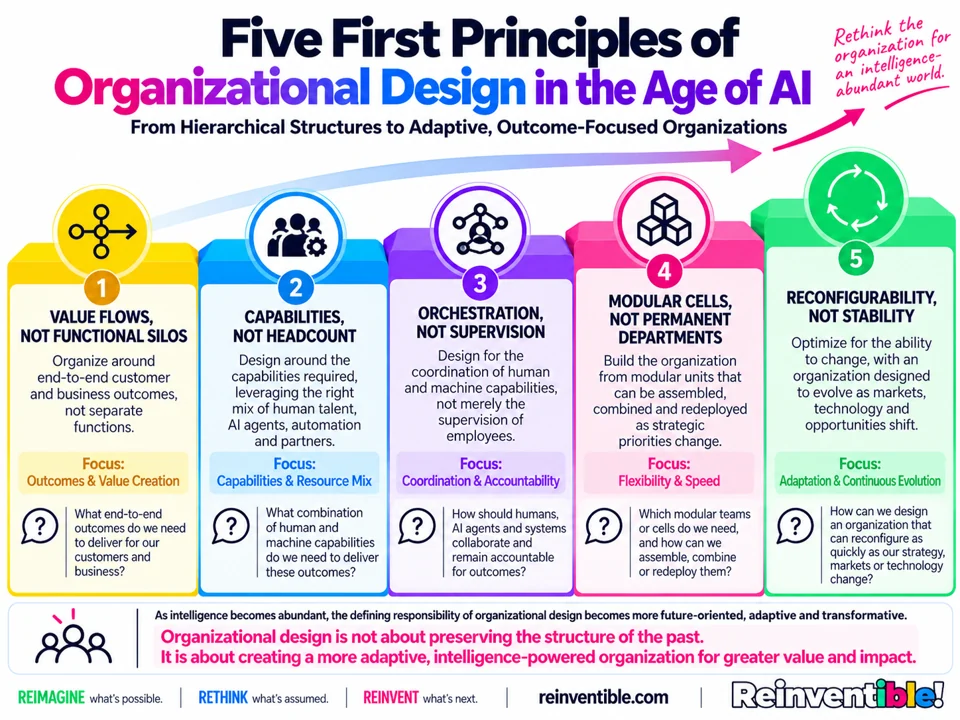
Principle 1: Value Flows, Not Functional Silos
Organize around outcomes to be delivered, not functions to be performed.
Traditional organizations are structured primarily around functional specialization.
Marketing does marketing. Finance does finance. Technology does technology. Operations does operations.
This arrangement concentrates expertise and creates functional efficiencies.
But it also fragments accountability for outcomes.
Consider a bank customer trying to obtain a mortgage.
The customer's objective is straightforward: secure appropriate financing quickly, affordably and reliably.
Yet fulfilling that objective may require interactions across sales, credit assessment, risk, compliance, legal, technology and operations.
Each function has its own priorities, processes, systems and performance indicators.
The customer outcome is divided across organizational boundaries.
Coordination becomes an activity in itself.
AI offers an opportunity to rethink this arrangement.
Instead of designing the organization primarily around functional expertise, we can design it around end-to-end value flows.
These might include customer acquisition, product development, order fulfilment, claims resolution, customer retention or other outcomes the enterprise exists to deliver.
Cross-functional teams, supported by AI agents and shared enterprise capabilities, can assume responsibility for complete outcomes rather than isolated activities.
Functional expertise does not disappear. It becomes a shared capability serving the value flows.
The organizing logic shifts from specialization of activities to ownership of outcomes.
The first-principles shift
From: Grouping people who perform similar activities.
To: Organizing capabilities around the end-to-end creation of customer and business value.
If we organized entirely around the outcomes our customers and business need, what would our organization look like?
Principle 2: Capabilities, Not Headcount
Design around the capabilities required, not the number of people employed.
Traditional organizational design assumes that work requires people.
When a company needs more sales capacity, it hires salespeople.
When customer service demand increases, it adds service representatives.
When analytics requirements grow, it recruits more analysts.
Organizational capacity is therefore closely associated with headcount.
This assumption is increasingly outdated.
AI introduces an entirely new category of organizational capability: intelligent systems that can reason, analyze, create, interact and execute work.
An AI-native enterprise may draw on five sources of productive capability:
- Human professionals, contributing judgement, creativity, relationships and accountability.
- AI copilots, augmenting individual human capabilities.
- AI agents, executing increasingly complex workflows and bounded decisions.
- Automation and digital platforms, delivering standardized execution at scale.
- External partners and ecosystems, providing specialized or complementary capabilities.
The design challenge is no longer simply determining how many people are needed.
It is determining the optimal combination of these capabilities to create the desired outcomes.
Consider a marketing function.
Traditionally, expanding its capabilities might require additional researchers, analysts, content creators, designers, campaign managers and coordinators.
An AI-native marketing capability could be assembled from a smaller human team supported by specialized AI agents, automated workflows, shared data platforms and external creative partners.
The result need not resemble a conventional marketing department.
This does not mean every activity should be automated or every team should be smaller.
Some activities will still depend heavily on human expertise, trust, empathy and judgement.
Others may require more human capacity as AI expands the business.
The fundamental shift is that human headcount is no longer the default building block of organizational capacity.
The first-principles shift
From: Designing positions and staffing them with people.
To: Assembling human, AI and ecosystem capabilities to deliver outcomes.
If we could access any combination of human and machine capabilities, how would we redesign the work and resources required?
Principle 3: Orchestration, Not Supervision
Design for the coordination of human and machine capabilities, not merely the supervision of employees.
Traditional organizations rely heavily on managerial hierarchies to coordinate work.
Managers assign tasks, monitor progress, resolve dependencies, approve decisions and ensure accountability.
This model assumes that productive contributors are predominantly human employees.
But what happens when a growing proportion of work is performed by AI agents and automated systems?
Imagine an insurance claims operation where:
An AI agent receives and interprets a claim.
Another verifies documentation.
A third evaluates policy coverage.
A fraud detection system assesses anomalies.
A human specialist handles ambiguous or sensitive cases.
An automated workflow executes approved payments.
The organizational challenge is no longer simply supervising individual employees.
It is orchestrating an interconnected system of human and machine contributors.
This requires a different coordination architecture.
- Clear outcomes and accountability.
- Defined decision rights.
- Interoperable systems and workflows.
- Shared data and contextual intelligence.
- Explicit human intervention and escalation rules.
- Real-time monitoring, auditability and governance.
Importantly, orchestration does not mean removing human accountability.
As autonomous systems perform more work, the need for clear ownership of outcomes, risk and exceptions becomes even more important.
Neither does it imply that all decisions should be decentralized.
Some decisions require enterprise-wide oversight. Others can be delegated to frontline teams or AI agents operating within defined boundaries.
The organizational design challenge is to establish where decisions happen, how contributors interact, and how accountability is maintained across the entire system.
Hierarchical supervision becomes only one of several coordination mechanisms.
The first-principles shift
From: Coordinating work through managerial authority and employee supervision.
To: Orchestrating networks of humans, AI agents and systems around shared outcomes.
How would we coordinate work if most routine execution and coordination could be handled by intelligent systems?
Principle 4: Modular Cells, Not Permanent Departments
Structure the organization as recombinable units, not rigid functional hierarchies.
Traditional organizations are built around relatively permanent departments.
Each department has its own leadership, headcount, budget, resources and responsibilities.
This provides continuity and clarity.
But it can also create rigidity.
When strategy changes, organizational resources cannot always move easily with it.
New opportunities require cross-functional committees, additional reporting relationships, matrix structures or major restructuring exercises.
The organization becomes constrained by its own architecture.
AI creates the possibility of a more modular model.
Imagine an enterprise composed of relatively autonomous organizational cells.
Each cell has a defined outcome, appropriate decision rights and access to the human and machine capabilities it requires.
One cell might focus on acquiring a specific customer segment.
Another might develop a new product.
A third might manage an end-to-end service journey.
These cells do not need to own every capability internally.
They can draw on shared enterprise platforms, specialist expertise, AI agents, common data infrastructure and external ecosystem partners.
The organization becomes a network of interoperable units rather than a collection of isolated departmental empires.
Cells can be established, combined, expanded, redeployed or retired as strategic priorities evolve.
This resembles the logic of modular systems architecture.
Individual components have clear purposes and interfaces, but can be assembled into different configurations.
However, modularity does not mean fragmentation.
Without shared standards, governance, technology interfaces and strategic direction, autonomous cells can simply become a new generation of silos.
The objective is autonomy with interoperability.
The first-principles shift
From: Permanent departments owning fixed people, budgets and resources.
To: Modular organizational cells drawing on shared capabilities to deliver distinct outcomes.
If our enterprise were built from interchangeable and interoperable organizational units, how would we assemble them?
Principle 5: Reconfigurability, Not Stability
Design the organization for continuous adaptation, not structural permanence.
For decades, organizational design has largely been treated as a periodic exercise.
A company establishes its strategy.
Consultants or executives design an appropriate structure.
Reporting lines change.
Departments are merged or separated.
Positions are created or eliminated.
The new organization then operates until another significant change becomes necessary.
The implicit objective is to find a relatively stable structure suited to the strategy.
But in an environment of accelerating technological and competitive change, structural stability can become a liability.
Business models change.
Customer expectations evolve.
Entire activities become automatable.
New AI capabilities emerge.
Competitive advantages erode.
Yet organizational structures often change far more slowly.
The fundamental design objective must therefore evolve.
The best organizational structure may no longer be the one that is optimal today, but the one that can adapt most effectively tomorrow.
An AI-native organization should be designed with reconfigurability built into its architecture.
That means capabilities can be reassigned without lengthy restructuring.
Teams can be assembled around emerging opportunities.
Human and AI responsibilities can evolve as technology improves.
Decision rights can shift as systems become more capable and trustworthy.
Organizational boundaries can change without disrupting the entire enterprise.
AI itself can support this capability.
Intelligent systems can help map work, identify bottlenecks, analyze organizational dependencies, simulate structural alternatives and detect emerging capability gaps.
Organizational design can become more continuous, evidence-informed and adaptive.
This is not an argument for endless reorganizations.
Constant structural change can destroy institutional knowledge, weaken accountability and exhaust employees.
The goal is not permanent disruption.
It is structural adaptability without organizational chaos.
The first-principles shift
From: Designing stable structures and periodically reorganizing them.
To: Engineering organizations that can continuously reconfigure without losing coherence.
How would we design an organization that can reinvent its own structure as quickly as its environment changes?
From Organization Chart to Organizational Operating System
The five principles point toward something more profound than a flatter hierarchy or a more agile enterprise.
They suggest that we need to rethink the very nature of the organization.
The traditional organization is essentially a hierarchy of people grouped into functions and coordinated through management.
The AI-native organization can increasingly be understood as an operating system for orchestrating outcomes, human and machine capabilities, intelligence, decisions and resources.
Its architecture is defined less by who reports to whom and more by how value is created, capabilities are assembled, work is coordinated and structures evolve.
Together, these principles challenge five foundational assumptions of conventional organizational design.
They also suggest why simply deploying AI across existing departments is insufficient.
An organization can automate thousands of tasks and still remain fundamentally constrained by an outdated architecture.
It can invest heavily in AI agents while retaining structures that prevent those agents from operating across boundaries.
It can improve individual productivity without improving end-to-end organizational performance.
The real prize is not an AI-enabled version of yesterday's organization. It is an entirely new organizational architecture designed for an intelligence-abundant world.
The Ultimate First-Principles Question
If you were building your company today, with access to powerful AI agents, abundant digital intelligence and globally distributed capabilities, would you recreate your existing organization chart?
Would you establish the same departments?
Hire for the same positions?
Maintain the same management layers?
Allocate the same decision rights?
Preserve the same organizational boundaries?
Or would you design something fundamentally different?
That is the challenge of organizational design in the AI era.
Stop asking how AI can fit into the organization we have inherited. Start asking what kind of organization we would create if we were starting from scratch.
The future of organizational design is not about redrawing boxes and reporting lines.
It is about reinventing the fundamental architecture through which enterprises create value.
And that may prove to be one of the most consequential reinventions of the AI era.
Originally published in Charlie Ang's Intelligent Reinvention Memo newsletter on LinkedIn (Issue 61), part of his "First Principles in the AI Age" series.

Charlie Ang is an Intelligent Reinvention Strategist, corporate futurist and AI keynote speaker based in Singapore and speaking worldwide. He helps organisations and leaders reinvent, rewire and retool for the Age of Intelligence, and has been featured by the BBC, Financial Times, National Geographic and CNA.