 Charlie
Almost every organization today is talking about AI workforce transformation.
The conversations are remarkably similar.
How do we equip employees with AI skills? Which jobs will AI replace? How do we reskill the workforce? What new competencies should HR develop? How do we make employees more productive with AI?
These are legitimate questions. But I believe most organizations are starting from the wrong place.
They are trying to prepare their existing workforce for AI, without fundamentally questioning why their workforce is structured the way it is.
Why do these jobs exist? Why are tasks bundled into these particular roles? Why do organizations need so many people to perform certain cognitive activities? And why should the division of labour that emerged before AI remain relevant after AI?
We are trying to transform the workforce without first rethinking the fundamental logic of work.
This is where first-principles thinking becomes indispensable.
Instead of extrapolating from today's jobs, organizational structures and skills frameworks, we need to strip workforce transformation down to its most fundamental truths.
I propose five first principles for workforce transformation in the AI age.
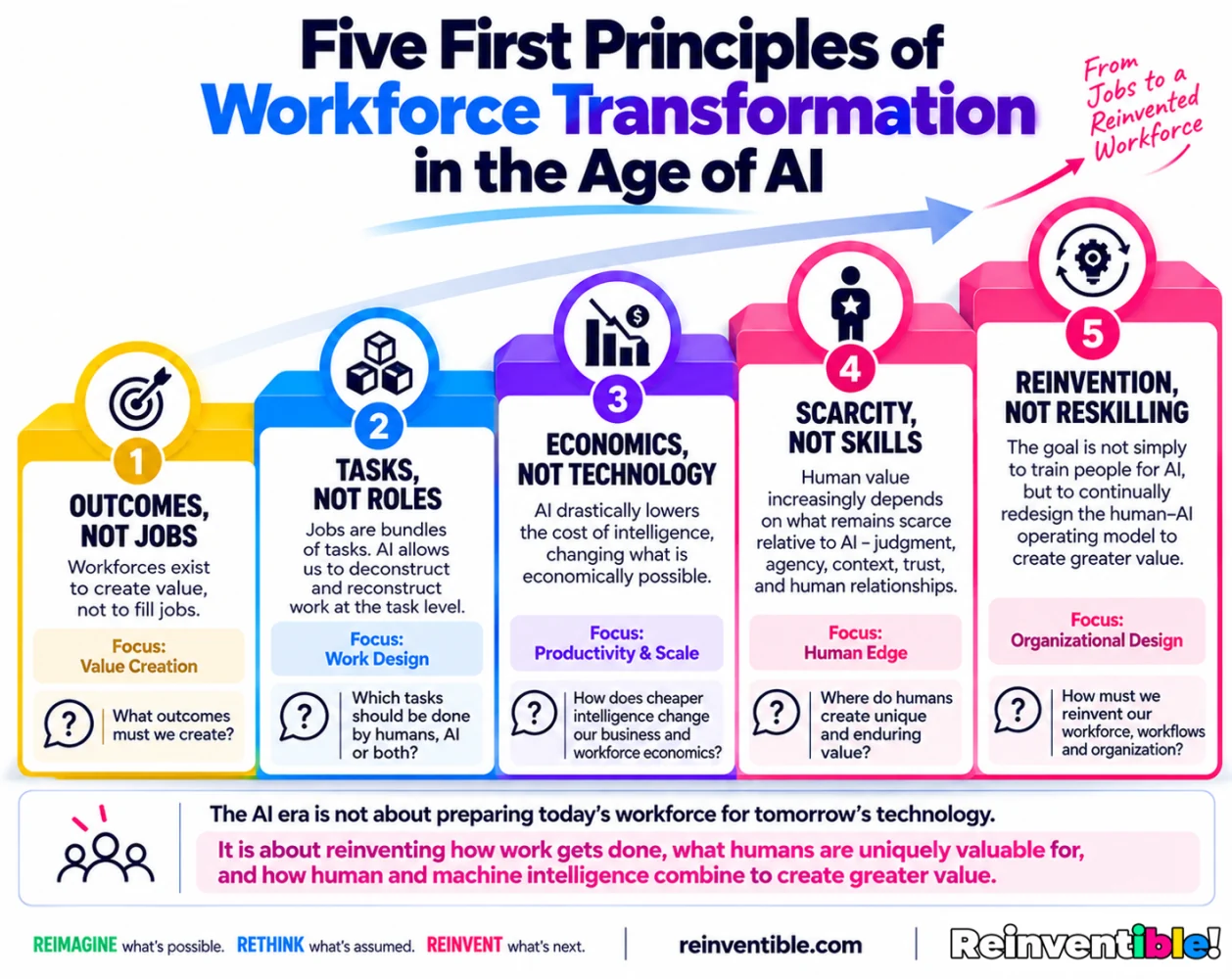
| Principle | Focus | Key question |
|---|---|---|
| 1. Outcomes, not jobs | Value creation | What outcomes must we create? |
| 2. Tasks, not roles | Work design | Which tasks should be done by humans, AI or both? |
| 3. Economics, not technology | Productivity and scale | How does cheaper intelligence change our business and workforce economics? |
| 4. Scarcity, not skills | Human edge | Where do humans create unique and enduring value? |
| 5. Reinvention, not reskilling | Organizational design | How must we reinvent our workforce, workflows and organization? |
Principle 1: Outcomes, not jobs
First Principle: A workforce exists to create value, not to sustain jobs.
Let's start with the most basic question.
Why does an organization employ people?
Not because it needs accountants, marketers, analysts, managers or software engineers.
It employs people because it needs to produce outcomes.
Customers need problems solved. Products need to be developed. Services need to be delivered. Decisions need to be made. Value needs to be created.
Jobs are simply the organizational structures we have historically developed to achieve those outcomes.
A job is a means, not an end.
Yet conventional workforce planning almost always starts with the existing organization.
How many accountants do we need next year? How many customer service executives should we hire? What skills should our marketing team develop?
These questions implicitly assume that today's job architecture remains the appropriate starting point.
But what if AI fundamentally changes how those outcomes can be achieved?
Consider a bank.
Its fundamental purpose is not to employ thousands of credit analysts, relationship managers and compliance officers.
It is to provide financial services that customers value while managing risk, meeting regulatory obligations and generating sustainable returns.
If AI enables dramatically different ways of achieving these outcomes, why should the existing roles, headcount ratios and departmental boundaries remain sacred?
The same applies to hospitals, manufacturers, logistics companies, universities and government agencies.
The fundamental unit of workforce transformation should be the value outcome, not the existing job.
This requires organizations to work backwards:
Desired outcomes → Required work → Human-machine capabilities → Organizational design
Rather than forwards:
Existing employees → Existing jobs → Skills gaps → Training programmes.
The distinction is profound.
One approach perpetuates the existing workforce model with better-trained employees.
The other questions whether the workforce model itself is still fit for purpose.
Principle 2: Tasks, not roles
First Principle: Jobs are artificial bundles of tasks, and AI changes how those tasks should be performed.
Once we understand the outcomes we need to create, the next question is straightforward.
What work is actually required?
For centuries, organizations have divided work into jobs and occupations.
But a job is not an indivisible unit.
A lawyer researches precedents, interprets legislation, drafts contracts, negotiates agreements and advises clients.
A marketer analyses customers, develops campaigns, creates content, manages agencies and evaluates performance.
A software engineer designs systems, writes code, tests applications, debugs problems and coordinates development.
These are collections of distinct tasks bundled together for reasons of efficiency, specialization and coordination.
AI changes the economics and feasibility of each task differently.
A lawyer may use AI to conduct legal research while retaining responsibility for legal judgment and client advice.
A marketer may delegate content generation and campaign analysis to AI while concentrating on brand strategy, customer understanding and creative direction.
A software engineer may increasingly supervise AI-generated code while focusing more on architecture, integration, security and product outcomes.
The implication is not simply that these professionals become more productive.
It is that the logic of their jobs begins to change.
Organizations should therefore deconstruct work into its constituent tasks and ask four questions:
- Automate: Which tasks should machines perform independently?
- Augment: Which tasks are best performed through human-AI collaboration?
- Humanise: Which tasks should remain primarily human because of judgment, empathy, trust or accountability?
- Eliminate: Which tasks no longer need to exist?
The fourth category is especially important.
Too many AI transformation initiatives focus on automating existing processes without questioning whether those processes should exist at all.
Why use AI to generate a report that nobody needs?
Why accelerate an approval process that could be eliminated?
Why automate the coordination between departments if AI enables the underlying work to be integrated?
This leads to a second-order transformation.
When tasks are redistributed between humans and machines, the original job bundles may no longer make sense.
Some roles will shrink. Others will expand. Several may converge into one. Entirely new roles may emerge.
A professional may evolve from performing individual tasks to orchestrating multiple AI agents, validating their outputs and managing end-to-end outcomes.
The future workforce will not simply consist of today's roles equipped with AI tools. It will increasingly consist of fundamentally redesigned roles built around a new division of labour between humans and machines.
Principle 3: Economics, not technology
First Principle: AI fundamentally changes the economics of intelligence, and therefore the economics of work.
To understand why AI is so transformative, we need to look beyond its technological capabilities.
We need to understand what happens when the cost of an essential economic input collapses.
The Industrial Revolution dramatically reduced the cost of physical power.
Computing reduced the cost of calculation and information processing.
The internet reduced the cost of distributing information and connecting people.
AI is now reducing the cost of producing many forms of cognitive output.
Writing, coding, analysing, translating, researching, synthesizing and generating content can increasingly be performed at radically different cost and speed.
Of course, not all intelligence is becoming equally cheap or reliable. Complex judgment, real-world context, verification and accountability can remain costly.
Nevertheless, the broader economic shift is unmistakable.
Capabilities that once required substantial human cognitive effort can increasingly be performed, or substantially assisted, by machines at much lower marginal cost.
And when the economics of a critical input change fundamentally, the optimal design of production changes with it.
Consider what happened when factories adopted electricity.
The greatest productivity gains did not come simply from replacing a steam engine with an electric motor while leaving everything else unchanged.
They came when factories eventually reorganized production around distributed electric power, enabling different layouts, workflows and manufacturing systems.
AI presents a similar strategic challenge.
Suppose an organization gives every employee an AI assistant and improves individual productivity by 30%.
That sounds impressive.
But what if the organization still relies on multiple approval layers, fragmented departments, unnecessary reporting, sequential handoffs and legacy processes?
The gains may dissipate across the system.
A worker completing a task in ten minutes instead of an hour achieves little if the output still waits three days for approval.
This reflects a fundamental principle of systems thinking:
Optimizing individual components does not necessarily optimize the overall system.
The real question is not how much faster each employee can work.
It is how the entire value stream should be redesigned when cognitive capabilities become dramatically cheaper and more accessible.
That could mean fewer handoffs, smaller teams, flatter structures, faster decision-making, greater autonomy and entirely new operating models.
It could also enable organizations to deliver services that were previously too expensive to provide.
Think of personalized education, individualized financial guidance, or continuously available customer support.
The opportunity is therefore not limited to cost savings.
It includes creating value that was previously economically impractical.
AI workforce transformation must start with a new understanding of the economics of work, not merely an inventory of AI technologies.
Principle 4: Scarcity, not skills
First Principle: Human value increasingly depends on what remains scarce and complementary to AI, not merely on what people are skilled at doing.
For decades, the dominant assumption behind workforce development has been that acquiring more advanced skills increases an individual's economic value.
Generally, this made sense.
Expertise was scarce. Knowledge was difficult to acquire. Specialized cognitive capabilities commanded a premium.
AI challenges this relationship.
A capability may be difficult for a human to master yet increasingly easy for AI to reproduce.
Someone may spend years becoming proficient at producing reports, writing standard code or conducting routine analysis.
But if comparable outputs become widely accessible through AI, the economic scarcity of those capabilities diminishes.
That does not mean the underlying skills become worthless.
It means their value increasingly depends on what they contribute beyond the capabilities available from machines.
This brings us to one of the most important economic principles of the AI age:
When intelligence becomes more abundant, scarce complements to that intelligence become more valuable.
What are these scarce complements?
Consider five categories.
- Judgment: Knowing which decisions to make, which risks to accept and when an apparently convincing AI recommendation should be rejected.
- Problem framing: Determining which problems are worth solving, rather than merely solving the problems presented.
- Context and integration: Understanding customers, organizations, industries and interconnected systems well enough to turn AI outputs into meaningful action.
- Trust and human relationships: Building confidence, exercising empathy, negotiating competing interests and accepting accountability for consequential decisions.
- Agency and adaptability: Initiating change, experimenting, learning, orchestrating AI and continuously developing new capabilities.
Creativity, taste and leadership cut across these categories.
These capabilities are not necessarily impossible for AI to develop or imitate. Nor will they remain permanently exclusive to humans.
Their importance lies in the value humans can contribute relative to increasingly capable machines, particularly where accountability, legitimacy and real-world judgment matter.
This also changes how we should think about career progression.
In many knowledge-intensive occupations, the opportunity is to migrate from:
Task execution → AI-assisted execution → AI orchestration → System design → Strategic direction
A marketer should aspire to do more than generate content faster.
An analyst should aspire to do more than produce better spreadsheets.
A manager should aspire to do more than supervise employees who use AI.
The greater opportunity is to move towards higher-value responsibilities that leverage both human and machine capabilities.
But there is a critical complication.
Not every worker can immediately make this transition. Nor will every organization have enough higher-level roles for everyone displaced from routine work.
AI may also erode the entry-level tasks through which junior employees traditionally learn their professions.
That creates a new workforce development challenge: how do we build experienced professionals when machines increasingly perform the tasks through which experience was historically acquired?
Traditional reskilling programmes may not adequately address this.
Organizations will need to redesign career pathways, apprenticeships, learning experiences and opportunities for progressively greater responsibility.
Ultimately, the most important capability may be the capacity to continuously reinvent one's own contribution.
In a rapidly changing AI environment, the durability of any particular skill is uncertain.
The future-ready workforce is not necessarily the one with the largest inventory of skills. It is the one that can most rapidly develop and redeploy valuable human capabilities as the intelligence frontier advances.
Principle 5: Reinvention, not reskilling
First Principle: The ultimate challenge is to continuously recombine human intelligence, machine intelligence and organizational capabilities around value creation.
The previous four principles lead us to a fundamental conclusion.
If organizations exist to produce outcomes…
If jobs are merely bundles of tasks…
If AI changes the economics of those tasks…
And if the relative value of human capabilities keeps changing…
Then workforce transformation cannot simply mean teaching existing employees new skills.
It must mean continuously reinventing how the organization creates value through humans and machines.
This is an organizational design challenge, not merely an HR challenge.
It requires three interconnected transformations.
First, capability transformation.
Organizations must determine which human capabilities they need to strengthen, develop, acquire or redeploy.
But these decisions must follow the redesign of work rather than precede it.
Training people for jobs that should no longer exist is not transformation.
Second, capacity transformation.
Organizations must reconsider how many people are required, in which functions, and for what responsibilities.
Greater AI capability could allow some teams to deliver more output with fewer people.
Other areas may need more people to capture new growth opportunities, oversee AI systems or deliver differentiated human experiences.
The goal should not automatically be headcount reduction.
It should be the appropriate allocation of human and machine capacity to maximize sustainable value creation.
Third, operating-model transformation.
This is where the greatest structural opportunities may emerge.
As AI becomes more autonomous, organizations must rethink workflows, decision rights, coordination mechanisms, reporting structures and managerial responsibilities.
Consider the traditional organizational hierarchy.
Many layers exist partly because humans have limited information-processing capacity, communication bandwidth and managerial span of control.
AI could relax some of these constraints.
A manager supported by capable AI systems may coordinate larger and more complex activities.
Small teams may manage workflows that previously required entire departments.
Organizations may increasingly shift from rigid functional hierarchies towards more fluid, outcome-oriented human-AI teams.
But none of this happens simply because employees attend AI training courses.
It requires deliberate enterprise redesign, appropriate governance, and changes to processes and incentives.
And the challenge is continuous.
AI capabilities are evolving too rapidly for organizations to redesign their workforce once and assume the new structure will remain optimal.
Today's human responsibility may become tomorrow's human-AI collaboration and eventually an autonomous AI workflow.
That means workforce planning must evolve from static headcount forecasting into dynamic capability allocation.
The most important organizational metric may eventually be neither the number of employees trained in AI nor the percentage of tasks automated.
It may be reinvention velocity: how quickly the organization can reconfigure its people, capabilities, workflows and operating model to capture new opportunities.
This is the difference between an AI-trained workforce and an AI-native organization.
One uses AI within the existing architecture of work.
The other continually redesigns that architecture around the expanding possibilities of intelligence.
The Bigger Shift: From Workforce Development to Workforce Reinvention
The five principles point to a fundamental change in strategic thinking.
For much of the Digital Age, workforce transformation focused on digitization, productivity improvements, new skills and organizational change.
These remain important.
But the Intelligence Age requires something more fundamental.
We need to question the assumptions that gave rise to existing jobs, professions, management structures and divisions of labour.
Why should work still be organized this way?
Why must this task be performed by a human?
Why should this process exist?
Why should one function hand work over to another?
Why should an organization's capabilities be constrained by the number of people it employs?
And perhaps most importantly:
If we were designing this organization from scratch today, with increasingly capable AI available, would we create the same workforce at all?
This is the question I believe every CEO, CHRO and business leader should be asking.
Because the greatest danger is not necessarily that organizations fail to train their people quickly enough.
It is that they successfully reskill thousands of employees to become more productive in an operating model that is becoming obsolete.
The organizations that thrive will not simply be those with the most AI-literate employees.
They will be those that most effectively reinvent the relationship between human intelligence, machine intelligence and value creation.
Reskilling changes what people can do. Reinvention changes what the enterprise can become.
And that, ultimately, is what workforce transformation in the Intelligence Age should be about.
Originally published in Charlie Ang's Intelligent Reinvention Memo newsletter on LinkedIn (Issue 57).

Charlie Ang is an Intelligent Reinvention Strategist, corporate futurist and AI keynote speaker based in Singapore and speaking worldwide. He helps organisations and leaders reinvent, rewire and retool for the Age of Intelligence, and has been featured by the BBC, Financial Times, National Geographic and CNA.