 Charlie
Rethinking what it takes to thrive when intelligence becomes abundant and work is being reinvented.
For generations, the formula for professional success has been remarkably consistent.
Study hard. Acquire qualifications. Develop expertise. Work diligently. Gain experience. Deliver results. Climb the corporate ladder.
This formula has served generations of professionals reasonably well. But its underlying assumptions are being challenged by artificial intelligence.
What happens when knowledge is no longer scarce? When AI can perform increasingly sophisticated cognitive work? When a single professional, equipped with intelligent agents, can accomplish what previously required an entire team?
As intelligence becomes abundant and the cost of execution declines, the foundations of professional value are shifting.
The question is no longer simply how to become better at your job.
It is what makes you valuable when AI can increasingly do your job.
To answer this, we need to rethink professional success from first principles, separating what has always mattered from what the Industrial and Knowledge Ages taught us to value.
Here are five principles for succeeding in the AI era.
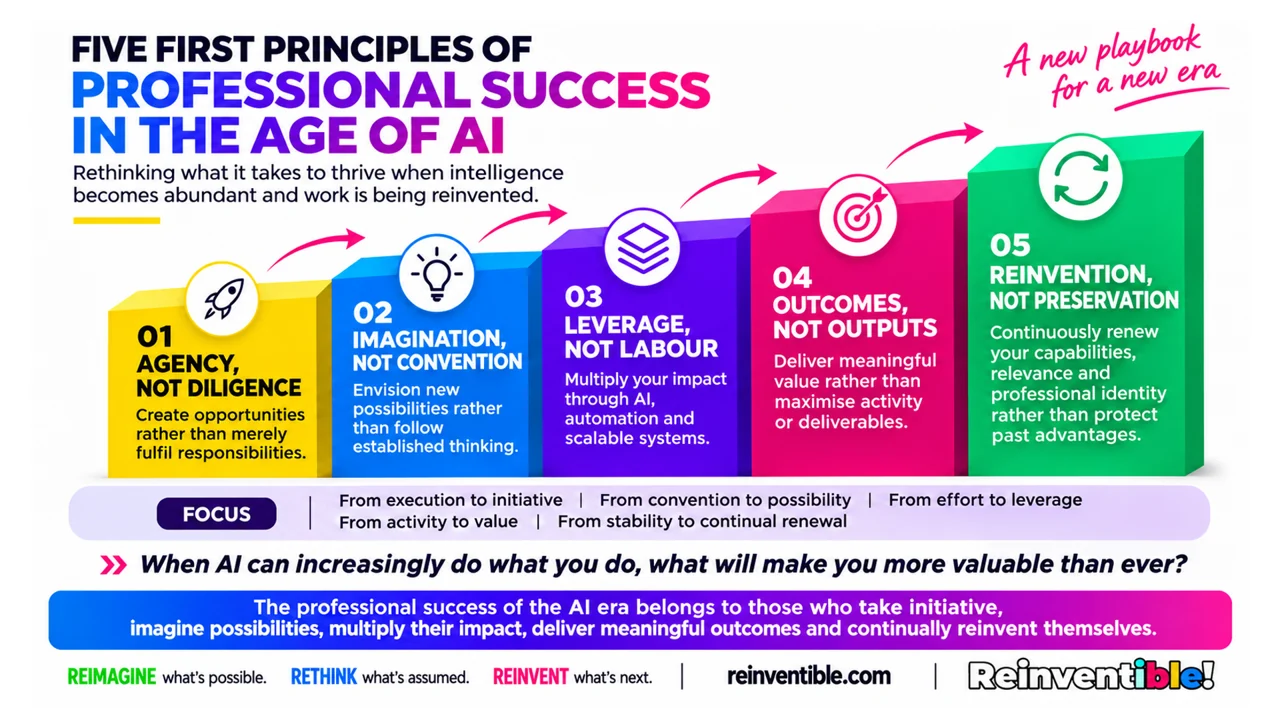
Principle 1: Agency, Not Diligence
From fulfilling responsibilities to creating opportunities.
For much of the industrial and corporate era, diligence was a cornerstone of professional success.
Organisations rewarded people who worked hard, followed instructions, met deadlines, executed assigned tasks and consistently delivered against expectations.
These qualities remain important. But diligence alone will become an increasingly insufficient source of differentiation.
AI systems are becoming capable of executing instructions, completing workflows, monitoring processes and producing deliverables with extraordinary speed and consistency.
What remains distinctly valuable is the ability to decide what should be done in the first place.
Agency is the capacity to act independently, exercise judgment, take initiative and shape outcomes rather than merely respond to circumstances.
An agentic professional does not simply wait to be assigned a problem. They identify unmet needs, challenge existing priorities, pursue opportunities and take responsibility for creating results.
Consider two employees with access to the same AI tools.
One uses AI to complete assigned work faster and more accurately.
The other identifies a previously neglected customer problem, designs a new solution, mobilises the right resources and uses AI to bring that solution to market.
Both may be productive. But the second is creating entirely new value.
In an era when execution becomes increasingly abundant, the scarcity shifts towards human initiative, judgment and ownership.
Your professional value increasingly depends on what you initiate, not merely what you execute.
Principle 2: Imagination, Not Convention
From following established practices to envisioning new possibilities.
Traditional professional development places enormous emphasis on mastering established knowledge, frameworks, methodologies and best practices.
We are trained to understand how things work, apply proven solutions and operate effectively within existing systems.
But what happens when AI can access, synthesise and apply much of that accumulated knowledge almost instantly?
The ability to reproduce conventional thinking becomes less distinctive.
The greater opportunity lies in imagining possibilities that existing conventions obscure.
Imagination is not simply creativity or generating novel ideas. It is the capacity to envision alternative futures, question fundamental assumptions and conceive solutions that do not yet exist.
A conventional banker asks how AI can improve loan underwriting.
An imaginative banker asks whether lending itself could be reinvented around continuous, personalised financial solutions.
A conventional HR professional asks how AI can improve recruitment efficiency.
An imaginative HR professional asks whether organisations should continue organising work primarily around fixed jobs and permanent roles.
A conventional consultant asks how AI can accelerate research, analysis and presentations.
An imaginative consultant asks whether the consulting business model should be reinvented around continuously operating, AI-powered solutions.
The difference is profound.
One starts with the existing system and seeks improvements. The other questions the system itself.
Of course, imagination without knowledge, judgment or execution can produce impractical ideas. Domain expertise remains essential for recognising meaningful possibilities and understanding real-world constraints.
But expertise must become a foundation for imagination rather than a boundary around it.
Your future value increasingly depends on your ability to imagine what could exist, not simply master what already exists.
Principle 3: Leverage, Not Labour
From working harder to multiplying your impact.
For centuries, professional productivity has been constrained by a fundamental limitation: human time and capacity.
There are only so many hours in a day, so many analyses one can perform, so many customers one can serve and so many decisions one can support.
Professional success has therefore often been associated with effort, endurance and the ability to manage increasingly large teams.
AI is beginning to change this economic equation.
A professional equipped with intelligent agents can research markets, develop prototypes, analyse financial data, create content, automate workflows and coordinate complex projects at a scale previously impossible for an individual.
The emerging advantage is not simply the ability to use AI tools.
It is the ability to architect systems of human and artificial intelligence that multiply one's productive capacity.
Consider an independent professional who once served five clients personally.
By deploying AI agents for research, analysis, customer support and routine execution, that professional may be able to serve substantially more clients while concentrating human attention on judgment, relationships and high-value decisions.
Or consider a product manager who can now orchestrate AI-assisted design, software development, testing and market research to rapidly validate ideas without assembling a large conventional team.
The traditional equation was relatively linear:
More effort + More people = More output.
The emerging equation is increasingly multiplicative:
Human judgment × AI capabilities × Scalable systems = Disproportionate impact.
Leverage also changes how professionals should evaluate their work.
Instead of asking, "How much can I accomplish today?", the better question is, "What can I design, automate or orchestrate so that value continues to be created beyond my personal effort?"
However, leverage also amplifies mistakes. Poor judgment, weak processes and unreliable AI outputs can create failures at greater scale.
Effective leverage therefore requires the ability to design, supervise and continuously improve human-AI systems.
Your professional advantage increasingly depends on the impact you can multiply, not the labour you personally contribute.
Principle 4: Outcomes, Not Outputs
From measuring activity to creating meaningful value.
Most organisations still measure professional contribution through proxies.
Hours worked. Reports produced. Projects completed. Meetings attended. Tasks closed. Deliverables submitted.
These measurements made some sense when producing outputs required substantial human effort and scarce expertise.
But AI is radically reducing the cost of generating many forms of output.
A report that once required days can be drafted in minutes. A presentation that once demanded hours can be generated almost instantly. Software code, market analyses and business proposals can increasingly be produced at extraordinary speed.
When output becomes abundant, producing more of it does not necessarily create more value.
A consultant who generates 100 slides has not necessarily improved a client's business.
A marketer who produces 1,000 pieces of content has not necessarily increased customer acquisition.
A software developer who writes 10,000 lines of code has not necessarily solved a meaningful user problem.
The real measure of professional contribution is the outcome achieved.
Did the client improve profitability? Did customers solve their problems? Did the business unlock a new revenue stream? Did employees become more capable? Did a product materially improve users' lives?
This requires professionals to move beyond task completion towards end-to-end responsibility for results.
It also requires a deeper understanding of the problems worth solving.
As AI makes execution easier, identifying valuable customer needs, defining the right objectives and exercising judgment over trade-offs become increasingly important.
The professional who understands the desired outcome can redesign the entire process around it, using AI wherever appropriate.
The professional who merely produces deliverables risks becoming a more efficient component of an increasingly automated workflow.
Your value is determined by the outcomes you create, not the outputs you produce.
Principle 5: Reinvention, Not Preservation
From protecting past advantages to continuously creating future relevance.
Traditional careers have often been built around accumulating expertise, experience, credentials and professional status.
The underlying assumption was that these assets would appreciate over time.
A lawyer became more valuable by mastering legal precedents. An accountant accumulated expertise in financial reporting. A software engineer deepened proficiency in programming languages. A manager advanced by mastering established organisational processes.
Experience and expertise remain valuable, but their economic relevance can no longer be taken for granted.
AI is changing what tasks are performed, how work is organised, which capabilities command a premium and which professional services customers are willing to pay for.
Some expertise will be augmented. Some will be commoditised. Some will become obsolete. Entirely new areas of expertise will emerge.
The greatest risk may not be a lack of skills, but an excessive attachment to the skills, identities and career models that made us successful in the past.
A professional who defines themselves primarily by the tasks they perform may experience AI as an existential threat.
A professional who defines themselves by the value they can create has more freedom to rethink how that value is delivered.
Consider an accountant whose professional identity centres on preparing and verifying financial statements.
As AI automates more of this work, preservation means defending existing tasks and workflows.
Reinvention means expanding into strategic financial intelligence, business-model innovation, risk anticipation or new AI-enabled advisory services.
The same principle applies to lawyers, consultants, engineers, designers, educators, managers and virtually every knowledge profession.
Reinvention does not mean abandoning accumulated expertise whenever a new technology appears.
It means continually reassessing which aspects of your expertise remain valuable, which assumptions have expired and which new capabilities and opportunities deserve investment.
Learning and adaptability are essential, but reinvention goes further.
Learning improves what you can do. Reinvention changes what you can become.
The objective is not simply to remain employable in an evolving labour market.
It is to continually discover new ways of creating distinctive value as the world changes.
Your long-term professional success depends on your capacity to reinvent your value, not preserve your past advantages.
Redefining Professional Success in the AI Era
These five principles point towards a fundamental change in how we should think about professional success.
The traditional formula rewarded professionals who acquired expertise, performed assigned work diligently, followed established practices and advanced through organisational hierarchies.
The emerging formula increasingly rewards those who create opportunities, imagine new possibilities, orchestrate intelligent systems, deliver meaningful outcomes and continually reinvent their professional value.
This does not mean diligence, expertise, hard work or experience suddenly become irrelevant.
They remain important foundations. But they are no longer sufficient guarantees of success.
AI is shifting the scarce sources of professional advantage from possessing knowledge and executing tasks towards exercising agency, imagining possibilities, multiplying capabilities, generating value and adapting to change.
Importantly, these principles reinforce one another.
- Agency gives you the initiative to act.
- Imagination helps you envision what is possible.
- Leverage enables you to achieve more with less.
- Outcomes ensure that your efforts create meaningful value.
- Reinvention keeps you relevant as the world changes.
Together, they offer a new operating philosophy for professional success in the age of abundant intelligence.
The Question Every Professional Must Ask
For generations, we have asked young people to prepare for professional success by studying hard, acquiring qualifications, developing expertise and securing good jobs.
We have encouraged working professionals to advance by becoming more knowledgeable, more experienced, more productive and more diligent.
These remain useful aspirations.
But they are incomplete for an era in which AI can increasingly replicate, augment or outperform many of the cognitive tasks that once defined professional value.
The future will not necessarily reward those who know the most, work the longest or produce the greatest volume of output.
It will increasingly reward those who can create possibilities, mobilise intelligence and generate meaningful value in ways that others cannot readily replicate.
The defining question is therefore no longer:
How can I become better at what I do?
It is:
What must I become to create greater value in a world where AI can increasingly do what I do today?
That is the challenge, and opportunity, of professional success in the AI era.
Originally published in Charlie Ang's Intelligent Reinvention Memo newsletter on LinkedIn (Issue 68), part of his "First Principles in the AI Age" series.

Charlie Ang is an Intelligent Reinvention Strategist, corporate futurist and AI keynote speaker based in Singapore and speaking worldwide. He helps organisations and leaders reinvent, rewire and retool for the Age of Intelligence, and has been featured by the BBC, Financial Times, National Geographic and CNA.