 Charlie
Digital Transformation changed how organisations manage work. Artificial Intelligence challenges the very logic of management itself.
For more than a century, management has been built around a relatively stable set of assumptions: work can be divided into jobs, assigned to people, coordinated through processes, supervised by managers, and measured against predefined performance targets.
These assumptions gave rise to modern management practices, from organisational hierarchies and functional departments to standard operating procedures, performance scorecards and management reporting systems.
They worked remarkably well in an industrial economy where human labour was the primary source of productive intelligence, information was relatively scarce, and coordination was expensive.
Even the digital revolution did not fundamentally change this management logic. Enterprise software automated transactions, dashboards improved visibility, and collaboration platforms accelerated communication. Yet humans remained responsible for most analysis, judgement, coordination and execution.
AI changes this equation.
For the first time, organisations can deploy increasingly capable, scalable and autonomous non-human intelligence across a growing range of managerial and operational activities.
AI can analyse information, generate plans, coordinate workflows, monitor performance, make recommendations and execute certain decisions within defined boundaries.
This raises a fundamental question:
If intelligence is no longer confined to human employees, why should management continue to be organised around supervising human work?
The answer demands more than AI-enhanced management. It requires us to rethink management from first principles.
To do so, we must return to its fundamental purpose.
Management exists to convert organisational resources into desired outcomes through effective allocation, coordination, execution and control.
Everything else, including hierarchies, reporting structures, job descriptions, meetings and approval processes, is a means to that end.
Once we recognise this distinction, five new management principles emerge.
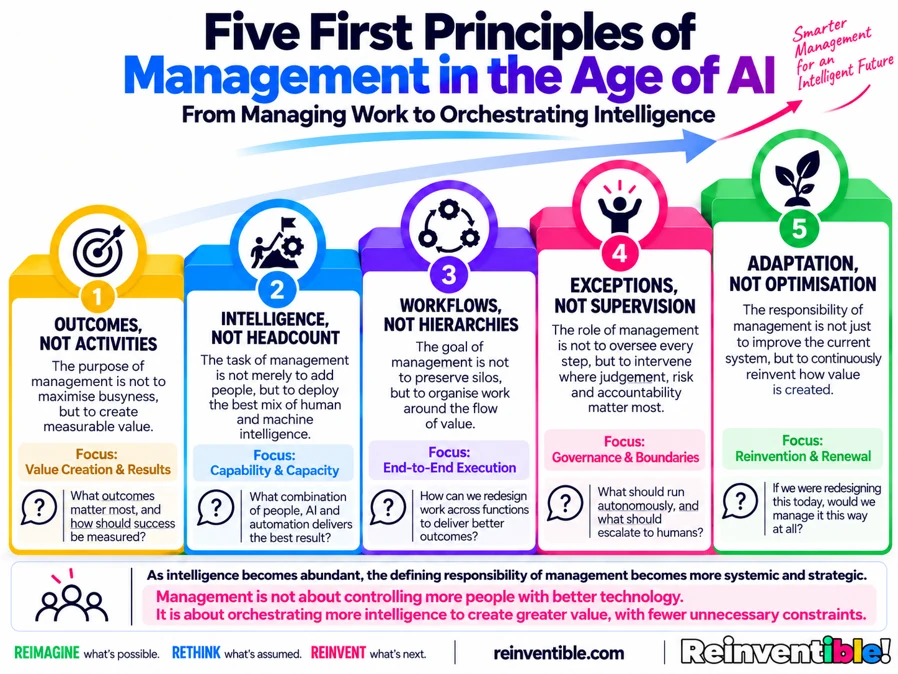
Principle 1: Outcomes, Not Activities
Manage for value creation, not the volume of work performed.
Traditional management has often relied on activities as proxies for productivity.
Managers track tasks completed, hours worked, meetings attended, projects delivered and utilisation rates.
These measures made sense when productive output was closely associated with human effort and time.
But AI breaks the relationship between effort and output.
A marketing team might generate an entire campaign in hours instead of weeks. A finance department might automate much of its monthly reporting. A customer service operation might resolve thousands of enquiries without human intervention.
In such environments, measuring activity becomes increasingly misleading.
A team that completes fewer tasks but delivers superior business results may be more productive than one that remains constantly busy.
The first principle is therefore to manage backwards from outcomes.
Managers must establish what value needs to be created, for whom, and how success should be measured.
This requires distinguishing among:
- Business outcomes: Revenue growth, profitability, customer retention and strategic impact.
- Operational outcomes: Speed, quality, reliability, cost and efficiency.
- Activity measures: Tasks, transactions, meetings and hours, which are useful only insofar as they contribute to outcomes.
AI makes activity increasingly abundant and inexpensive. Value creation remains the ultimate constraint.
From measuring how much work gets done to measuring how much value gets created.
Principle 2: Intelligence, Not Headcount
Allocate capabilities, not merely human resources.
Traditional resource management is fundamentally built around people.
Managers determine how many employees are needed, what skills they require, where they should be deployed and how their workload should be distributed.
This is reflected in familiar management concepts such as headcount planning, spans of control, capacity utilisation and workforce budgets.
However, these concepts assume that productive capability must be supplied predominantly by human employees.
AI introduces an entirely new category of organisational capacity.
A task might now be performed by a human professional, an AI copilot, an autonomous agent, a conventional software system or a combination of these resources.
The relevant management question is no longer simply:
How many people do we need to perform this work?
It becomes:
What combination of human and machine intelligence can deliver this outcome most effectively?
This requires managers to assess work according to its underlying requirements:
- Human intelligence: Contextual judgement, complex accountability, relationships and decisions requiring human responsibility.
- Machine intelligence: High-volume analysis, information processing, pattern recognition and increasingly sophisticated knowledge work.
- Hybrid intelligence: Workflows in which humans and AI contribute complementary capabilities.
The objective is not indiscriminate labour substitution.
It is the economically and operationally optimal allocation of intelligence, accounting for cost, quality, speed, risk and accountability.
A manager responsible for a growing business function may no longer need to increase headcount proportionately with workload.
Instead, the function may scale through an intelligent combination of human expertise, AI agents and automation.
From managing human capacity to optimising total intelligence capacity.
Principle 3: Workflows, Not Hierarchies
Organise execution around the flow of value, not organisational boundaries.
Most organisations are structured into departments, functions, teams and reporting lines.
These structures emerged partly because managing large numbers of people requires coordination, specialisation and clear authority.
Yet hierarchies also create friction.
Work moves between departments. Decisions travel through approval chains. Information becomes fragmented across organisational boundaries. Managers spend considerable time coordinating handoffs and resolving dependencies.
AI creates an opportunity to fundamentally redesign how work gets done.
Instead of asking how AI can improve each existing department, managers should ask how an entire business process can be reconfigured from end to end.
Consider customer onboarding.
Traditionally, sales, compliance, finance, operations and customer service might each perform separate activities, with multiple handoffs between them.
An AI-native workflow could coordinate information collection, verification, risk assessment, account creation and customer communication through an integrated orchestration system.
Humans would intervene where exceptions, ambiguity or consequential decisions require their judgement.
The process would no longer need to mirror the organisation chart.
This changes the unit of management from departments and individual tasks to end-to-end value streams.
Three design questions become essential:
- What outcome must the workflow deliver?
- Which activities can be integrated, automated or eliminated?
- Where are human intervention, decision rights and accountability genuinely necessary?
Hierarchies may remain necessary for governance, talent development and organisational accountability.
But they need not determine how every piece of work flows through the enterprise.
From coordinating organisational silos to orchestrating integrated human-AI workflows.
Principle 4: Exceptions, Not Supervision
Manage by intervention where necessary, rather than oversight everywhere.
Traditional management depends heavily on supervision.
Managers review work, check progress, approve requests, resolve problems and ensure compliance with established standards.
Much of this oversight exists because employees have limited information, processes are difficult to monitor continuously, and deviations may go undetected until they become significant.
AI fundamentally changes the economics of monitoring and control.
Intelligent systems can continuously track workflows, identify anomalies, detect emerging risks and escalate matters requiring intervention.
This creates the possibility of moving from routine human supervision towards exception-based management.
Instead of manually reviewing every transaction, a manager might oversee an AI-enabled system that automatically handles standard cases while flagging unusual or consequential situations.
Instead of conducting frequent status meetings, managers might receive real-time alerts when projects deviate from agreed parameters.
Instead of approving every routine operational decision, managers could establish decision boundaries within which systems operate autonomously.
The critical management discipline becomes the design of these boundaries.
Managers must determine:
- Which decisions can be delegated to AI systems?
- What thresholds should trigger escalation?
- What controls ensure accuracy, compliance and safety?
- Who remains accountable when autonomous systems make mistakes?
This is not management without control.
It is management through more precisely designed control systems.
Indeed, greater AI autonomy may demand stronger governance, auditability and accountability, even as routine supervision declines.
From supervising every step to governing autonomy and managing exceptions.
Principle 5: Adaptation, Not Optimisation
Manage the continuous evolution of the operating system, not simply its efficiency.
Management has traditionally emphasised optimisation.
Once an organisation establishes a business process, managers seek to improve its efficiency, consistency, cost and reliability.
This logic produced powerful disciplines such as Lean management, Six Sigma, process improvement and operational excellence.
These remain valuable.
But optimisation assumes that the underlying process, operating model or business logic remains sufficiently relevant to justify improving it.
In an AI-disrupted environment, that assumption can become dangerous.
An organisation may become exceptionally efficient at performing activities that AI has rendered unnecessary.
A department may optimise a workflow that could be eliminated entirely.
A business may reduce operating costs while competitors redefine the economics of its industry.
The managerial challenge is therefore no longer simply to improve the existing system.
It is to determine whether the existing system should continue to exist in its current form.
This requires two complementary management disciplines:
- Operational optimisation: Continuously improve the performance of existing processes, resources and systems.
- Operational reinvention: Periodically challenge the underlying assumptions, architecture and necessity of those processes, resources and systems.
AI makes both possible.
It can help organisations optimise existing operations while enabling radically different ways of delivering the same outcomes.
Managers must therefore ask two very different questions:
How can we do this better?
And, more fundamentally:
If we were building this operation from scratch today, would we design it this way at all?
The second question becomes increasingly important as AI capabilities, costs and possibilities evolve.
From optimising a relatively stable operating model to continuously reinventing how the organisation creates value.
Together, these principles represent a fundamental change in management philosophy.
Management is no longer primarily about directing human effort through established organisational structures.
It is increasingly about designing, allocating, coordinating and governing an evolving system of human and machine intelligence.
From Managing People to Managing Intelligent Systems
The distinction between leadership and management becomes particularly important in the Intelligence Age.
Leadership concerns direction, purpose, people, culture and the mobilisation of collective commitment.
Management concerns the systematic translation of direction into execution, the allocation of resources, coordination of work, monitoring of performance and delivery of results.
AI transforms both, but in different ways.
For leadership, the central challenge is how to guide people and organisations through unprecedented disruption and change.
For management, the central challenge is how to redesign the mechanisms through which organisational outcomes are delivered.
This means tomorrow's managers must increasingly become architects and orchestrators of intelligent operating systems.
They will need to understand not only people, budgets, processes and performance, but also AI capabilities, agentic workflows, decision architectures, escalation mechanisms and autonomous operations.
Their effectiveness will depend less on how many people report to them and more on how effectively they coordinate the total intelligence available to the organisation.
This does not make human managers obsolete.
It changes where their contribution is most valuable.
As routine coordination, monitoring and administrative decision-making become increasingly automated, managers must concentrate on system design, resource optimisation, judgement, governance and continuous adaptation.
The best managers will not necessarily be those who control the largest teams.
They will be those who create the greatest organisational value through the most effective combination of human and machine capabilities.
The Intelligent Reinvention Imperative
Digital Transformation enabled managers to operate existing organisations more efficiently through technology.
Intelligent Reinvention requires managers to reconsider the fundamental design of organisational execution itself.
That is a much more consequential shift.
Simply inserting AI into existing management structures risks automating yesterday's assumptions.
Reinventing management demands that we challenge those assumptions before redesigning the system.
Ultimately, the future of management is not about managing more people with better technology.
It is about orchestrating more intelligence to create greater value, with fewer unnecessary organisational constraints.
The defining management question of the Intelligence Age is no longer: "How do we get people to do the work?"
It is: "How should intelligence, human and artificial, be organised to deliver the best possible outcomes?"
That is the shift from traditional management to AI-native management.
Originally published in Charlie Ang's Intelligent Reinvention Memo newsletter on LinkedIn (Issue 59).

Charlie Ang is an Intelligent Reinvention Strategist, corporate futurist and AI keynote speaker based in Singapore and speaking worldwide. He helps organisations and leaders reinvent, rewire and retool for the Age of Intelligence, and has been featured by the BBC, Financial Times, National Geographic and CNA.