 Charlie
For much of modern management history, leaders were expected to have the answers.
They had more experience. More knowledge. More information. More authority.
They were expected to tell people what to do, make the important decisions and steer their organisations towards success.
And because intelligence and expertise were scarce, those who possessed them commanded influence.
But what happens when intelligence is no longer scarce?
Today, an employee with access to powerful AI can research complex issues, analyse competitors, generate strategies, challenge assumptions and develop solutions that previously required teams of specialists.
Tomorrow, increasingly capable AI agents may independently undertake work, coordinate activities and make decisions across entire business processes.
We are entering an era in which intelligence is becoming abundant, but effective leadership remains scarce.
This creates a fundamental question:
If AI can increasingly provide the answers, make recommendations and execute decisions, what are leaders actually for?
To answer this, we must return to first principles.
Strip away hierarchy, job titles, positional authority and corporate rituals, and leadership exists for a fundamental purpose:
To inspire and mobilise people towards a shared future they would struggle to achieve independently.
Leadership is not fundamentally about occupying a position of power.
It is about moving people.
Helping them see possibilities they previously could not see. Inspiring them to pursue goals they might otherwise consider impossible. Building the trust and confidence to act despite uncertainty. Unleashing their potential. And guiding them through the discomfort of change.
These responsibilities become more important, not less, in the Intelligence Age.
From this fundamental purpose, we can reconstruct leadership around five first principles.
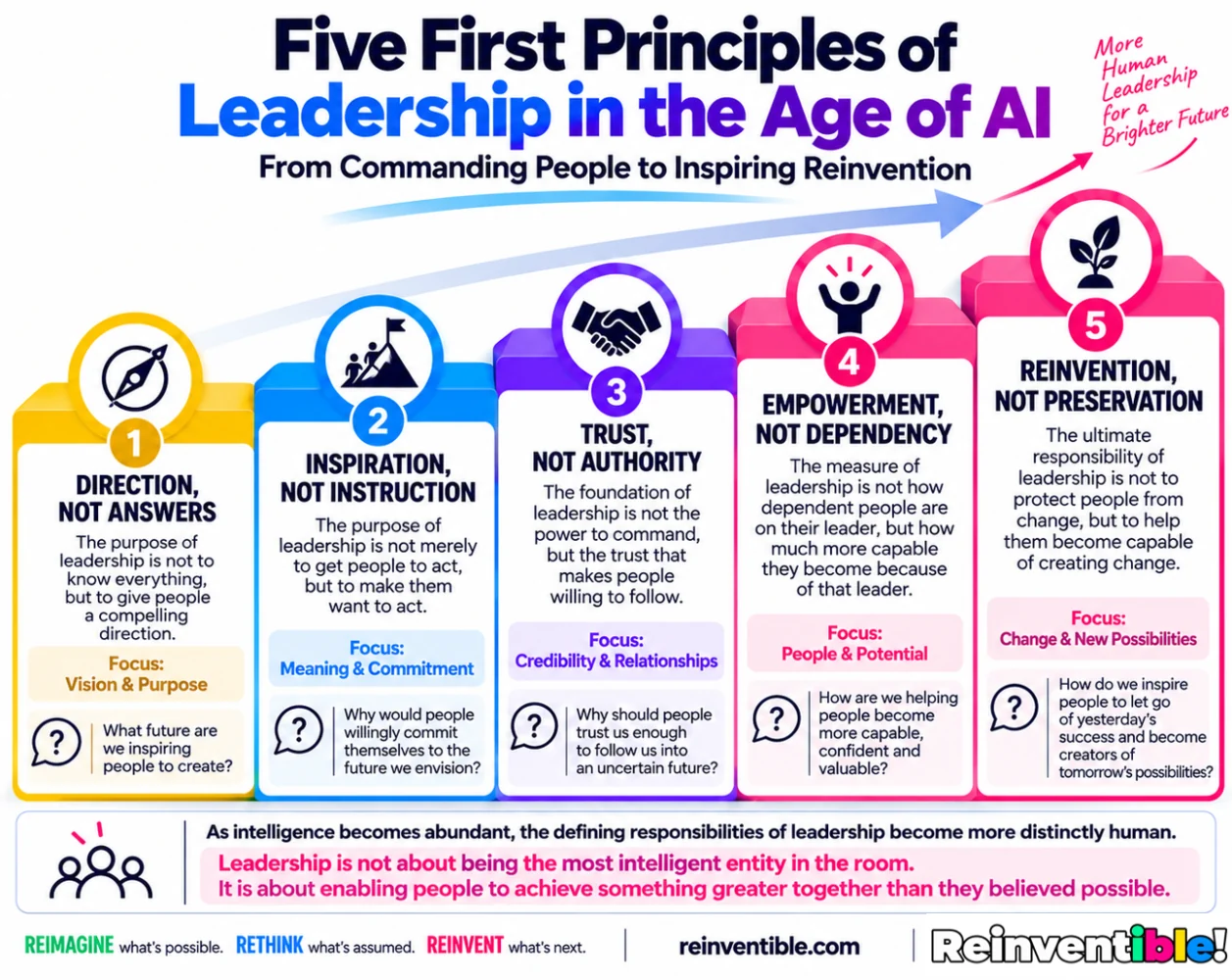
Principle 1: Direction, Not Answers
The purpose of leadership is not to know everything. It is to give people a compelling direction.
Historically, seniority often came with an informational advantage.
Executives had access to knowledge, expertise and perspectives unavailable to employees further down the hierarchy.
Leaders could earn respect by knowing more than everyone else.
AI is eroding that advantage.
Today, an employee can ask AI to analyse an industry, evaluate competitors, identify emerging opportunities and propose strategic alternatives.
The leader may no longer be the most knowledgeable person in the room.
Increasingly, that distinction may belong to a machine.
But having more intelligence does not automatically produce greater clarity about what matters.
AI can generate a hundred possible futures.
It cannot independently determine which future an organisation ought to pursue, what sacrifices its people should accept, or what collective purpose deserves their commitment.
Consider two CEOs confronting AI disruption.
The first announces an ambitious AI transformation programme, sets adoption targets and instructs every department to identify AI use cases.
The second articulates a compelling future: how the company will fundamentally change the value it creates for customers, why that future matters and what role its people will play in making it possible.
Both may deploy the same technologies.
But only one has given people a meaningful direction.
This distinction matters because people do not commit themselves wholeheartedly to technology adoption targets.
They commit to futures they believe are worth creating.
Great leaders must therefore become exceptional at three things:
- Seeing possibilities: Recognising emerging futures that others have yet to imagine.
- Creating meaning: Explaining why a particular future matters to customers, employees and society.
- Providing clarity: Helping people understand where they are going, even when the path remains uncertain.
The leader's role is no longer to possess all the answers.
It is to ensure that everyone understands the destination and why reaching it matters.
What future are we inspiring people to create?
Principle 2: Inspiration, Not Instruction
The purpose of leadership is not merely to get people to act. It is to make them want to act.
There is an important difference between compliance and commitment.
Compliance occurs when people do something because they have been instructed to.
Commitment occurs when people do something because they believe in it.
Traditional hierarchies could generate compliance through positional authority.
Managers assigned responsibilities. Employees followed instructions. Performance was measured against predetermined expectations.
Such arrangements can produce predictable outcomes, particularly for routine work.
But genuine transformation requires something more.
It requires people to challenge existing assumptions, embrace unfamiliar possibilities, take intelligent risks and invest their energy in creating something that does not yet exist.
Instructions alone cannot reliably produce that commitment.
And AI makes the distinction even more important.
As machines become increasingly capable of following instructions and executing structured tasks, the relative value of human initiative, creativity and discretionary effort rises.
Why should someone challenge an established business model when doing so might threaten their current role?
Why should an experienced employee invest time learning unfamiliar capabilities when existing skills have served them well for decades?
Why should a team support a transformation that could fundamentally disrupt its identity?
These are not primarily technical questions.
They are deeply human questions.
They involve fear, ambition, identity, belonging and hope.
A leader who responds only with instructions and performance targets may secure superficial compliance while leaving underlying resistance untouched.
An inspiring leader connects change to meaning.
They explain not only what must change, but why the change is worth making.
They make the future emotionally compelling.
They help people see themselves as participants in building that future rather than casualties of technological disruption.
Think about the difference between telling employees:
"We need everyone to become proficient in AI."
And saying:
"We have an opportunity to remove much of the repetitive work that limits us today, expand what each of us can accomplish and create entirely new forms of value for our customers. I want us to build that future together."
The first is an instruction.
The second is an invitation.
Of course, inspiration without action becomes empty rhetoric.
But action without inspiration rarely produces extraordinary commitment.
In the Intelligence Age, when AI can execute instructions with increasing proficiency, the human capacity to inspire voluntary commitment becomes a defining leadership advantage.
Why would people willingly commit themselves to the future we envision?
Principle 3: Trust, Not Authority
The foundation of leadership is not the power to command. It is the trust that makes people willing to follow.
Authority and trust are not the same thing.
Authority comes from a position.
Trust must be earned.
A person can be appointed CEO overnight.
They cannot be appointed trustworthy overnight.
Historically, organisational hierarchies allowed leaders to rely substantially on positional authority.
Employees followed decisions because those decisions came from above.
But in an increasingly complex, interconnected and AI-enabled world, authority alone becomes a weaker foundation for leadership.
People have greater access to information.
They can challenge claims and compare alternatives.
They can identify contradictions between what leaders say and what they do.
And during periods of disruptive change, they have legitimate reasons to question whether organisational decisions serve their interests.
Consider one of the most difficult questions employees face today:
Will AI help me become more valuable, or will it eventually make me redundant?
An executive can announce that AI transformation will benefit everyone.
But why should employees believe that promise?
Particularly when the same organisation is simultaneously discussing automation, restructuring and headcount reduction?
This is where leadership credibility becomes decisive.
Trust does not require pretending that difficult trade-offs do not exist.
It requires the willingness to acknowledge them.
Leaders build trust when they demonstrate:
- Integrity: Their actions consistently reflect their stated principles.
- Honesty: They communicate uncertainty and uncomfortable realities rather than manufacturing reassurance.
- Empathy: They understand the human consequences of the changes they champion.
- Fairness: They make difficult decisions transparently and treat affected people with dignity.
- Accountability: They accept responsibility for their choices rather than shifting blame.
Trust also creates the conditions for people to speak up.
When employees fear embarrassment, punishment or retaliation, they conceal problems, avoid difficult conversations and hesitate to challenge assumptions.
This becomes particularly dangerous during AI transformation.
Organisations need people willing to question AI-generated recommendations, expose failures, challenge overconfident predictions and raise concerns about unintended consequences.
That requires psychological safety alongside clear accountability.
A culture of unquestioning obedience may appear efficient.
But it becomes fragile when circumstances change.
A culture of trust allows people to disagree without becoming disloyal.
It enables constructive challenge without undermining collective commitment.
In an age when AI-generated content can be persuasive, misinformation can spread rapidly and technological change can provoke genuine anxiety, credibility becomes an increasingly valuable leadership asset.
Authority can secure obedience.
Trust creates followership.
Why should people trust us enough to follow us into an uncertain future?
Principle 4: Empowerment, Not Dependency
The measure of leadership is not how dependent people are on their leader. It is how much more capable they become because of that leader.
Some leaders make themselves indispensable.
Every major decision requires their approval.
Every difficult problem eventually reaches their desk.
Every important initiative depends on their personal involvement.
They become the centre of organisational activity.
This can create the appearance of strong leadership.
But it may actually reveal a weakness.
The organisation has become excessively dependent on one individual.
Great leadership should produce the opposite result.
It should create people who are increasingly capable of thinking, deciding, learning and leading for themselves.
That has always been an important leadership responsibility.
But AI radically expands what empowerment can mean.
For much of history, an individual's capabilities were constrained by their knowledge, experience, training and access to specialist resources.
AI is beginning to relax many of those constraints.
A marketing professional can develop sophisticated analytical capabilities.
A frontline employee can access expert knowledge previously unavailable to them.
A small team can undertake work that once required a much larger organisation.
An entrepreneur can prototype products, analyse markets and develop business concepts using capabilities previously beyond their reach.
The potential is extraordinary.
But access to AI does not automatically produce empowerment.
Employees may have powerful tools yet remain constrained by fear, rigid hierarchies, poor incentives or a lack of confidence.
This is where leadership matters.
The leader must create an environment in which people feel both capable and authorised to contribute.
That involves four responsibilities.
First, develop people's judgement, not merely their knowledge.
When knowledge becomes readily accessible, the ability to question, evaluate, interpret and apply it becomes more valuable.
Second, encourage agency rather than dependency.
People should feel they can initiate improvements, challenge outdated practices and pursue opportunities without constantly seeking permission.
Third, cultivate growth rather than fear.
When employees see AI primarily as a threat to their relevance, they may resist it. When they see it as an opportunity to expand their capabilities, they become more willing to experiment and learn.
Fourth, develop future leaders rather than permanent followers.
The greatest contribution of leadership is not simply what the leader personally accomplishes.
It is what others become capable of accomplishing.
Imagine a leader responsible for 100 people.
One approach is to use AI to become dramatically more productive personally, allowing the leader to supervise more activity and make more decisions.
Another is to help all 100 people become more resourceful, creative, confident and capable.
The second approach can create far greater collective potential.
And it produces something even more valuable: an organisation capable of progressing beyond the limitations of any single leader.
The best leaders do not seek to be the most indispensable person in the organisation.
They seek to make the people around them increasingly indispensable.
How are we helping people become more capable, confident and valuable than they believed possible?
Principle 5: Reinvention, Not Preservation
The ultimate responsibility of leadership is not to protect people from change. It is to help them become capable of creating change.
Human beings are naturally attached to what they know.
Experience provides confidence.
Expertise creates identity.
Established routines provide stability.
Success reinforces existing beliefs.
These are strengths in a stable environment.
But they can become liabilities when the world changes fundamentally.
An experienced executive may have spent thirty years mastering a particular industry.
A professional may have built an entire career around specialised knowledge.
An employee may derive pride and identity from work that AI can increasingly perform.
When technology threatens these foundations, resistance is not necessarily irrational.
It can be a deeply human response to uncertainty and potential loss.
This is why transformation is rarely just a technological challenge.
It is also a psychological, cultural and leadership challenge.
Consider the familiar pattern of corporate disruption.
A company succeeds through a particular business model.
Its leaders develop expertise around that model.
Employees acquire specialised skills.
Incentives reward the preservation and improvement of existing operations.
Over time, the organisation's identity becomes intertwined with its historical success.
Then a disruptive technology emerges.
Even when leaders recognise its significance, the organisation struggles to respond.
Why?
Because embracing the future may require people to question the assumptions, capabilities and identities that made them successful.
This is not merely resistance to technology.
It is resistance to losing the familiar.
And no amount of technology investment can fully solve that problem.
Leadership must help people cross the divide between their established identity and an uncertain future.
That requires three forms of courage.
The courage to confront reality.
Leaders must be willing to acknowledge when existing strategies, capabilities and business models are becoming obsolete.
False reassurance delays reinvention.
The courage to challenge orthodoxy.
Leaders must question deeply held assumptions, including those responsible for past success.
The question is not simply how to improve what exists.
It is whether what exists still makes sense.
The courage to bring people through change.
Reinvention cannot simply be imposed through announcements, restructuring programmes and technology deployments.
People need a compelling reason to change, confidence that change is possible and support as they develop new capabilities and identities.
This is especially important in the Intelligence Age.
AI is not merely introducing another generation of enterprise technology.
It is challenging fundamental assumptions about expertise, work, value creation and the relative capabilities of humans and machines.
Organisations may need to reinvent what they do.
But individuals may also need to reinvent who they are professionally.
A leader's task is therefore not simply to announce a new destination.
It is to help people discover that they can become capable of reaching it.
How do we inspire people to let go of yesterday's success and become creators of tomorrow's possibilities?
The Leadership Imperative in the Intelligence Age
Put these five principles together and a very different conception of leadership emerges.
| Principle | What it means |
|---|---|
| Direction, Not Answers. | Help people see a compelling future rather than positioning yourself as the source of all knowledge. |
| Inspiration, Not Instruction. | Create commitment and collective ambition rather than relying primarily on compliance. |
| Trust, Not Authority. | Earn credibility and followership rather than depending on positional power. |
| Empowerment, Not Dependency. | Unleash people's potential rather than making them increasingly reliant on you. |
| Reinvention, Not Preservation. | Help people embrace and create change rather than defending the familiar. |
Notice something important about these principles.
None depends on the leader being more intelligent than everyone else.
None requires the leader to possess all the answers.
And none can be reduced to deploying more technology.
They are fundamentally about human beings.
Their aspirations.
Their motivations.
Their relationships.
Their potential.
Their capacity for change.
This does not mean AI will be irrelevant to leadership. Quite the opposite.
AI can help leaders understand complex situations, explore strategic possibilities, communicate more effectively, identify development opportunities and make better-informed decisions.
But these capabilities do not eliminate the need for leadership.
They raise the standard of what good leadership must accomplish.
When information was scarce, leaders could distinguish themselves by knowing more.
When coordination was difficult, they could distinguish themselves by directing others.
When organisations were relatively stable, they could distinguish themselves by preserving successful practices.
Those advantages become less durable in an era of abundant intelligence and accelerating disruption.
The most consequential leaders will increasingly be those who can give people purpose amid uncertainty, inspire commitment amid disruption, build trust amid anxiety, unleash potential amid technological change and cultivate the courage to reinvent.
The Paradox of Leadership in the Age of AI
The more capable machines become, the more tempting it will be to think that leadership itself can be automated.
After all, AI can increasingly analyse situations, recommend actions, generate communications and evaluate alternatives.
Some activities traditionally associated with leaders will undoubtedly become automated or augmented.
But leadership is not merely the sum of those activities.
It is a relationship between people, built around purpose, trust, influence and shared commitment.
A machine may generate an inspiring vision.
But will people believe in the person presenting it?
A machine may recommend a difficult transformation.
But who will take responsibility for the people affected?
A machine may identify someone's potential.
But who will believe in that person, support their development and encourage them to take risks?
A machine may calculate that an organisation needs radical reinvention.
But who will mobilise people to undertake that difficult journey?
These questions bring us back to the fundamental purpose of leadership.
Leadership is not about being the most intelligent entity in the room. It is about enabling people to achieve something greater together than they believed possible.
And that leads to perhaps the most important paradox of the Intelligence Age:
The more artificial intelligence transforms what machines can do, the more human leadership must become.
The future of leadership is not about commanding more people.
It is about inspiring more human potential.
Not about protecting the present.
But about giving people the courage, confidence and conviction to reinvent their future.
That is the leadership imperative of the Intelligence Age.
Originally published in Charlie Ang's Intelligent Reinvention Memo newsletter on LinkedIn (Issue 58).

Charlie Ang is an Intelligent Reinvention Strategist, corporate futurist and AI keynote speaker based in Singapore and speaking worldwide. He helps organisations and leaders reinvent, rewire and retool for the Age of Intelligence, and has been featured by the BBC, Financial Times, National Geographic and CNA.