 Charlie
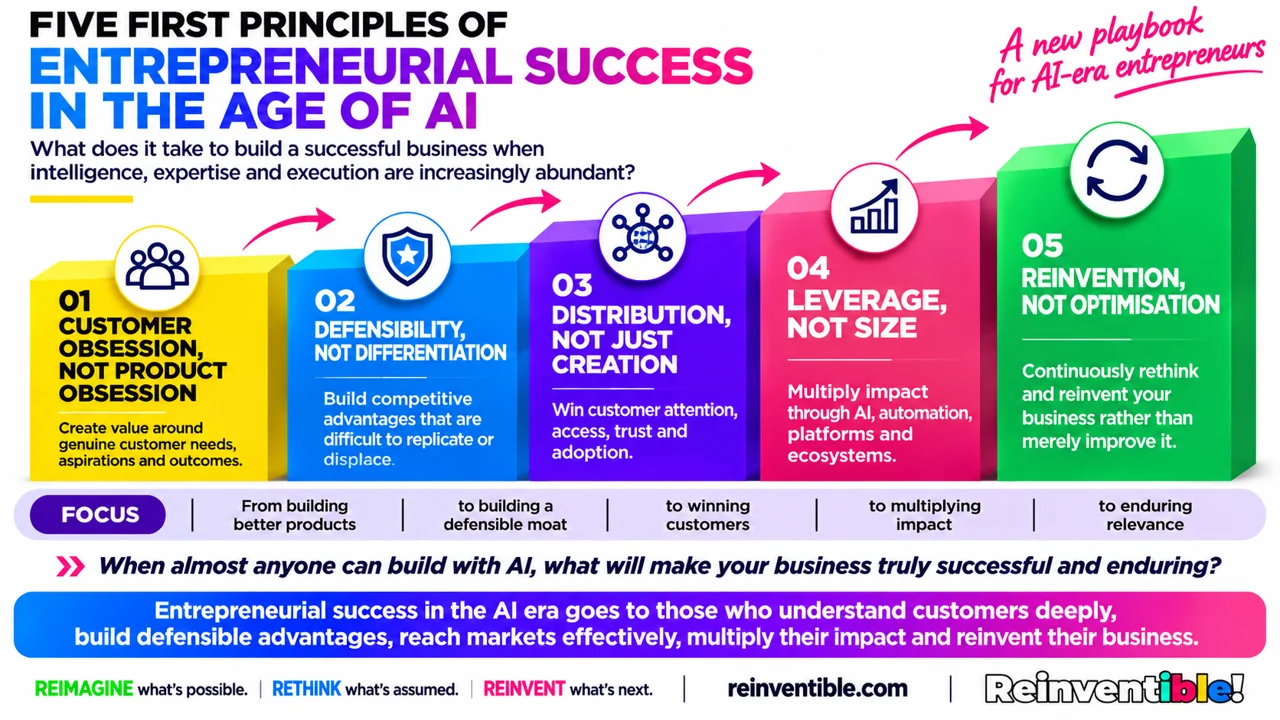
What does it take to build a successful business when intelligence, expertise and execution are increasingly abundant?
AI is radically lowering the barriers to entrepreneurship.
A small team can now research markets, develop products, write software, create content, analyse customers, execute marketing campaigns and automate operations at a level that once required dozens of specialists.
But easier entrepreneurship does not necessarily mean easier entrepreneurial success.
In fact, when everyone gains access to similar intelligence and tools, many traditional competitive advantages begin to disappear.
Ideas become cheaper. Execution becomes faster. Expertise becomes replicable. Imitation becomes easier. Competition multiplies.
The scarce advantage shifts elsewhere.
The entrepreneurs who succeed will not simply be those who use AI most effectively. They will be those who understand customers more deeply, build more defensible businesses, reach markets more effectively, leverage resources more intelligently and continuously reinvent their businesses.
Here are five first principles of entrepreneurial success in the age of AI.
Principle 1: Customer Obsession, Not Product Obsession
Entrepreneurs often fall in love with their products.
They become obsessed with features, functionality, technology and what they have created.
But customers do not fundamentally care about products. They care about what those products help them achieve.
A customer does not want a financial app. They want greater financial security, convenience or freedom.
They do not want an AI assistant. They want to get things done better, faster and with less effort.
The first principle of entrepreneurship is therefore to understand the customer's underlying Jobs-to-be-Done, aspirations, frustrations and desired outcomes.
AI makes product development dramatically easier. This makes understanding what customers genuinely value even more important.
Entrepreneurs must continuously ask:
What progress are our customers really trying to make, and how might we help them achieve it dramatically better?
Customer obsession also means anticipating needs that customers themselves may not yet recognise or articulate.
The greatest entrepreneurial opportunities often emerge not from improving existing products, but from reimagining how customers achieve their desired outcomes.
From building better products to delivering better customer outcomes.
Principle 2: Defensibility, Not Differentiation
For decades, businesses have been taught to differentiate.
Offer better features. Improve quality. Lower prices. Deliver superior service.
But AI raises the competitive bar.
When competitors can rapidly analyse successful products, reproduce features, generate similar content and imitate business models, incremental differentiation becomes increasingly fragile.
Being different is no longer enough.
Entrepreneurs must build something more valuable: defensibility.
A defensible business creates competitive advantages that rivals cannot easily replicate, neutralise or displace.
Such advantages might arise from proprietary data, network effects, switching costs, exclusive access, trusted customer relationships, economies of scale, powerful ecosystems or difficult-to-replicate operating capabilities.
Consider how Amazon built competitive advantages extending beyond its online storefront: an extensive fulfilment network, marketplace network effects, customer relationships and sophisticated technology infrastructure.
Or how Visa and Mastercard benefit from global payment networks whose value depends on extensive participation by financial institutions, merchants and consumers.
These advantages cannot be replicated simply by developing a competing application.
However, defensibility in the AI era does not necessarily mean permanence.
As intelligence, expertise and execution become increasingly accessible, many competitive advantages may become more transient.
A technological edge that once lasted years may disappear in months. A proprietary capability may become widely available through AI platforms. An innovative business model may be replicated before its creator fully captures its value.
Entrepreneurs must therefore recognise that competitive advantage is increasingly something to create, exploit and renew, rather than acquire and protect indefinitely.
The objective is not necessarily to build an impregnable moat, but to establish meaningful advantages while continually developing the next ones.
The entrepreneurial question is therefore not merely:
How can we offer something better or different?
It becomes:
What makes our business difficult to compete against today, and how will we sustain our advantage as the competitive landscape changes?
In an AI-abundant world, the ultimate defensibility may increasingly lie not in any single product, technology or business model, but in an organisation's ability to repeatedly create new sources of competitive advantage.
From standing out to building and renewing competitive advantages.
Principle 3: Distribution, Not Just Creation
Entrepreneurs have traditionally focused heavily on creating great products.
But a great product does not automatically create a great business.
Customers must first discover it, trust it, try it, adopt it and ultimately pay for it.
As AI dramatically reduces the cost and complexity of creating products, the ability to reach and win customers becomes an increasingly important competitive advantage.
The bottleneck shifts from creation to distribution.
An entrepreneur can now build an application in days rather than months. But attracting customers, establishing credibility and developing sustainable acquisition channels may become more difficult and expensive.
Successful entrepreneurs must therefore treat distribution not as an afterthought, but as an integral part of their business model.
That means building effective channels to reach customers through communities, partnerships, platforms, ecosystems, referrals, content, direct relationships, or other forms of market access.
It also means designing products with distribution advantages built in, such as network effects, social virality, platform integrations and customer evangelism.
AI can accelerate content creation, customer engagement and marketing optimisation. But it cannot automatically manufacture genuine trust, attention or loyalty.
The critical question becomes:
How will we consistently reach, attract, convert and retain customers more effectively than our competitors?
In increasingly crowded markets, the business with the best distribution can outperform the business with the best product.
From creating great products to winning customers and markets.
Principle 4: Leverage, Not Size
The traditional entrepreneurial playbook frequently equated success with organisational growth.
More employees. More offices. More capital. More assets.
Businesses expanded their resources to expand their capabilities.
AI fundamentally changes this equation.
Today, a small entrepreneurial team can increasingly accomplish what once required a much larger organisation.
AI agents can execute complex workflows. Automation can handle repetitive processes. Digital platforms can connect businesses to global markets. External ecosystems can provide capabilities without requiring ownership.
This creates a fundamentally different entrepreneurial opportunity.
Instead of asking how many resources a business needs to grow, entrepreneurs should ask:
How can we create and capture new value without proportionately increasing our resources?
The objective is not necessarily to build the largest organisation.
It is to create the greatest possible value, impact and economic return relative to the resources employed.
This requires entrepreneurs to rethink their operating models from first principles.
Which activities genuinely require employees?
Which can be performed by AI agents?
Which capabilities can be accessed through platforms and partnerships?
Which processes can be eliminated entirely?
And how might the business scale tenfold without increasing its workforce tenfold?
Size may still matter in businesses requiring physical infrastructure, capital-intensive assets or extensive operations.
But size should increasingly be the consequence of genuine business needs, not the default measure of entrepreneurial success.
The new entrepreneurial advantage is super leverage: achieving disproportionate results with intelligently orchestrated resources.
From accumulating resources to multiplying impact.
Principle 5: Reinvention, Not Optimisation
Perhaps the greatest danger to entrepreneurial success is success itself.
Once a business model works, entrepreneurs naturally focus on making it work better.
They optimise processes, improve products, reduce costs, expand markets and strengthen existing competitive advantages.
These activities are necessary.
But they can also create a dangerous illusion of progress.
A business can become increasingly efficient at delivering something the market increasingly needs less.
AI makes this risk especially significant.
Technologies evolve. Customer expectations change. Industry boundaries dissolve. Entirely new business models emerge.
What made a business successful yesterday may become the very constraint that prevents it from succeeding tomorrow.
Entrepreneurs must therefore distinguish between optimising the existing business and reinventing the business itself.
Optimisation asks:
How can we make our current business better?
Reinvention asks:
If we were starting from scratch today, knowing what AI now makes possible, would we build the same business?
This requires continually challenging assumptions about customers, products, revenue models, operations and competitive boundaries.
It also requires the courage to disrupt successful products and business models before competitors or new entrants do.
Consider how Netflix moved from DVD rentals to streaming and subsequently into original content production.
Each transition required rethinking the underlying business rather than merely optimising the existing model.
In the AI era, entrepreneurs must develop the capacity to reinvent repeatedly, not just once.
You cannot optimise your way out of a business model that AI is making obsolete.
From incremental improvement to fundamental renewal.
The New Entrepreneurial Playbook
The industrial-era entrepreneurial model often rewarded access to capital, specialised expertise, organisational resources and execution capacity.
AI is increasingly democratising many of these advantages.
But it is not eliminating the fundamental challenges of entrepreneurship.
It is shifting where entrepreneurial advantage resides.
The five first principles reveal a new progression:
- 1. Customer Obsession → Customer Value Understand the progress customers genuinely want to achieve.
- 2. Defensibility → Competitive Advantage Build competitive advantages repeatably so competitors cannot easily copy or catch up.
- 3. Distribution → Market Access Develop superior ways to reach, win and retain customers.
- 4. Leverage → Scalable Economics Multiply output and impact without proportionately multiplying resources.
- 5. Reinvention → Enduring Relevance Continuously renew the business as technologies, markets and customer needs evolve.
These principles are mutually reinforcing.
Customer obsession reveals meaningful opportunities.
Defensibility helps protect the value a business creates from rapid imitation and competitive erosion.
Distribution converts that value into market adoption and commercial success.
Leverage allows the business to grow more efficiently and profitably.
Reinvention ensures that today's competitive advantages do not become tomorrow's constraints.
There is an important tension between defensibility and reinvention.
Defensibility protects the competitive advantage you have built. Reinvention challenges whether that advantage will remain relevant.
Successful entrepreneurs must master both.
They need to build competitive moats without becoming prisoners of them.
The Defining Entrepreneurial Question
When almost anyone can access advanced intelligence, build sophisticated products and automate complex operations, what will separate successful entrepreneurs from everyone else?
The greatest entrepreneurial opportunity of the AI era is not merely to build businesses faster or cheaper.
It is to rethink what kinds of businesses are now possible.
The entrepreneurs who thrive will not merely build successful companies. They will continuously reinvent what entrepreneurial success can mean.
Originally published in Charlie Ang's Intelligent Reinvention Memo newsletter on LinkedIn (Issue 69), part of his "First Principles in the AI Age" series.

Charlie Ang is an Intelligent Reinvention Strategist, corporate futurist and AI keynote speaker based in Singapore and speaking worldwide. He helps organisations and leaders reinvent, rewire and retool for the Age of Intelligence, and has been featured by the BBC, Financial Times, National Geographic and CNA.