 Charlie
For decades, business strategy has been built around a relatively stable set of assumptions.
Industries had recognisable boundaries. Competitive advantages could persist for years. Expertise was scarce. Economies of scale protected incumbents. And strategic planning could reasonably extrapolate from the past.
AI is challenging almost every one of these assumptions.
Intelligence is becoming abundant and inexpensive. Capabilities once exclusive to large enterprises are increasingly accessible to startups and individuals. Products can be replicated faster. Industry boundaries are blurring. And competitive advantages that took decades to build may be undermined in years, sometimes months.
Yet many organisations continue to practise strategy as though the underlying rules of competition have barely changed.
- They analyse existing markets.
- Benchmark existing competitors.
- Set three-to-five-year financial targets.
- Develop strategic plans based on incremental growth.
- And increasingly, add an “AI strategy” to their existing corporate strategy.
But what if the problem is not that businesses lack an AI strategy?
What if business strategy itself needs to be reinvented for the AI era?
To answer that question, we need to return to first principles.
At its most fundamental, business strategy is about making a coherent set of choices to create and capture superior value, build competitive advantage and position an organisation for long-term success under uncertainty.
From this starting point, five principles emerge.
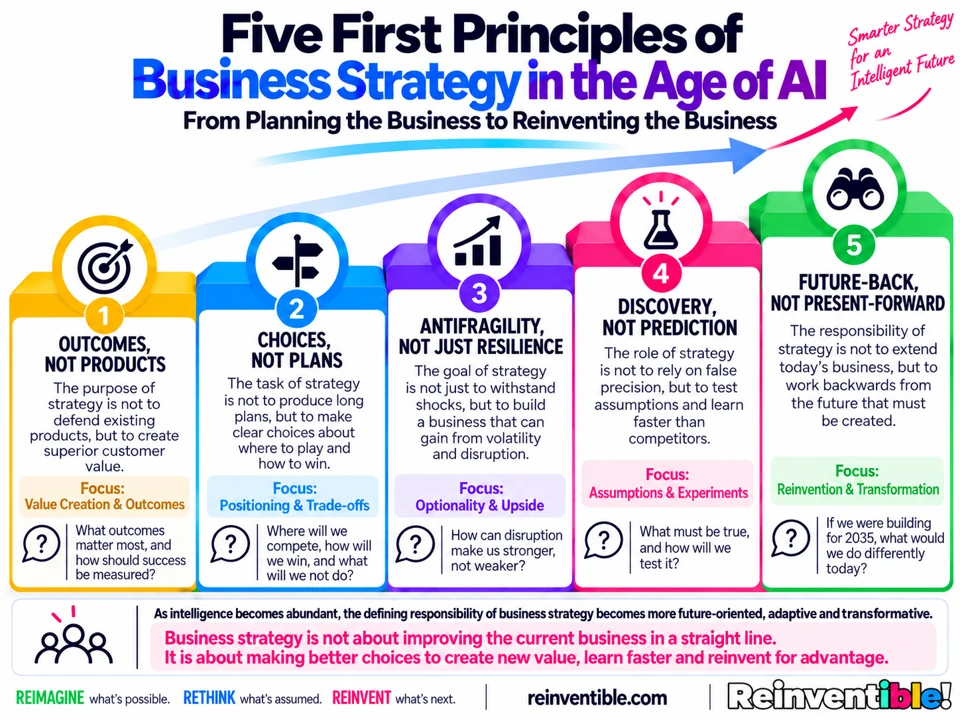
Principle 1: Outcomes, Not Products
The first principle of strategy is to understand the value customers seek, not the products companies currently sell.
Most businesses define themselves by what they produce or provide. Banks offer financial products. Insurers sell insurance policies. Universities provide degrees. Media companies produce content. Logistics companies transport goods.
But customers do not fundamentally want these products.
They want financial security, protection against risk, better career prospects, reliable information and dependable access to goods.
Products are simply the current mechanisms through which these desired outcomes are achieved.
This distinction becomes strategically critical in the AI era. AI can unbundle existing products, automate their underlying functions, personalise their delivery or combine multiple services into entirely new solutions. It may even eliminate the need for certain products altogether.
Consider professional services. Traditionally, consulting firms have sold expertise through billable hours, projects and advisory engagements. But clients do not ultimately want consulting hours. They want better decisions, improved performance, reduced risks and measurable business outcomes.
As AI increasingly commoditises access to expertise, the strategic opportunity may shift from selling expert advice towards delivering outcomes through combinations of human expertise, AI agents, proprietary data and continuous services.
Similarly, an insurance company might rethink its purpose from compensating customers after losses towards preventing losses before they occur. A university might move beyond selling qualifications towards continuously improving an individual’s career relevance and economic opportunities.
These are not merely product innovations. They can fundamentally change the definition of the business.
The essential strategic question is therefore not: “How can we use AI to improve our existing products?”
“What outcomes are customers ultimately trying to achieve, and how might we deliver them in radically better ways?”
Start with the outcome. Then reinvent the business around it.
Principle 2: Choices, Not Plans
The second principle of strategy is that competitive advantage comes from making distinctive choices, not producing elaborate plans.
One of the most persistent misconceptions in business is that strategy is a plan. It is not.
A plan describes what an organisation intends to do. A strategy determines where it will compete, how it intends to win and what it deliberately chooses not to pursue.
That distinction becomes even more important when AI dramatically expands what is technologically possible. Today, virtually every enterprise can identify dozens of AI initiatives:
- Automate customer service
- Deploy AI copilots
- Build autonomous agents
- Personalise customer experiences
- Improve forecasting
- Optimise supply chains
- Develop AI-powered products
- Reinvent entire business processes
Individually, many of these initiatives may be worthwhile. Collectively, however, they do not necessarily constitute a strategy.
An organisation can implement hundreds of AI use cases without fundamentally improving its competitive position. Indeed, if every competitor deploys similar technologies to improve similar processes, the result may simply be greater efficiency across the industry, with much of the resulting value passed to customers through lower prices.
Operational improvement is not the same as strategic differentiation.
Business strategy therefore requires difficult choices.
- Which customer outcomes should we prioritise?
- Which markets and competitive arenas should we enter, defend or exit?
- Where are new value pools emerging as AI disrupts traditional industry boundaries?
- Which capabilities will distinguish us from competitors?
- Where should we concentrate scarce capital, talent and management attention?
- And critically, what should we stop doing?
Consider two banks. Both deploy AI extensively.
One focuses on making existing banking operations more efficient. The other makes a deliberate strategic choice to become the leading financial wellbeing platform for a particular customer segment, integrating personalised advice, predictive intelligence, financial products and proactive interventions.
The first has a collection of AI initiatives. The second has a strategic position it is trying to establish.
This distinction echoes a fundamental insight from Michael Porter: strategy requires trade-offs. Without them, organisations risk becoming indistinguishable from competitors.
In the AI era, this discipline becomes even more important. When technology makes many more things possible, choosing what matters becomes the ultimate strategic constraint.
Strategy is not about doing everything better. It is about choosing where and how to be different.
Principle 3: Antifragility, Not Just Resilience
The third principle of strategy is to design businesses that can benefit from disruption, not merely withstand it.
For years, business leaders have emphasised resilience. Resilient supply chains. Resilient operations. Resilient business models. Resilient organisations.
Resilience is important, especially amid geopolitical tensions, economic uncertainty, technological disruption and increasingly frequent external shocks.
But resilience has a fundamental limitation. It focuses primarily on surviving disruption and recovering from it.
What if the strategic ambition were greater?
Nassim Nicholas Taleb introduced the concept of antifragility to describe systems that actually benefit from certain forms of volatility, stress and disorder. The distinction is profound.
- Fragile systems deteriorate under stress.
- Resilient systems withstand stress and recover.
- Antifragile systems improve through exposure to certain stresses and uncertainties.
Applied to business strategy, this raises a powerful question: “How might we design our business to become stronger because of disruption, rather than merely survive it?”
Consider a traditional company heavily dependent on a single business model, distribution channel or source of competitive advantage. When AI disrupts that model, the organisation may struggle to defend its existing economics.
A more antifragile organisation deliberately develops multiple sources of future value. It experiments with emerging business models. Invests selectively in promising technologies. Builds partnerships across industries. Creates strategic options through ventures, investments and acquisitions. And develops capabilities that can be redeployed when competitive conditions change.
Amazon provides a useful illustration of strategic diversification. Its expansion from online retail into cloud infrastructure, advertising, logistics and other businesses created multiple growth engines with different economic characteristics.
This does not make Amazon immune to disruption, nor does diversification automatically create antifragility. But it illustrates how organisations can develop additional sources of opportunity beyond their original business model.
The deeper strategic principle involves asymmetry. Limit exposure to potentially catastrophic losses while preserving opportunities for disproportionate upside.
A company might allocate most of its resources to strengthening its core business while reserving a smaller portion for high-potential strategic experiments. Many experiments may fail. But a few could create entirely new growth engines. The cost of failure is bounded, while the potential upside may be substantial.
This is especially valuable in the AI era, when technological breakthroughs can suddenly open new markets or undermine established ones.
Importantly, antifragility does not mean embracing every risk or assuming every disruption is beneficial. Some shocks can destroy businesses outright. The objective is to protect against existential threats while positioning the organisation to exploit favourable uncertainty.
Resilience asks how we can survive disruption. Antifragility asks how we can turn disruption into advantage.
Principle 4: Discovery, Not Prediction
The fourth principle of strategy is to replace false certainty with disciplined strategic discovery.
Traditional strategic planning often relies heavily on forecasting: market growth projections, five-year financial models, technology adoption curves, competitive forecasts and capital investment assumptions.
These tools remain useful, especially in relatively stable environments. But the more uncertain the environment, the less reliable precise predictions become. And few environments are more uncertain than the rapidly evolving AI landscape.
- How capable will AI agents become in three years?
- Which professional tasks will be automated?
- How quickly will the economics of intelligence change?
- Which new competitors will emerge?
- What will customers be willing to pay for when many existing capabilities become inexpensive or free?
Any long-term AI strategy inevitably rests on assumptions about questions whose answers are not yet known. The strategic mistake is to treat those assumptions as facts.
This is where Rita McGrath and Ian MacMillan’s concept of discovery-driven planning becomes particularly relevant. Their central insight is that when entering uncertain markets or pursuing novel opportunities, organisations should identify the assumptions necessary for success and systematically test them before making irreversible commitments.
Instead of asking only: “What do we predict will happen?”
Ask: “What must be true for our strategy to succeed, and how can we discover whether it is true?”
Imagine a professional-services firm considering a transition from billing clients by the hour to charging for AI-enabled business outcomes. Its strategy might depend on several critical assumptions.
- Will customers trust AI-enabled delivery?
- Will they pay for outcomes rather than consultant time?
- Can the firm reliably measure those outcomes?
- Will delivery costs fall sufficiently to improve margins?
- Can the operating model scale?
Rather than committing the entire organisation to the new business model immediately, the firm can test these assumptions through pilots, commercial experiments and staged investments. Each experiment generates evidence. Each discovery informs the next strategic decision. And capital commitments increase only as uncertainty decreases.
This requires a fundamentally different approach to strategic planning.
From forecasts to hypotheses. From assumptions to evidence. From large upfront commitments to staged investments. From rigid plans to adaptive strategic decisions.
The objective is not to eliminate uncertainty. It is to reduce the cost of being wrong while increasing the speed at which the organisation discovers what works.
AI itself can accelerate this process through simulation, experimentation, scenario analysis and rapid prototyping. But AI-generated predictions should not be confused with evidence from actual customers and markets.
The ultimate competitive advantage may increasingly belong to organisations that discover strategic truths faster and act on them more decisively.
In an uncertain world, the ability to learn can be more valuable than the ability to forecast.
Principle 5: Future-Back, Not Present-Forward
The fifth principle of strategy is to envision the future business first, then work backwards to determine what must change today.
Most corporate strategies begin with the present. What products do we currently sell? What assets do we own? What capabilities do we possess? What markets are we serving? How can we increase revenue, improve profitability and expand into adjacent markets?
Organisations then extrapolate forward. This is present-forward strategy. It generally assumes the future will resemble the present, with incremental improvements and manageable changes.
But in an age of exponential technological change and structural disruption, that assumption can become dangerous.
A business might become extraordinarily efficient at producing something customers will no longer need. It might optimise an operating model whose underlying economics are about to collapse. Or it might defend an industry position even as the most valuable opportunities migrate outside its traditional boundaries.
AI makes these risks especially acute because it can fundamentally alter what is possible, affordable and valuable.
This is why organisations must complement present-forward planning with future-back strategy. Instead of asking how to extend today’s business into tomorrow, begin with a more provocative question:
“If we were building this business from scratch for the world of 2035, what would it look like?”
- What customer needs would remain?
- How might those needs be fulfilled differently?
- What capabilities would become abundant or nearly free?
- Which activities would be automated?
- Where would scarcity, differentiation and pricing power remain?
- What entirely new business models could emerge?
- And what would an AI-native competitor build if it were unconstrained by our current legacy?
Consider a logistics company. A present-forward strategy might focus on using AI to optimise routes, automate documentation, improve demand forecasts and reduce operating costs. These are valuable improvements.
But a future-back strategy might envision an entirely different business. Instead of merely transporting goods, the company could evolve into an intelligent orchestration platform that predicts supply-chain disruptions, autonomously coordinates logistics providers, optimises sourcing and inventory decisions, and continuously manages customers’ supply-chain outcomes.
This represents a shift from providing logistics services towards managing supply-chain intelligence and outcomes.
The future-back process then works backwards.
- What capabilities would such a business require?
- What data and technology infrastructure must be developed?
- Which partnerships and ecosystems would be necessary?
- What new revenue models could emerge?
- Which existing activities should be automated, reinvented or abandoned?
- And what strategic moves must begin today?
Importantly, future-back strategy is not about predicting one inevitable future. It involves exploring multiple plausible futures, identifying attractive strategic positions and making deliberate choices about which futures the organisation wants to help create.
This is where future-back thinking connects naturally with discovery-driven planning. Future-back thinking establishes strategic ambition. Discovery-driven planning tests the assumptions necessary to achieve it. Antifragility ensures the organisation retains the flexibility and strategic options to thrive even when the future unfolds differently.
The purpose of strategy is not simply to extend the present. It is to create a path towards a future worth winning.
The Reinvention of Business Strategy
The AI era does not make business strategy obsolete. It makes strategy more consequential than ever.
When intelligence becomes increasingly abundant, execution becomes cheaper, imitation becomes faster and industry boundaries become less stable, the traditional foundations of competitive advantage are fundamentally challenged.
Businesses cannot simply add AI initiatives to existing strategies and expect to remain competitive. They must rethink how strategy itself is conceived, developed and executed.
That requires returning to five first principles. Together, these principles redefine business strategy as a continuous process of creating value, making choices, exploiting change, discovering opportunities and shaping the future.
The defining strategic question of the next decade will not be: “What is our AI strategy?”
It will be: “What must our business become in a world where intelligence itself is being reinvented?”
Digital transformation helped organisations compete more effectively in the Digital Era. But the Intelligence Age demands something more fundamental.
Not simply better strategies for existing businesses. Better strategies for reinventing the businesses themselves.
That is the essence of Intelligent Reinvention.
REIMAGINE what’s possible. RETHINK what’s assumed. REINVENT what’s next.
Originally published in Charlie Ang's Intelligent Reinvention Memo newsletter on LinkedIn (Issue 60).

Charlie Ang is an Intelligent Reinvention Strategist, corporate futurist and AI keynote speaker based in Singapore and speaking worldwide. He helps organisations and leaders reinvent, rewire and retool for the Age of Intelligence, and has been featured by the BBC, Financial Times, National Geographic and CNA.