 Charlie
There is a lot of discourse recently on how big AI will be and whether there is excessive hype, particularly in the financial markets.
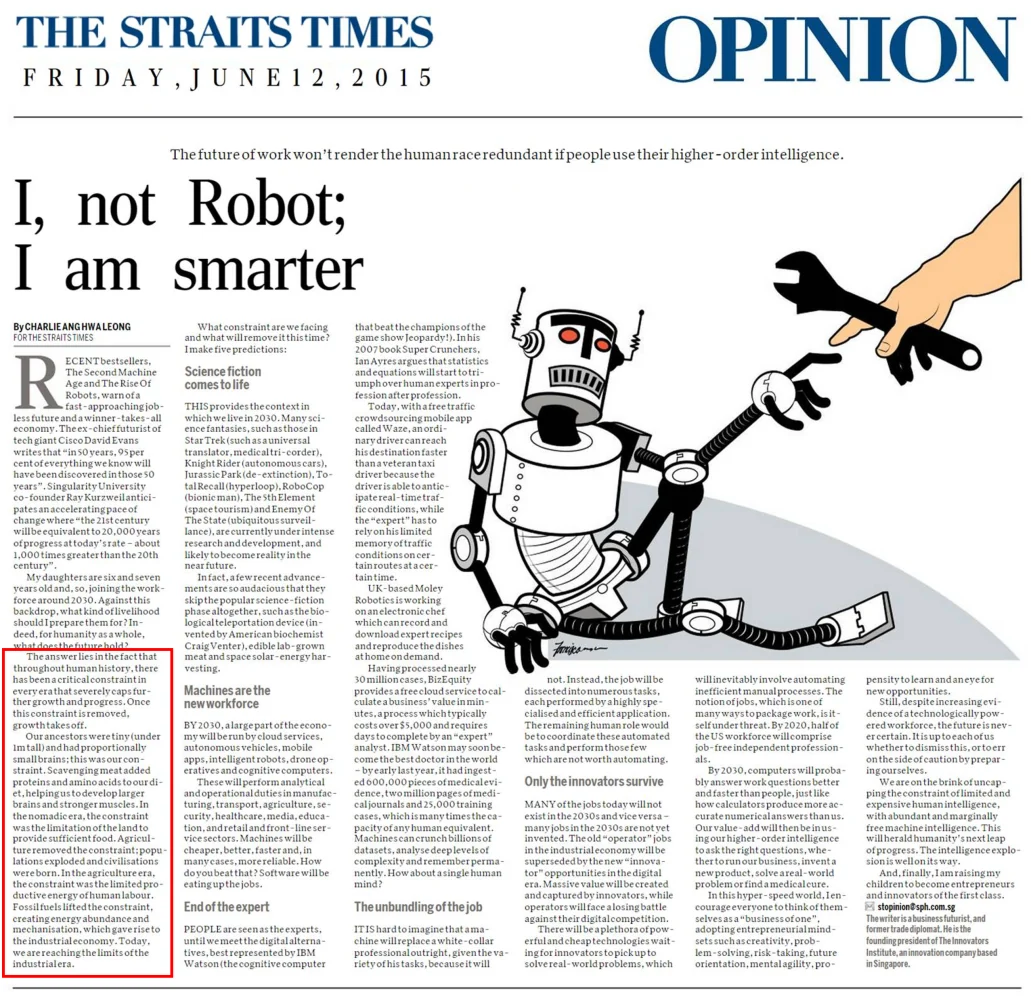
How big will AI be, exactly? I first tackled this "big" question ten years ago, in this opinion piece:
History of Progress
The history of human progress is the story of transcending constraints. These are natural limits that cap growth in human welfare, organization and development. Once that constraint has been breached, growth takes off for a long period of time, until we are capped by the next constraint.
There are countless constraints of all magnitudes that society faces on an ongoing basis. A modern example is: how can we produce enough food for 8.2 billion people with available resources and preferably without significant environmental impact?
For the really big constraints, what I call the "Mother of Constraints", humanity has conquered only three in our deep history. Once a Mother Constraint has been breached, the child and grandchild constraints are subsequently dissolved too.
Now, we are battling the fourth constraint.
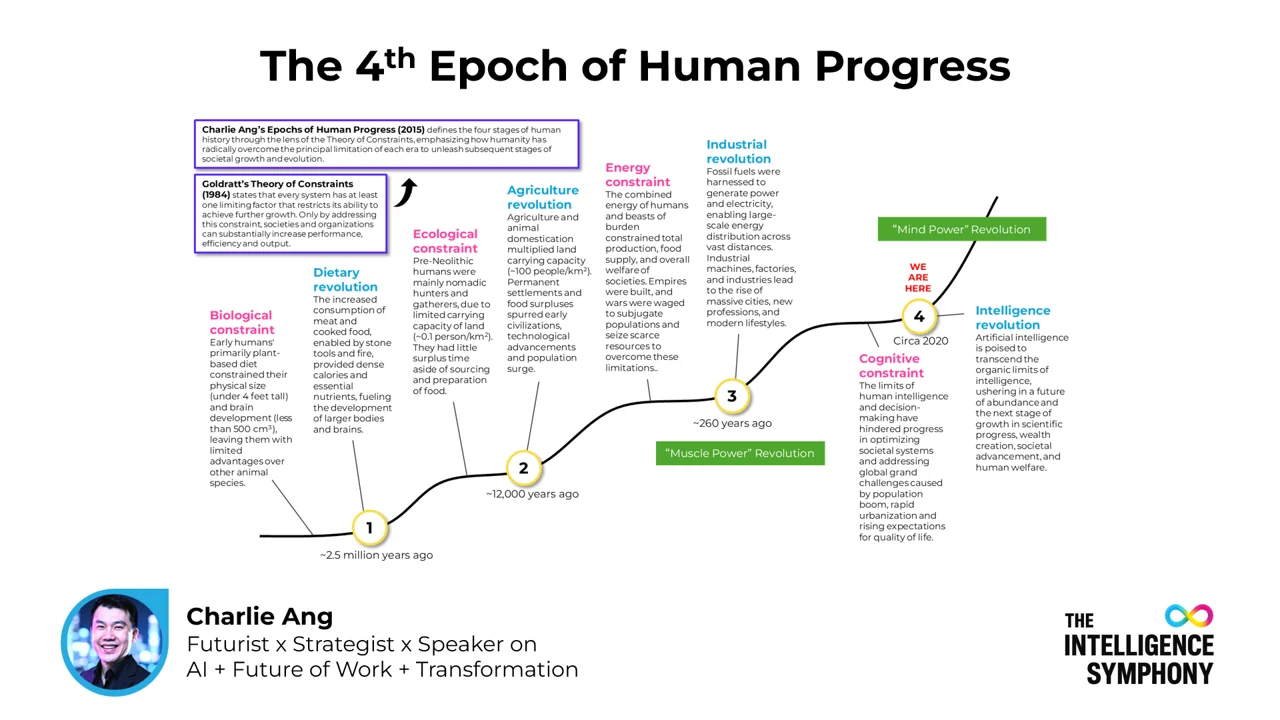
The Four Epochs
Constraint 1
Biological constraint: Early humans' primarily plant-based diet constrained their physical size (under 4 feet tall) and brain development (less than 500 cm³), leaving them with limited advantages over other animal species.
Dietary revolution: The increased consumption of meat and cooked food, enabled by stone tools and fire, provided dense calories and essential nutrients, fueling the development of larger bodies and brains.
Constraint 2
Ecological constraint: Pre-Neolithic humans were mainly nomadic hunters and gatherers, due to the limited carrying capacity of land (~0.1 person/km²). They had little surplus time beyond sourcing and preparing food.
Agriculture revolution: Agriculture and animal domestication multiplied land carrying capacity (~100 people/km²). Permanent settlements and food surpluses spurred early civilizations, technological advancements and population surges.
Constraint 3
Energy constraint: The combined energy of humans and beasts of burden constrained total production, food supply, and overall welfare of societies. Empires were built and wars were waged to subjugate populations and seize scarce resources to overcome these limitations.
Industrial revolution: Fossil fuels were harnessed to generate power and electricity, enabling large-scale energy distribution across vast distances. Industrial machines, factories, and industries led to the rise of massive cities, new professions, and modern lifestyles.
Constraint 4
Cognitive constraint: The limits of human intelligence and decision-making have hindered progress in optimizing societal systems and addressing global grand challenges caused by population boom, rapid urbanization and rising expectations for quality of life.
Intelligence revolution: Artificial intelligence is poised to transcend the organic limits of intelligence, ushering in a future of abundance and the next stage of growth in scientific progress, wealth creation, societal advancement, and human welfare.
Muscle and Mind Power
The energy and cognitive constraints map exactly to the two parts of the four industrial revolutions. Today, we are at the vertical takeoff of the next stage of human progress.
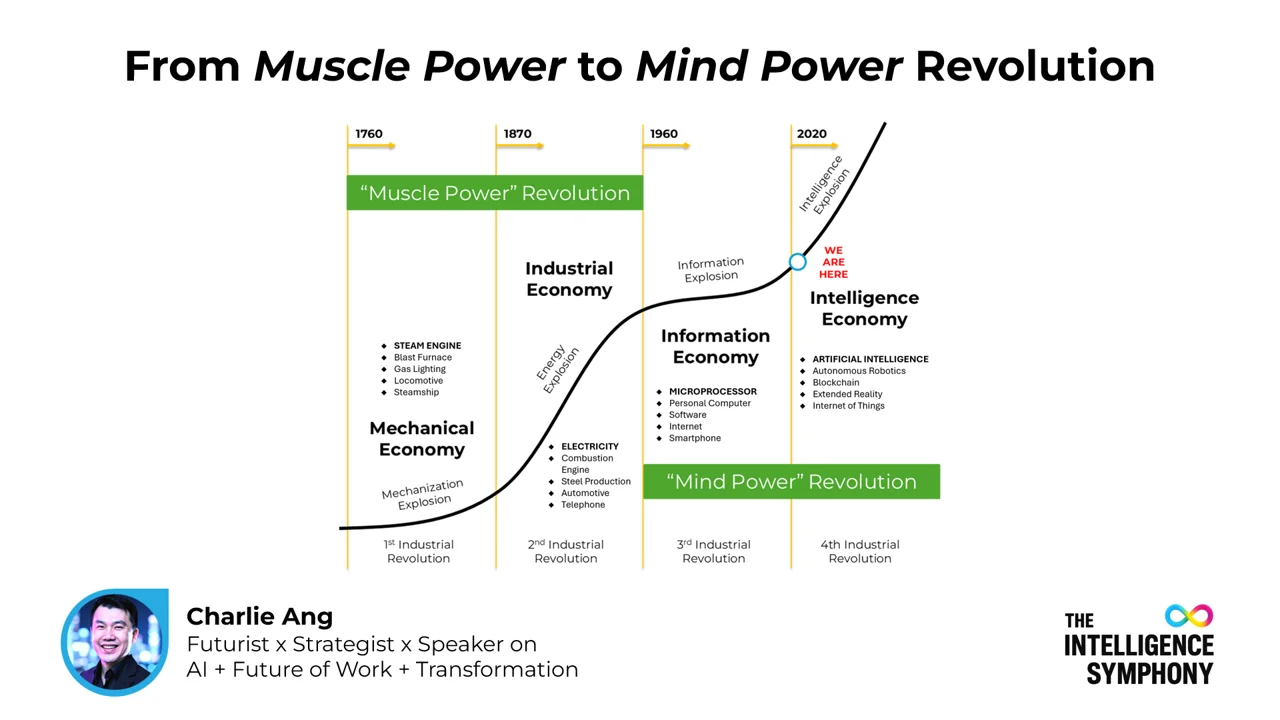
We are very fortunate to be living in the brief moment when humanity is on the verge of overcoming the fourth. We are witnessing grand history unfold in real time.
If you throw a dart across a 2.5-million-year timeline, the probability of being alive in this monumental decade is only 0.0004 percent.
Take a moment to marvel, then spend the rest of your life adjusting to the rocketship ascent of humanity.
Originally published in Charlie Ang's Intelligent Reinvention Memo newsletter on LinkedIn (Issue 31).

Charlie Ang is an Intelligent Reinvention Strategist, corporate futurist and AI keynote speaker based in Singapore and speaking worldwide. He helps organisations and leaders reinvent, rewire and retool for the Age of Intelligence, and has been featured by the BBC, Financial Times, National Geographic and CNA.