 Charlie
For the first time in history, societies have to incorporate Intelligent Machines into our production systems, workflows and daily routines.
We have done it before with animals; horses for rapid mobility, buffaloes to toil the fields, dogs to shepherd cattle, monkeys to pick fruits, pigeons to deliver notes, and worms to produce silk.
While animals extended our physical senses and limbs, digital intelligence amplifies our cognitive faculties and gifts.
While the slow adoption of animals into the primitive workforce took centuries and millennia, the sudden infusion of intelligent agents into our modern workforce will take months and years, at most.
Within organizations, we are witnessing the historical inflection where digital intelligence goes from nowhere to everywhere, invisible to conspicuous and ancillary to integral at the workplace.
This is so big that even the notion of organizations, as in organizing people and work, is poised for its own upgrade to orchestrations, for orchestrating the multiplex of intelligences to get work done, deliver customer value and generate profits.
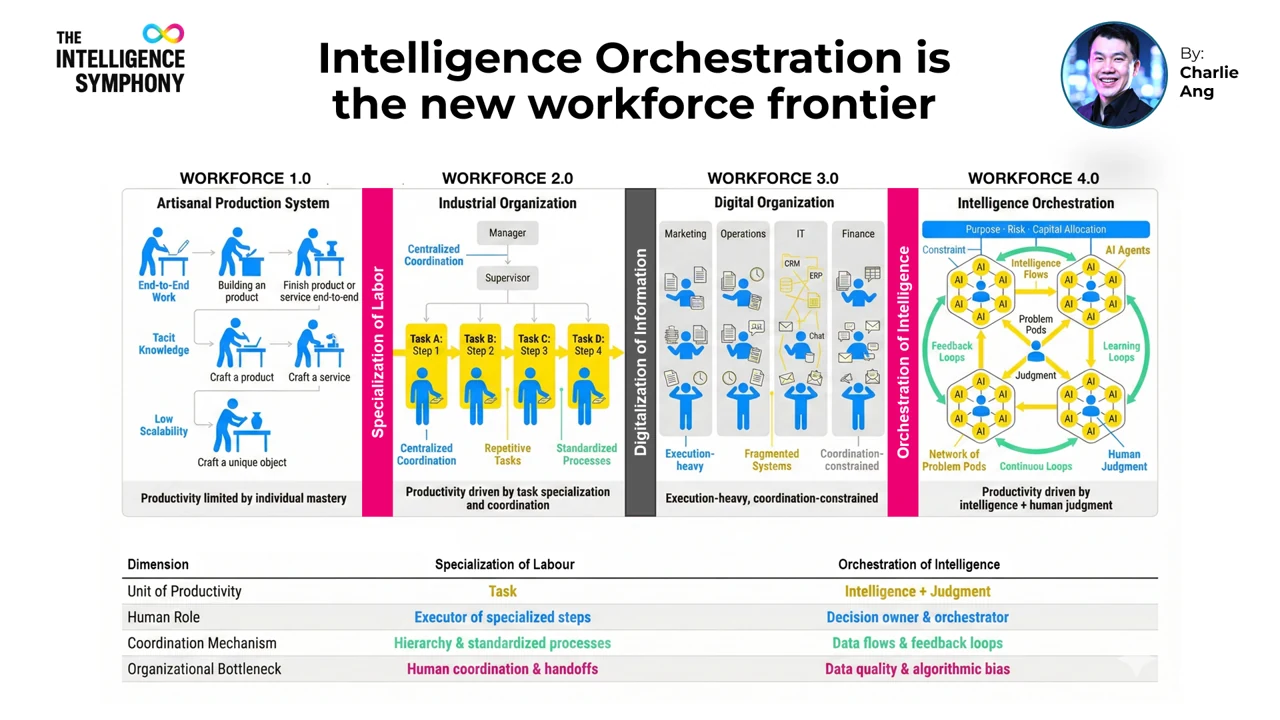
I call them intelligence symphonies and AI-Generation workforces, interchangeably.
To architect this hybrid Human-AI workforce, a new taxonomy, vocabulary and set of building blocks are required.
Introducing the AI-Generation System Design Patterns (AIGP)
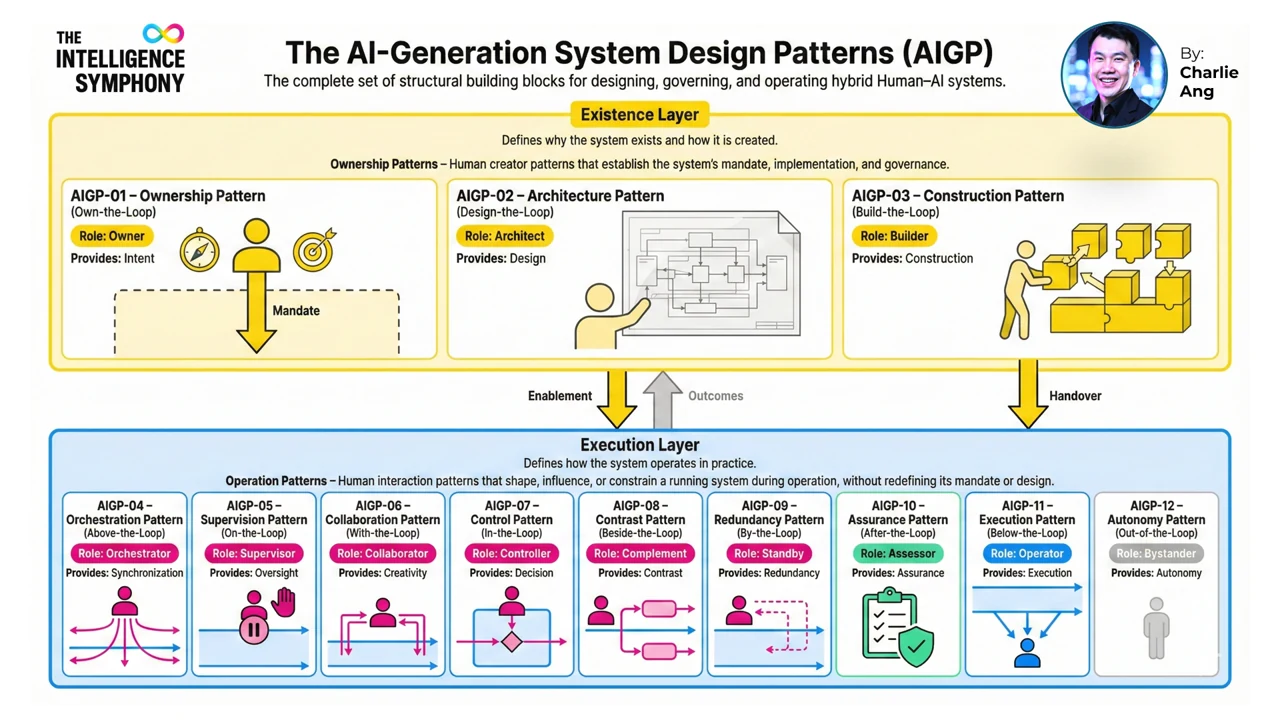
I created AIGP as the near-complete set of building blocks for any Human-AI system, which when nested together, becomes the AI-Generation Workforce of an organization.
Patterns
They are the basic and discrete building blocks of a Human-AI workflow or system. Think of Lego bricks or physical atoms that can be combined into more and more complex structures and functional systems.
There are a total of 12 "Human-X-the-loop" patterns that can cover most usage scenarios.
As an example, when we use an LLM, we are primarily engaged with the "With-the-loop" pattern.
Layers
There are two layers of patterns:
Existence Layer
- the ownership, construction and governance of the system
- consists of 3 Ownership Patterns
- As an analogy, think of this as the development group of a real estate project, comprising the Owner (Own-the-loop), Architect (Design-) and Builder (Build-)
Execution Layer
- the run-time and real-time operation of the system
- consists of 9 Operation Patterns
- As an analogy, think of this as the operations and maintenance group after the real estate project has been completed and handed over.
Pods
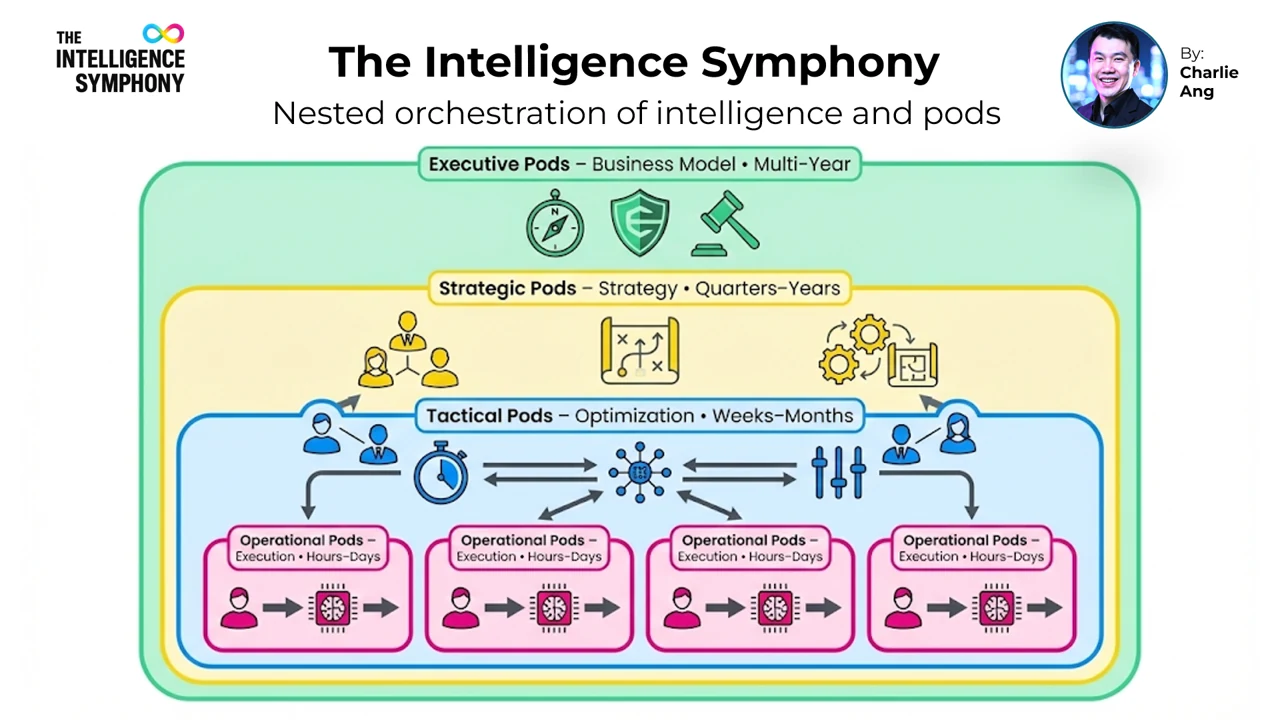
- Are the basic organizing units of the AI-Generation Workforce, similar to teams today
- Orchestration is the real-time coordination, structural integration and hierarchical layering of pods to achieve enterprise goals
- Each pod consists of multi-disciplinary human workers, alongside AI, required to accomplish a stated goal
- Pods and their circular and lateral intelligence loops replace the rigid and siloed structure of corporate hierarchy with vertical information flows
- Permanent pods oversee goals over a longer horizon while transient pods may be formed or dissolved on demand like project teams to accomplish a short-term objective
- They interface, overlap and coordinate with other pods for intelligence flows, feedback loops, and task handovers
- The lowest level pods are Operational Pods, rising to Tactical Pods, Strategic Pods and Executive Pods, the pinnacle pods of the organization.
Summary
With the grand entrance of Agentic AI into enterprises in 2026, the hybrid Human-AI workforce is no longer a fantasy.
We are reimagining the fundamental organizing principle and shape of organizations.
We are bidding goodbye to digital transformation and heralding intelligent reinvention.
The AI-Generation System Design Patterns offer a new conceptual model to visualize, design and communicate the next generation of organizations, the intelligence symphonies.
Refer to the Patterns and Pods Glossaries below for detailed explanations.
Patterns Glossary
AIGP-01: Ownership Pattern (Own-the-Loop)
Definition: Establishes the system’s mandate, sponsorship, legitimacy, risk appetite, and ultimate accountability.
Use Case: A senior executive or business owner formally sponsors a new hybrid human-AI initiative by:
- approving the business case and funding
- assigning executive ownership and decision rights
- defining acceptable risk and compliance boundaries
- committing organizational backing to see the system through delivery and operation
This pattern answers: Who is accountable, who is sponsoring, and why this system exists.
AIGP-02: Architecture Pattern (Design-the-Loop)
Definition: Defines the system’s structure, decision logic, boundaries, and interaction model.
Use Case: Enterprise architects, product owners, and risk teams design the hybrid Human–AI system by:
- determining which decisions are automated, augmented, or human-led
- specifying data sources, inputs, and outputs
- defining escalation points and human intervention thresholds
- embedding auditability, explainability, and control mechanisms
This pattern answers: How should this system work, and under what conditions should humans intervene?
AIGP-03: Construction Pattern (Build-the-Loop)
Definition: Implements and assembles the system according to the approved architecture, making it operational.
Use Case: Engineering teams, vendors, and platform teams build the hybrid Human–AI system by:
- training and integrating models and tools
- configuring workflows, guardrails, and controls
- testing performance, reliability, and failure modes
- deploying the system into production environments
This pattern answers: How do we turn intent and design into a working, reliable system?
AIGP-04: Orchestration Pattern (Above-the-Loop)
Definition: Coordinates and synchronizes multiple hybrid Human–AI workflows to achieve a higher-level outcome.
Use Case: A human orchestrator oversees multiple AI-driven workflows by:
- sequencing tasks across different systems
- resolving conflicts between competing priorities
- reallocating resources when conditions change
- ensuring end-to-end coherence across pods
This pattern answers: How do multiple Human–AI workflows work together as a system?
AIGP-05: Supervision Pattern (On-the-Loop)
Definition: Monitors system behavior in real time and intervenes when predefined conditions are met.
Use Case: A human supervisor oversees an AI-driven process by:
- monitoring performance and anomalies
- pausing or overriding decisions that breach thresholds
- handling edge cases and exceptions
- escalating issues when risk increases
This pattern answers: When and how should humans intervene during operation?
AIGP-06: Collaboration Pattern (With-the-Loop)
Definition: Enables humans and AI to work side-by-side, each contributing complementary strengths.
Use Case: A human collaborator works with AI tools by:
- using AI-generated outputs as creative or analytical input
- refining, curating, or extending AI suggestions
- iterating rapidly through human–AI feedback cycles
- combining human judgment with AI speed and scale
This pattern answers: How do humans and AI jointly solve problems and create solutions?
AIGP-07: Control Pattern (In-the-Loop)
Definition: Requires human decision approval at critical points before the system proceeds.
Use Case: A human controller reviews AI recommendations by:
- approving, modifying, or rejecting decisions
- validating outputs in high-risk or high-impact scenarios
- ensuring compliance with policy or ethical constraints
- acting as the final decision authority
This pattern answers: Which decisions must remain under direct human control?
AIGP-08: Contrast Pattern (Beside-the-Loop)
Definition: Runs human judgment or alternative logic in parallel with the system to provide comparison and challenge.
Use Case: A human complement evaluates system outputs by:
- independently assessing results or recommendations
- comparing human and AI conclusions
- identifying blind spots or systemic bias
- providing an alternative perspective before action
This pattern answers: How do we prevent groupthink or over-reliance on AI outputs?
AIGP-09: Redundancy Pattern (By-the-Loop)
Definition: Keeps humans on standby to take over when the system fails or degrades.
Use Case: A human standby role is maintained by:
- monitoring system availability and reliability
- stepping in during outages or degraded performance
- handling fallback procedures and continuity tasks
- restoring operations during system recovery
This pattern answers: How do we ensure continuity when the system fails?
AIGP-10: Assurance Pattern (After-the-Loop)
Definition: Assesses system outcomes after execution to ensure quality, compliance, and trust.
Use Case: A human assessor reviews system outputs by:
- auditing decisions and actions taken
- verifying compliance with rules and standards
- analyzing errors, bias, or drift
- recommending corrective actions or policy changes
This pattern answers: How do we validate and trust system outcomes over time?
AIGP-11: Execution Pattern (Below-the-Loop)
Definition: Carries out physical or operational actions triggered by the system.
Use Case: A human operator executes tasks by:
- performing actions that require physical presence
- following system-generated instructions
- handling tasks that cannot yet be automated
- closing the loop between digital decisions and real-world action
This pattern answers: How are system decisions translated into real-world action?
AIGP-12: Autonomy Pattern (Out-of-the-Loop)
Definition: Allows the system to operate independently without human involvement.
Use Case: Humans intentionally step out of the loop by:
- delegating full decision authority to the system
- monitoring outcomes only at a macro level
- intervening only if systemic issues arise
- accepting automated operation within agreed boundaries
This pattern answers: When is it appropriate for the system to operate autonomously?
Pods Glossary
AIGP-PL1: Operational Pods
Definition: Execute day-to-day Hybrid Human–AI workflows reliably, efficiently, and at scale.
- Primary focus: Execution
- Decision horizon: Seconds to days
- Accountability: Task completion, efficiency, reliability
What they do:
- Run day-to-day workflows
- Execute decisions within predefined rules
- Handle volume, speed, and consistency
- Respond to routine exceptions and alerts
Typical scope:
- A single workflow or a tightly coupled set of workflows
- High-frequency, repeatable activities
Dominant AIGP patterns:
- In-the-Loop
- With-the-Loop
- By-the-Loop
- Below-the-Loop
- Out-of-the-Loop
Sample Use Cases:
- Transaction processing
- Case handling
- Content production
- Monitoring and response
This pod level answers: How does work get done consistently and efficiently today?
AIGP-PL2: Tactical Pods
Definition: Coordinate, optimize, and adapt multiple operational pods to meet performance targets.
- Primary focus: Optimization and coordination
- Decision horizon: Weeks to months
- Accountability: Performance, quality, trade-offs
What they do:
- Coordinate work across multiple operational pods
- Tune thresholds, priorities, and parameters
- Allocate resources dynamically
- Resolve trade-offs between cost, speed, quality, and risk
Typical scope:
- A capability area or sub-system
- Multiple operational pods working toward a shared objective
Dominant AIGP patterns:
- Above-the-Loop
- On-the-Loop
- Beside-the-Loop
- After-the-Loop
Sample Use Cases:
- Demand optimization
- Capacity planning
- Risk tiering
- Campaign orchestration
This pod level answers: How do we optimize execution across competing objectives?
AIGP-PL3: Strategic Pods
Definition: Shape direction, capability, and system evolution to achieve long-term outcomes.
- Primary focus: Direction and system evolution
- Decision horizon: Quarters to years
- Accountability: Outcomes, positioning, long-term value
What they do:
- Decide which pods, sub-systems, and capabilities should exist
- Define success metrics and strategic priorities
- Allocate investment and sponsorship
- Reconfigure systems in response to market, regulatory, or technology shifts
Typical scope:
- An enterprise sub-system or outcome system
- Numerous tactical and operational pods
Dominant AIGP patterns:
- Own-the-Loop
- Design-the-Loop
- Build-the-Loop
Sample Use Cases:
- Growth strategy
- Platform strategy
- Capability build-out
- Portfolio shaping
This pod level answers: What capabilities should we build, change, or retire to win over time?
AIGP-PL4: Executive Pods
Definition: Establish enterprise mandate, legitimacy, and stewardship across all pods.
- Primary focus: Mandate and stewardship
- Decision horizon: Multi-year / existential
- Accountability: Enterprise survival, trust, and coherence
What they do:
- Set organizational purpose, values, and strategic guardrails
- Approve mandates, sponsorship, and risk appetite
- Ensure coherence across strategic, tactical, and operational pods
- Accept or reject systemic risk on behalf of the enterprise
Typical scope:
- Whole-of-enterprise
- Portfolio of strategic pods and enterprise systems
Dominant AIGP patterns:
- Own-the-Loop (constitutional governance)
Use Case Examples:
- Mission and values setting
- Business model choices
- Capital allocation
- Regulatory posture
- Systemic risk acceptance
This pod level answers: Why does this organization exist, and under what authority does it operate?
Originally published in Charlie Ang's Intelligent Reinvention Memo newsletter on LinkedIn (Issue 40).

Charlie Ang is an Intelligent Reinvention Strategist, corporate futurist and AI keynote speaker based in Singapore and speaking worldwide. He helps organisations and leaders reinvent, rewire and retool for the Age of Intelligence, and has been featured by the BBC, Financial Times, National Geographic and CNA.