 Charlie
For more than a century, the economics of professional services have rested on one fundamental scarcity: expert human intelligence.
Law firms sold legal expertise. Consulting firms sold strategic expertise. Accounting firms sold financial and regulatory expertise. Investment banks sold analytical and transactional expertise.
Clients could not easily replicate this knowledge internally. So they paid premium fees to access highly trained professionals, supported by armies of analysts, associates, accountants and consultants.
Artificial intelligence is beginning to break that scarcity.
AI can increasingly research, analyse, draft, synthesise, model, review, benchmark and reason across enormous bodies of professional knowledge. AI agents are moving beyond answering questions toward executing complete workflows.
That does not mean lawyers, consultants or accountants disappear.
It means something potentially more consequential:
The industrial model through which professional expertise has been produced, priced and delivered is starting to become obsolete.
And professional services may therefore be entering the largest business model disruption in their history.
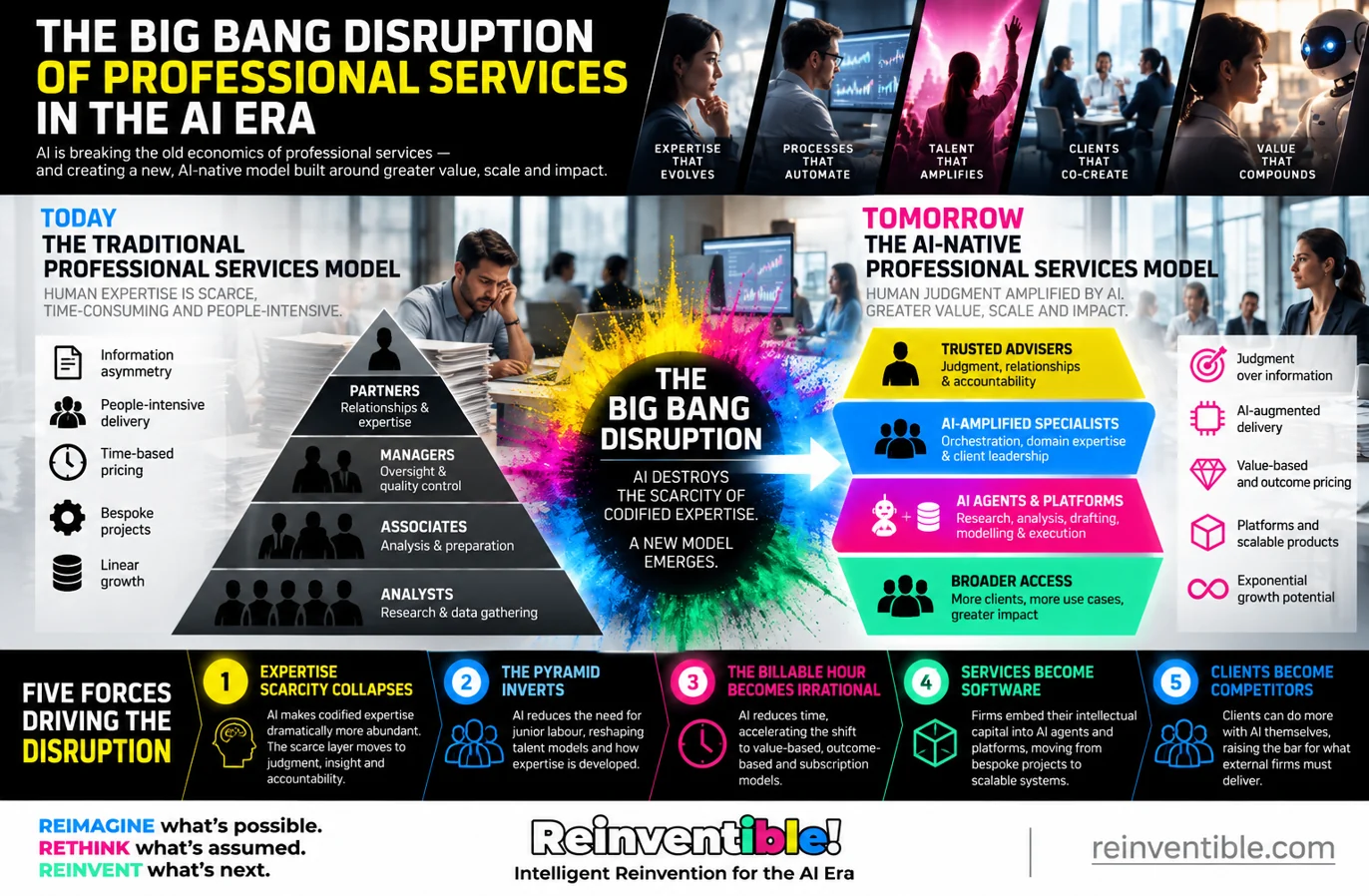
The professional services machine
The traditional professional services model is remarkably elegant.
At the top sits a relatively small number of partners with deep expertise, relationships and reputations.
Beneath them sits a much larger base of managers, associates and analysts doing research, modelling, document preparation, due diligence, analysis and execution.
The firm buys human intelligence in the form of salaries and sells that intelligence back to clients in the form of billable hours.
Scale comes through leverage.
One partner can oversee several managers. Each manager can oversee several associates. Those associates can in turn supervise analysts.
The pyramid is therefore not simply an organisational structure.
It is the economic engine of the firm.
AI now enters this engine at precisely the point where much of the leverage has historically been created.
Research that took an analyst several days can increasingly be done in hours.
Large document sets can be reviewed algorithmically.
First drafts of contracts, reports, presentations and analyses can be generated instantly.
Financial models can be constructed and interrogated conversationally.
Tax and regulatory research can be searched and synthesised across vast bodies of material.
Thomson Reuters estimates that professionals in legal, tax and accounting could save around 240 hours per year through AI, translating into an estimated US$32 billion annual economic impact across those US sectors alone. (Thomson Reuters)
Those numbers matter.
But the bigger issue is what happens when those productivity gains compound across the entire professional-services production system.
| Disruption | What AI breaks | What becomes valuable |
|---|---|---|
| 1. Expertise scarcity collapses | The information asymmetry that justified high fees | Judgment, framing the right problem and accepting responsibility for decisions |
| 2. The pyramid inverts | Leverage built on large amounts of junior labour | A diamond or hourglass model, and new ways to create expertise |
| 3. The billable hour breaks | Time-based pricing | Value-based, outcome-based and subscription-based models |
| 4. Services become software | Bespoke, one-off projects | Intelligence systems supervised by humans (Service-as-Software) |
| 5. Clients become competitors | Work clients once had to send outside | What clients still need when they possess the same intelligence |
Disruption #1: The collapse of expertise scarcity
Professional services have historically benefited from enormous information asymmetry.
The professional knew things the client did not.
The consultant had access to proprietary frameworks and industry benchmarks.
The lawyer understood thousands of pages of case law.
The accountant understood complex standards and regulations.
The banker understood how transactions were structured and valued.
That information asymmetry justified high fees.
AI compresses it.
A capable executive with sophisticated AI tools can already perform forms of industry research, competitive analysis, financial analysis and strategic synthesis that once required teams of junior professionals.
Corporate legal departments can increasingly perform work internally that would previously have been sent outside.
Tax departments can automate substantial amounts of research and preparation.
Expertise does not become worthless.
But codified expertise becomes dramatically more abundant.
The scarce layer moves upward.
From knowing information to exercising judgment.
From producing analysis to framing the right problem.
From creating a presentation to deciding what the organisation should actually do.
From providing answers to accepting responsibility for consequential decisions.
That distinction will define much of the future professional-services hierarchy.
Disruption #2: The professional-services pyramid starts to invert
The traditional pyramid assumes large amounts of junior labour.
But junior professionals disproportionately perform exactly the work AI handles best: searching, summarising, reviewing, preparing, benchmarking, modelling and drafting.
That creates a structural problem.
If one experienced professional with AI can accomplish work that previously required several juniors, firms need fewer people at the bottom of the pyramid.
Signs of this are already visible.
The Big Four have been reducing some graduate intake while simultaneously competing aggressively for AI talent. An FT analysis found that the Big Four posted more vacancies for AI specialists than for auditors across English-speaking markets in 2025. (Financial Times) ICAEW has separately reported reductions in graduate intake across the Big Four, while cautioning that junior professionals will continue to be needed in redesigned roles. (ICAEW)
The future professional-services organisation may therefore look less like a pyramid and more like a diamond or hourglass.
A smaller number of AI-amplified professionals at the bottom.
A powerful layer of experienced specialists, orchestrators and client leaders in the middle.
And senior rainmakers, trusted advisers and domain authorities at the top.
But this creates another problem.
Junior work has historically been how future experts learned.
You became an excellent consultant by conducting hundreds of analyses.
You became an excellent lawyer by reviewing contracts and researching cases.
You became an excellent auditor by working through accounts.
Remove the apprenticeship work and firms must reinvent how expertise itself is created.
AI therefore disrupts both the firm's labour model and its talent-development model simultaneously.
Disruption #3: The billable hour becomes economically irrational
AI creates an even more uncomfortable problem.
Professional services frequently charge clients for time.
AI reduces time.
Consider the contradiction.
A firm invests heavily in AI so that a task requiring ten hours can now be completed in two.
Under an hourly model, the firm has just destroyed 80 per cent of its own revenue.
This is why AI will accelerate the migration from time-based pricing toward value-based, outcome-based and subscription-based models.
Thomson Reuters has already argued that AI efficiency is putting pressure on traditional legal billing economics and increasing the attractiveness of pricing based on outcomes rather than hours consumed. (Thomson Reuters)
Clients will increasingly ask a very simple question:
Why should I pay for 1,000 hours of work if AI enables you to produce the same result in 100?
Professional firms will eventually need an equally simple answer:
You are not buying our hours. You are buying the outcome.
That sounds obvious.
But it represents a profound redesign of the economics of professional services.
For the firms that do not adjust to this new reality, revenue compression will be inevitable.
Disruption #4: Services start becoming software
Professional firms have traditionally sold bespoke projects.
AI makes it increasingly possible to embed their intellectual capital into reusable systems.
Imagine a strategy consultancy that does not simply deliver a transformation report but provides an always-on AI strategy agent trained on its methodologies, benchmarks and accumulated experience.
A law firm that does not simply draft contracts but operates a continuously running contracting intelligence platform.
An accounting firm that does not perform periodic reviews but continuously monitors transactions, controls and risks.
This transition is already beginning.
McKinsey describes its Lilli platform as infrastructure capable of rewiring how its consultants conduct research, analysis, planning and creative problem solving. (McKinsey & Company)
Deloitte has embedded networks of AI agents into its Omnia audit platform to coordinate and execute workflows across its global audit organisation. (Deloitte)
Harvey says more than 200,000 lawyers across 2,400 organisations now use its legal AI platform, and in September 2026 announced a US$15.5 billion valuation. (Harvey)
Professional services are therefore beginning to cross an important boundary:
From selling human work supported by software to selling intelligence systems supervised by humans.
That is a fundamentally different business. This model is increasingly known as Service-As-Software (SaS), flipping the Software-as-a-Service (SaaS) paradigm.
Disruption #5: Clients become competitors
AI attacks professional services from both sides.
It changes how firms produce their work.
But it also increases what clients can do themselves.
This second force may ultimately prove even more disruptive.
A corporate strategy team equipped with enterprise AI agents can perform significant amounts of research, scenario analysis and competitive intelligence internally.
A general counsel can deploy AI across contract review, discovery and legal research.
A finance team can automate reporting, tax analysis and compliance processes.
The question facing professional firms therefore changes from:
How do we use AI to perform our existing services more efficiently?
to:
What will clients still need us for when they possess much of the same intelligence themselves?
That is the real strategic question.
And answering it requires moving beyond AI adoption into strategic reinvention.
The paradox: professional services could become smaller and much larger
This disruption does not necessarily mean professional services shrink.
There is another possibility.
When something becomes dramatically cheaper, demand frequently expands.
Spreadsheets did not eliminate financial analysis. They multiplied it.
Software did not eliminate business processes. It digitised billions more of them.
AI may similarly create an explosion of demand for sophisticated professional intelligence.
Companies will confront more strategic choices, regulatory questions, technological possibilities and organisational transformations than ever before.
Accenture offers an early indication of this opportunity. Its fiscal 2025 generative and agentic AI revenue reached US$2.7 billion, triple the previous year, while bookings reached US$5.9 billion. (Accenture)
So the market may not disappear.
It may bifurcate.
Commodity professional work becomes automated, internalised or dramatically cheaper.
At the same time, demand expands for difficult work involving judgment, reinvention, systems integration, implementation, governance and accountability.
The middle gets squeezed.
The frontier gets larger.
From professional services firm to intelligent outcomes company
The winning firms of the Intelligence Age may consequently look very different from today's partnerships.
Their competitive advantage will increasingly come from combining several forms of capital:
- Human judgment.
- Proprietary data.
- Domain expertise.
- AI agents.
- Unique methodologies and intellectual property.
- Technology platforms.
- Client relationships and trust.
- Implementation capability.
- Ecosystems.
The objective will no longer be maximising utilisation across thousands of professionals.
It will be maximising intelligence leverage.
How much client value and how many customer outcomes can one exceptional professional create when amplified by hundreds of specialised AI agents?
How can the accumulated knowledge of an entire firm become available instantly to every professional?
Which services should remain human-led?
Which should become AI-native?
Which should become products?
Which should become platforms?
Which should disappear altogether?
Those are reinvention questions, not technology questions.
Professional services need Intelligent Reinvention
This is why simply deploying copilots across an existing professional services firm is insufficient.
That produces an AI-enhanced version of the old model.
The greater opportunity is to rethink the model itself.
The consulting firm of the AI era should not merely ask how AI can produce better work faster.
It should ask what strategic advisory becomes when analysis is abundant.
The law firm should not merely automate contract drafting.
It should rethink legal services when legal intelligence can operate continuously.
The accounting firm should not merely automate audit work.
It should rethink assurance when every transaction can potentially be examined by intelligent systems in real time.
Professional services spent decades monetising the scarcity of human intelligence.
AI is making intelligence increasingly abundant.
That changes almost everything.
The firms that merely automate today's work may become more efficient.
The firms that reinvent what professional services can become may define the next era.
The greatest disruption will not come from AI replacing professionals.
It will come from AI destroying the assumptions on which the professional services business model was constructed.
This is the Big Bang Disruption of Professional Services in the AI Era. And we are watching it play out in real-time.
Originally published in Charlie Ang's Intelligent Reinvention Memo newsletter on LinkedIn (Issue 55).

Charlie Ang is an Intelligent Reinvention Strategist, corporate futurist and AI keynote speaker based in Singapore and speaking worldwide. He helps organisations and leaders reinvent, rewire and retool for the Age of Intelligence, and has been featured by the BBC, Financial Times, National Geographic and CNA.