Technology advancement, industry disruption, organisational dynamics, and workforce impact are intricately interconnected threads of the AI era.

Yet most of us interpret what is coming by reading each thread separately.

Not any more.

As an AI Futurist, I have constructed an integrated story of the near-term future through 2030 and beyond, called The Great Intelligence Shock™.
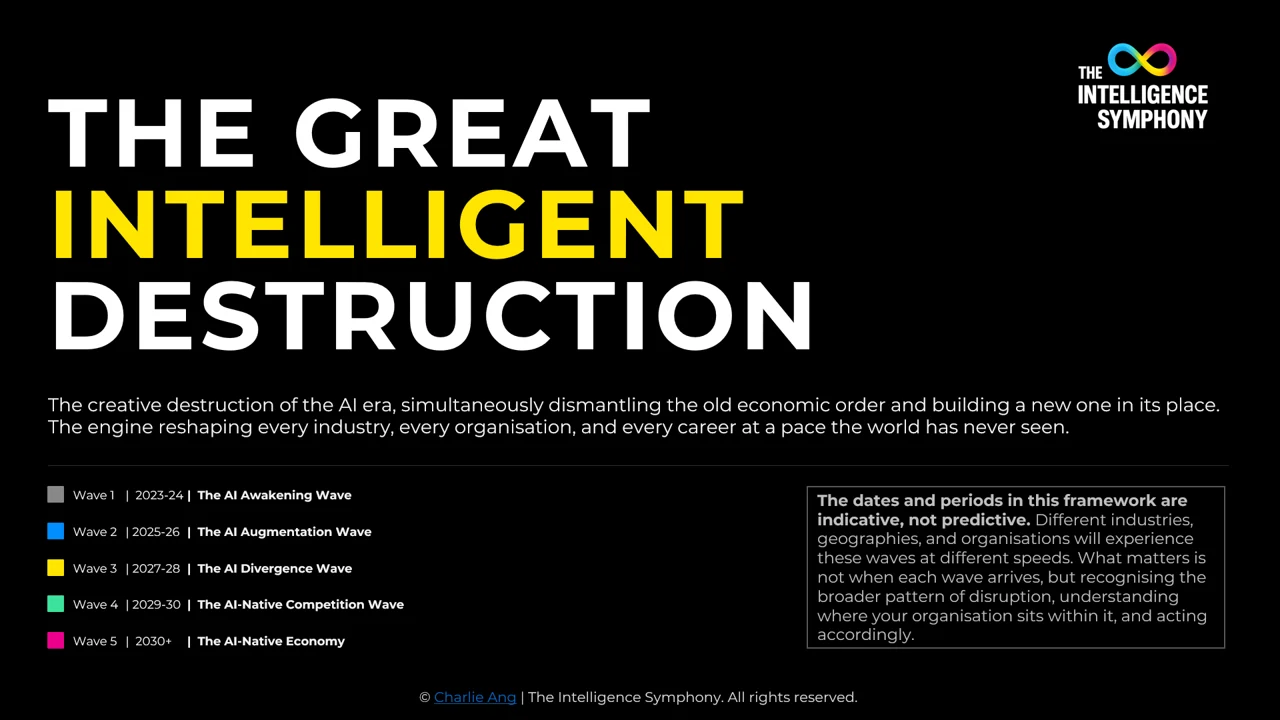
The Great Intelligence Shock by Charlie Ang, shown under its earlier title The Great Intelligent Destruction: the creative destruction of the AI era, simultaneously dismantling the old economic order and building a new one in its place. Five waves: Wave 1, 2023 to 2024, the AI Awakening Wave; Wave 2, 2025 to 2026, the AI Augmentation Wave; Wave 3, 2027 to 2028, the AI Divergence Wave; Wave 4, 2029 to 2030, the AI-Native Competition Wave; Wave 5, 2030 onwards, the AI-Native Economy. The dates are indicative, not predictive.
The Great Intelligence Shock™: five waves, with dates that are indicative, not predictive.Click to enlargeTap to enlarge

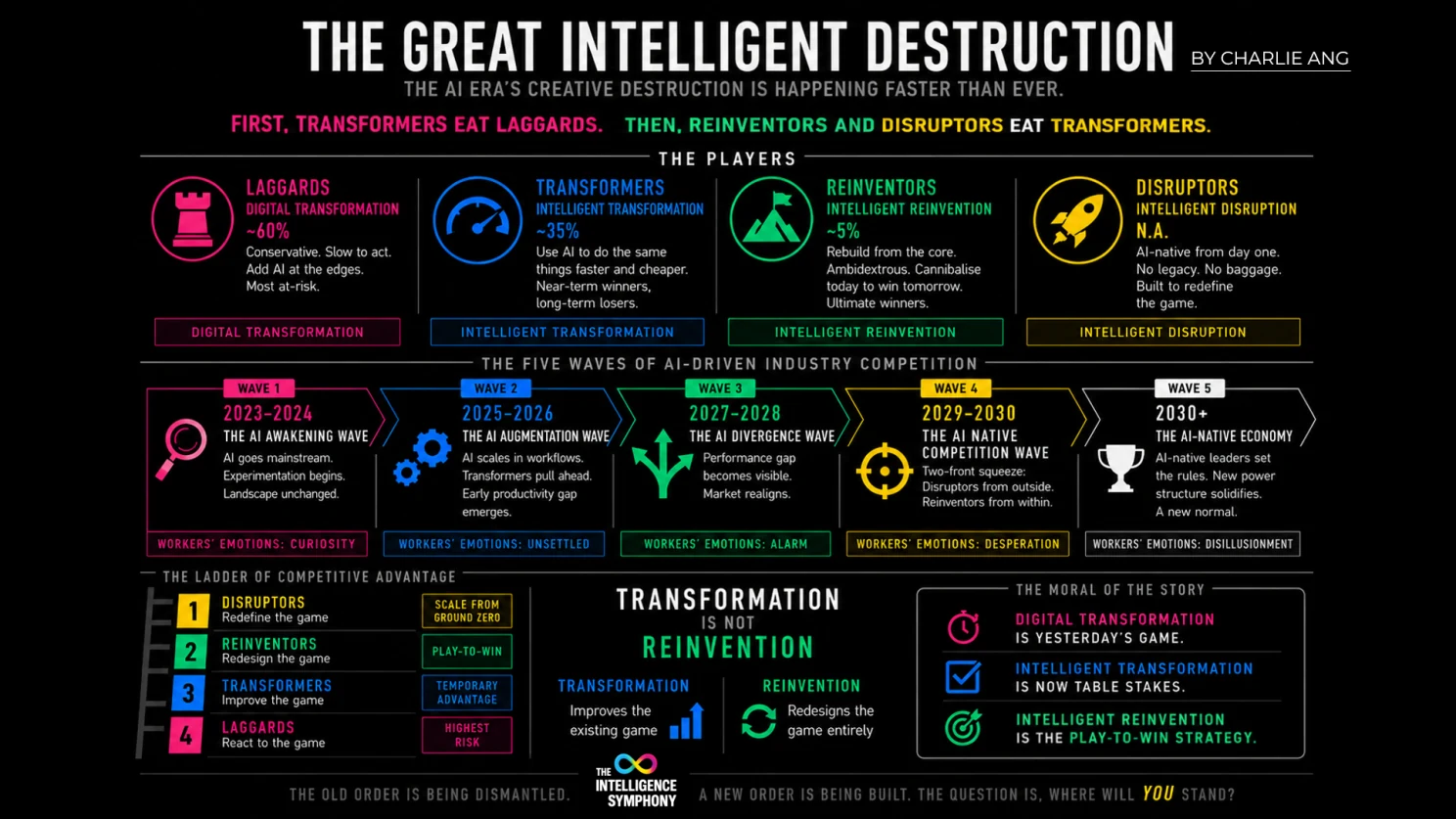
Below is the visual summary.

The Great Intelligence Shock infographic by Charlie Ang, shown under its earlier title The Great Intelligent Destruction. The AI era's creative destruction is happening faster than ever. First, Transformers eat Laggards. Then, Reinventors and Disruptors eat Transformers. The players: Laggards, about 60 percent, digital transformation, most at risk; Transformers, about 35 percent, intelligent transformation, near-term winners and long-term losers; Reinventors, about 5 percent, intelligent reinvention, ultimate winners; Disruptors, AI-native from day one, intelligent disruption. The five waves of AI-driven industry competition run from the AI Awakening Wave in 2023 to 2024 to the AI-Native Economy from 2030, with workers' emotions moving from curiosity to unsettled, alarm, desperation and disillusionment. The ladder of competitive advantage: Disruptors redefine the game, Reinventors redesign it, Transformers improve it, Laggards react to it. Transformation improves the existing game; reinvention redesigns the game entirely. The moral of the story: digital transformation is yesterday's game, intelligent transformation is now table stakes, intelligent reinvention is the play-to-win strategy.
The visual summary: the players, the five waves, the ladder of competitive advantage and the moral of the story.Click to enlargeTap to enlarge

It narrates the hyper-accelerated creative destruction of economies, industries, businesses, and careers unleashed by AI.

And features Four Types of Organisational Actors competing across Five Waves of Industry Competition from 2023 to 2030.

The players
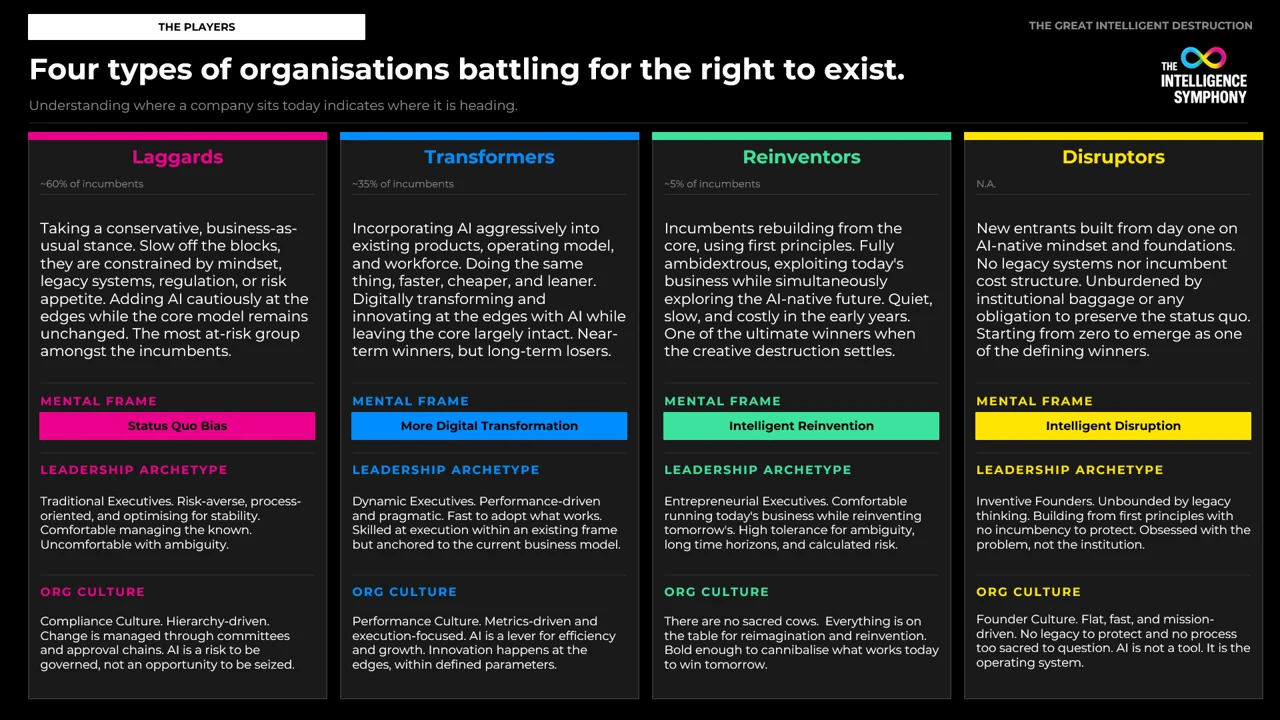
Four types of organisations battling for the right to exist. Laggards, about 60 percent of incumbents: conservative and slow, mental frame status quo bias, traditional executives, compliance culture. Transformers, about 35 percent: incorporating AI aggressively while leaving the core intact, mental frame more digital transformation, dynamic executives, performance culture. Reinventors, about 5 percent: rebuilding from the core using first principles, fully ambidextrous, mental frame Intelligent Reinvention, entrepreneurial executives, no sacred cows. Disruptors: new entrants built AI-native from day one, mental frame Intelligent Disruption, inventive founders, founder culture where AI is the operating system.
Four types of organisations battling for the right to exist: mental frame, leadership archetype and culture.Click to enlargeTap to enlarge
The four players at a glance
PlayerShare of incumbentsMental frameOutlook
Laggards~60%Status quo biasThe most at-risk group amongst the incumbents
Transformers~35%More digital transformationNear-term winners, but long-term losers
Reinventors~5%Intelligent ReinventionOne of the ultimate winners when the creative destruction settles
DisruptorsN.A. (new entrants)Intelligent DisruptionStarting from zero to emerge as one of the defining winners

The five waves

The five waves of AI-driven industry competition
WavePeriodState of playWorkers' emotions
1. The AI Awakening Wave2023–2024AI goes mainstream. Experimentation begins. Landscape unchanged.Curiosity
2. The AI Augmentation Wave2025–2026AI scales in workflows. Transformers pull ahead. Early productivity gap emerges.Unsettled
3. The AI Divergence Wave2027–2028Performance gap becomes visible. Market realigns.Alarm
4. The AI-Native Competition Wave2029–2030Two-front squeeze: Disruptors from outside, Reinventors from within.Desperation
5. The AI-Native Economy2030+AI-native leaders set the rules. New power structure solidifies. A new normal.Disillusionment

This is not just a technology story. It is an economic story. A business story. And every worker's story. All told at once.

The timeframes are indicative. What matters more is the broader pattern of disruption and how those separate threads play out as one cohesive narrative.

The waves are illustrated as snapshots of an RTS-styled wargame in action, with indicators and metrics showing the state of play at each turn.

The moral of the story?

Digital Transformation is yesterday's game.

Intelligent Transformation is now table stakes.

Intelligent Reinvention is the play-to-win strategy.
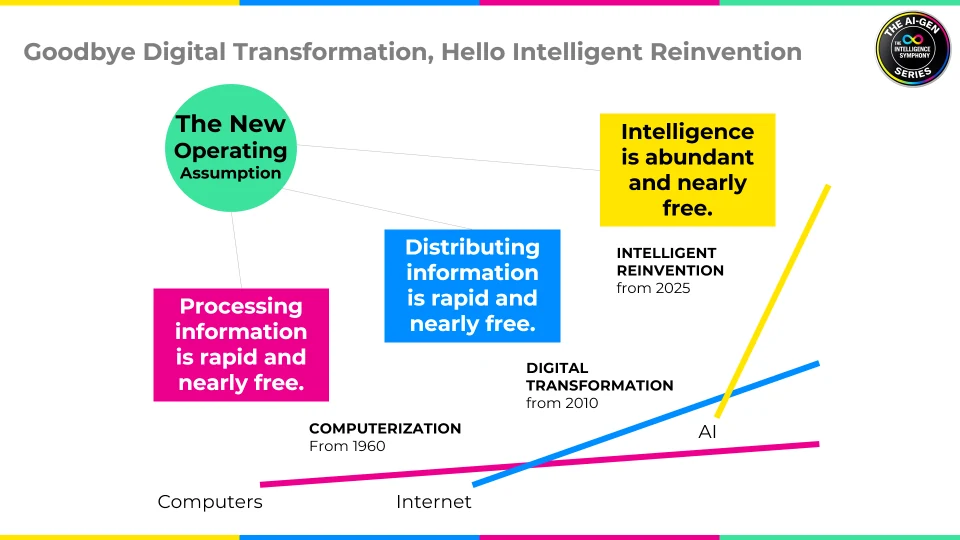
Goodbye Digital Transformation, Hello Intelligent Reinvention. Computerization from 1960 made processing information rapid and nearly free. Digital transformation from 2010, driven by the internet, made distributing information rapid and nearly free. Intelligent Reinvention from 2025, driven by AI, rests on a new operating assumption: intelligence is abundant and nearly free.
Goodbye Digital Transformation, Hello Intelligent Reinvention: the new operating assumption.Click to enlargeTap to enlarge

Originally published in Charlie Ang's Intelligent Reinvention Memo newsletter on LinkedIn (Issue 50).

About the author
Charlie Ang

Charlie Ang is an Intelligent Reinvention Strategist, corporate futurist and AI keynote speaker based in Singapore and speaking worldwide. He helps organisations and leaders reinvent, rewire and retool for the Age of Intelligence, and has been featured by the BBC, Financial Times, National Geographic and CNA.