 Charlie
The Old Europe in Serenity
5,500 years ago, much of Europe was a land of settled agricultural life.
For centuries, farming communities had flourished across the continent.
These Neolithic societies built permanent settlements, cultivated crops, raised livestock and organised their lives around agricultural, social and seasonal rhythms.
Some communities were relatively egalitarian, while others developed more complex social hierarchies. Their cultures, beliefs and institutions varied considerably.
But they shared something fundamental.
Their way of life was built around permanence.
Land, settlements, agricultural production and established social relationships formed the foundations of their economies.
Generation after generation, these communities adapted and improved ways of living that had served them for centuries.
By all appearances, it was an enduring way of life.
But that was about to change.
The Dawn of the Next Generation Society
From the East, across the vast Eurasian steppes north of the Black and Caspian Seas, a very different kind of society was emerging.
They were the Yamnaya, mobile pastoralists who would help reshape the genetic, cultural and linguistic landscape of much of Europe.
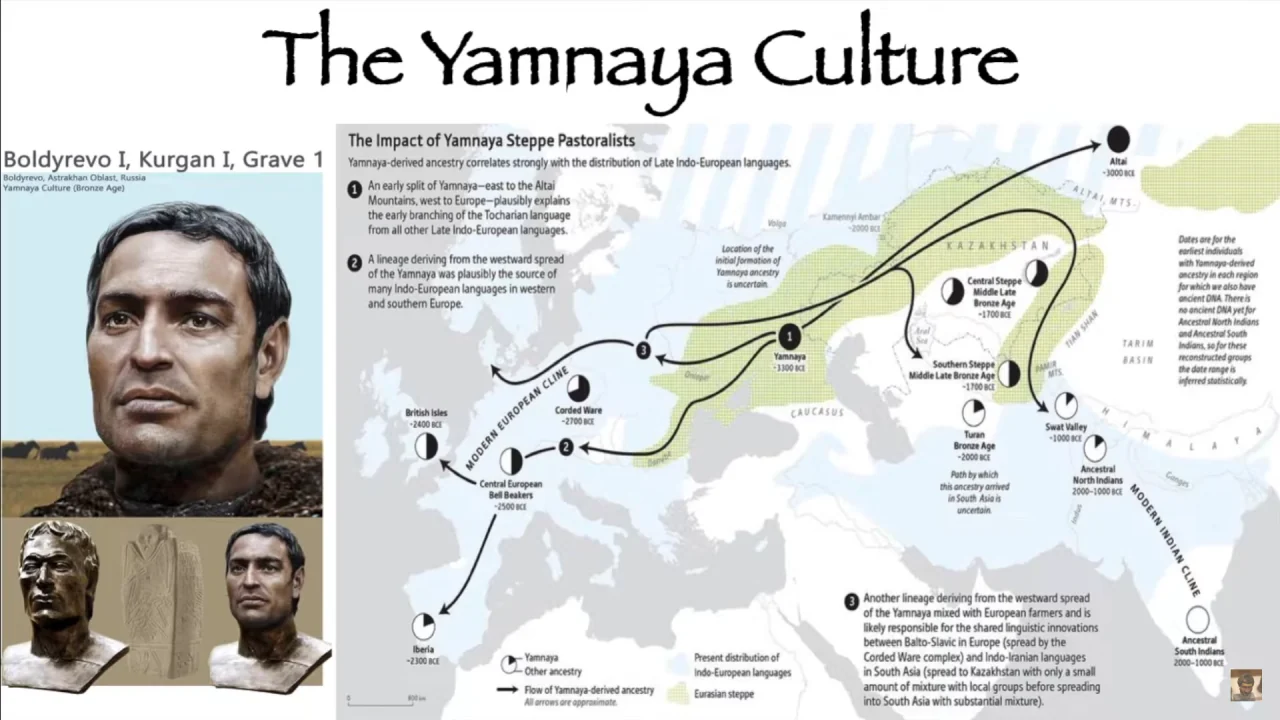
Unlike settled farming communities, the Yamnaya organised much of their lives around herding, mobility and access to vast grazing territories.
They moved with their livestock, travelled across considerable distances and relied on an economic system fundamentally different from permanent agricultural settlements.
Where farming societies were anchored to land, steppe pastoralists could organise their lives around movement.
Where agricultural economies depended heavily on fixed production cycles, pastoral economies could mobilise people, animals and resources across changing territories.
Their advantage was not simply that they were stronger or more aggressive.
They operated according to a different logic.
And that difference would prove enormously consequential.
The Breakthrough That Changed Everything
The Yamnaya did not invent every technology they used.
Herding, dairying, wheeled transport and the management of domesticated animals had developed across different societies over many centuries.
Yet the Yamnaya and related steppe communities brought together several capabilities that supported an extraordinarily mobile way of life.
- First, dairy-based pastoralism. Livestock provided meat, milk and other resources, helping support communities living across vast grasslands. Importantly, the Yamnaya did not need to possess widespread adult lactose tolerance to benefit from dairying. Archaeological research indicates dairy consumption even though the genetic ability to digest fresh milk into adulthood remained uncommon.
- Second, animal-supported mobility. Herding economies depended on the movement and management of domesticated animals. Horses also became associated with steppe mobility, although the precise timing and role of riding in the earliest Yamnaya expansion remain debated.
- Third, wheeled transport. Wagons enabled the movement of goods, provisions and household possessions across considerable distances.
The wheel itself was not a Yamnaya invention.
But wheeled transport, livestock management and mobile pastoralism could operate together as part of a highly adaptable economic and social system.
The breakthrough was not any single technology.
It was the combination of capabilities into a fundamentally different operating model.
What emerged was more than another variation of the existing agricultural society.
It was a different way of organising people, resources, mobility and livelihoods.
And that difference changed history.
Here Come the Eastern Cowboys
Beginning roughly 5,000 years ago, Yamnaya-related populations expanded across substantial parts of Eurasia.
Their movements contributed to major demographic and cultural transformations, especially across Europe.
Ancient DNA research has revealed that populations associated with these migrations contributed substantial ancestry to later European communities.
Their expansion and that of related successor populations also played an important role in the spread of Indo-European languages.
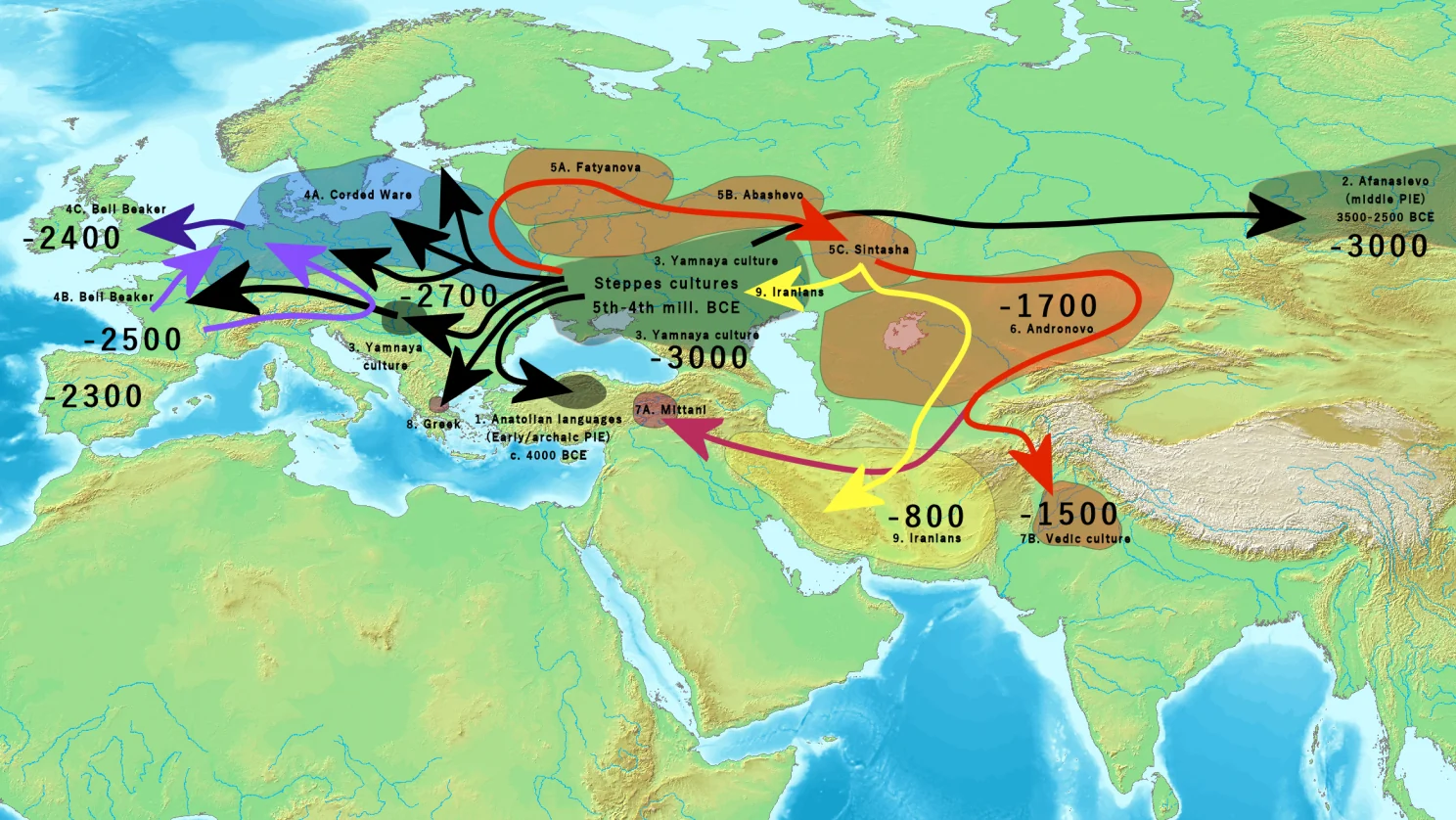
The precise balance of migration, conflict, intermarriage, cultural exchange and assimilation varied across regions and remains a subject of research.
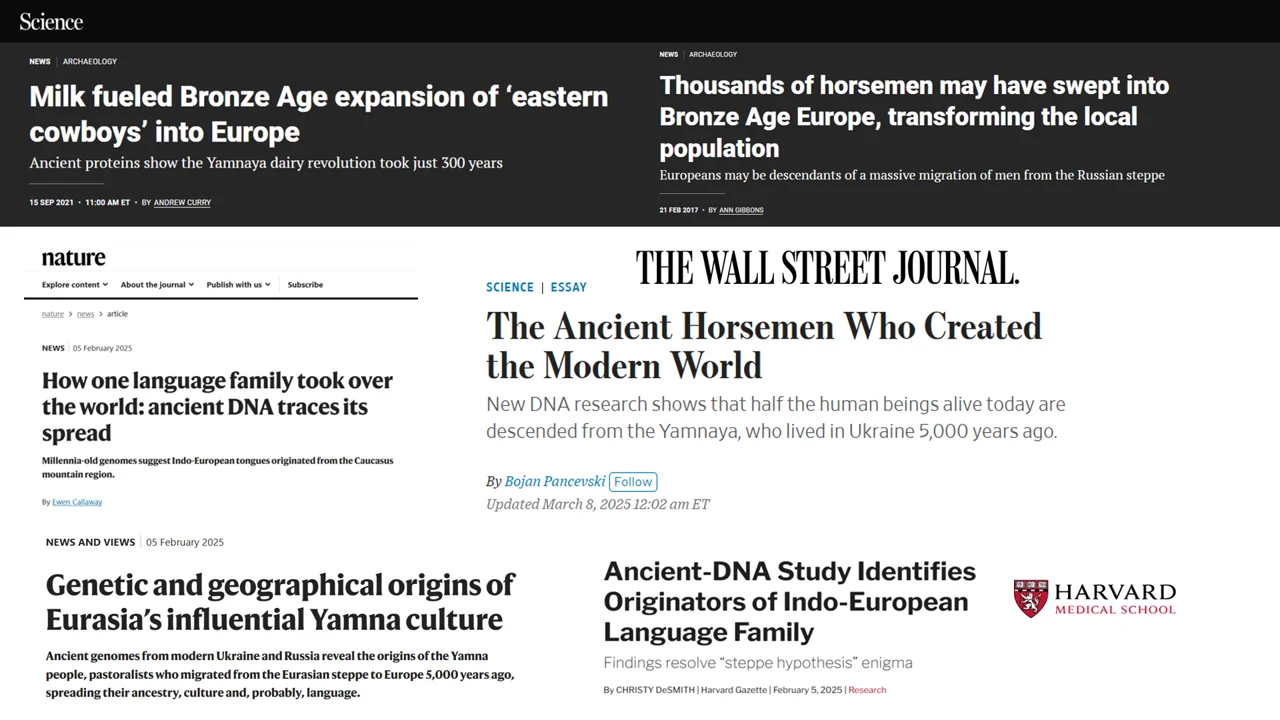
What is clear is that the existing demographic and cultural landscape changed profoundly.
The populations that followed were not simply the old societies with a few new technologies.
New combinations of ancestry, language, practices and social organisation emerged.
A new way of organising human life had helped transform the old order.
And that brings us to an uncomfortable question for today's business leaders.
Now Come the AI Cowboys
What is the moral of this epic story for today's businesses?
We may be standing at the beginning of a wave of creative destruction that is far faster than the transformations experienced by ancient societies.
AI and its adjacent technologies are the dairy, animal-powered mobility and wheel of our age.
Not because any single technology guarantees dominance.
But because their convergence makes entirely new operating models possible.
AI-first companies are the new cowboys: faster, leaner, more adaptive and potentially far more scalable.
They can combine artificial intelligence, autonomous agents, cloud infrastructure, robotics, real-time data and digital ecosystems in ways that challenge the assumptions of established industries.
They are not simply using better tools.
They are discovering fundamentally different ways of organising and working.
- Where incumbents rely on large departments, AI-native challengers may orchestrate networks of human specialists and digital agents.
- Where traditional companies depend on labour-intensive processes, AI-native competitors may automate entire workflows.
- Where established businesses create products for broad customer segments, emerging companies may deliver increasingly personalised products and services at scale.
- Where incumbents manage complex organisational hierarchies, AI-native enterprises may coordinate work through intelligent systems and smaller, more adaptive teams.
The fundamental advantage is not necessarily size, capital or history.
It may increasingly be the ability to combine human imagination with scalable artificial intelligence.
This is Intelligent Reinvention, not merely Digital Transformation.
Perfecting the Village While the Horsemen Approach
Most established companies today resemble the settled societies of Old Europe.
They have built sophisticated organisations around familiar assumptions about labour, expertise, production, management and competition.
Their institutions have served them well for decades.
We have heard the distant rumblings.
Stories of intelligent agents, autonomous businesses, AI scientists, digital employees and software capable of performing increasingly complex cognitive work.
Yet much of corporate activity remains business-as-usual.
- Polishing processes.
- Tweaking organisational charts.
- Launching another transformation initiative.
- Experimenting with ChatGPT and other generative AI tools.
- Automating yesterday's workflows.
- Adding AI capabilities to existing products and services.
These initiatives may be useful, even necessary.
But they do not necessarily change the fundamental logic of the business.
We are perfecting the village while the horsemen close in.
The greatest danger is not that established companies fail to adopt AI.
It is that they adopt AI enthusiastically while preserving the very assumptions that emerging competitors are preparing to overturn.
They may become exceptionally good at optimising and transforming business models whose fundamental logic is becoming obsolete.
This is why the next strategic imperative cannot be merely another round of Digital Transformation.
It must be Intelligent Reinvention.
The Coming Great Intelligence Shock
Consider what the convergence of AI capabilities could mean for established industries and professions.
- Thought leadership could be transformed as AI systems generate increasingly sophisticated research, analysis and content.
- Professional expertise could become more accessible and affordable, challenging traditional advisory business models.
- Professional services could be restructured as intelligent systems undertake work previously requiring large teams of specialists.
- Companies could face competition from much smaller AI-native enterprises with radically different economics.
- Entire job categories could be redesigned, while new roles and professions emerge.
- Millions of professionals could find that their existing skills, career assumptions and methods of creating value need substantial reinvention.
The magnitude and timing of these changes remain uncertain.
Not every industry will be disrupted at the same speed.
Not every new entrant will succeed.
Regulation, customer trust, physical infrastructure, capital requirements and human judgment will continue to matter.
But the direction of change is increasingly difficult to ignore.
As intelligence becomes more abundant, affordable and scalable, the economics of business and work will be fundamentally rewritten.
And when the economics change, the operating models can change.
When operating models change, the basis of competition changes.
When the basis of competition changes, yesterday's leaders can become tomorrow's laggards.
The AI Cowboys are not coming.
They are already here.
Becoming the AI Cowboys
The lesson is not that every established organisation is destined to fall.
Nor is it that the newest or most aggressive companies will inevitably win.
History is more complex than that.
The Yamnaya story illustrates how dramatically different combinations of capabilities and ways of organising society can produce profound change.
The business lesson is equally powerful.
When the environment changes, improving the old operating model may no longer be sufficient.
The opportunity is not simply to defend what exists.
It is to rethink what becomes possible.
What if your organisation were designed from scratch today, knowing what AI can already do and what it may soon make possible?
- Would you have the same number of management layers?
- Would work be divided into the same departments?
- Would you employ the same combination of people, software and external service providers?
- Would your products and services be designed, delivered and priced in the same way?
- Would you still serve the same customer jobs through the same business model?
- Would your competitors even come from the same industry?
These are not questions of technological adoption.
They are questions of strategic imagination.
And they are at the heart of Intelligent Reinvention.
From Digital Transformation to Intelligent Reinvention
Digital Transformation helped organisations digitise information, connect systems, automate processes and create new digital experiences.
It was an essential foundation.
But the Intelligence Age changes the strategic possibilities.
AI is no longer simply another technology to be embedded into existing business operations.
It introduces the possibility of generating and applying increasingly sophisticated intelligence across products, processes, decisions and entire organisations.
This calls for more than becoming digitally enabled.
It calls for becoming AI-native.
Organisations must return to first principles, challenge inherited assumptions and rethink the fundamental logic of how they create, deliver and capture value.
They must learn to combine human imagination, judgment and purpose with the expanding capabilities of artificial intelligence.
They must rethink not only their technology stacks, but their business models, operating models, products, services, functions and ecosystems.
That is the shift from Digital Transformation to Intelligent Reinvention.
Digital Transformation got us here. Intelligent Reinvention gets us there.
The Choice Before Us
So, ask yourself:
- How much of your organisation's energy is spent improving the existing model?
- How much is devoted to preparing for threats from fundamentally different competitors?
- And more importantly, how much are you investing in becoming one of those fundamentally different competitors?
Because the greatest strategic response to disruption is not always to build stronger defences.
Sometimes, it is to reinvent yourself around the very forces that threaten your existence.
Do not merely defend the old village. Learn to build the next civilisation.
The AI Cowboys are already here.
The question is whether you will be among them, or among those still perfecting yesterday's village.
Editor's note: This is an updated adaptation of my original LinkedIn article, “The AI Cowboys Are Here: Business Lessons from the Yamnaya Invasion.” The historical narrative has been revised to distinguish established archaeological and genetic findings from debated interpretations. The Yamnaya story is used as an analogy for business disruption, not as a literal prediction of corporate competition.
Historical references:

Charlie Ang is an Intelligent Reinvention Strategist, corporate futurist and AI keynote speaker based in Singapore and speaking worldwide. He helps organisations and leaders reinvent, rewire and retool for the Age of Intelligence, and has been featured by the BBC, Financial Times, National Geographic and CNA.