 Charlie
Today, the answer to every external challenge seems to be: oh, we must be more agile.
It’s the panelist’s go-to reply when they have no real insight.
It’s the holy grail of organization design for responding to change.
It’s become the be-all-and-end-all catchphrase.
It is talked up as the panacea for everything.
No, it is not.
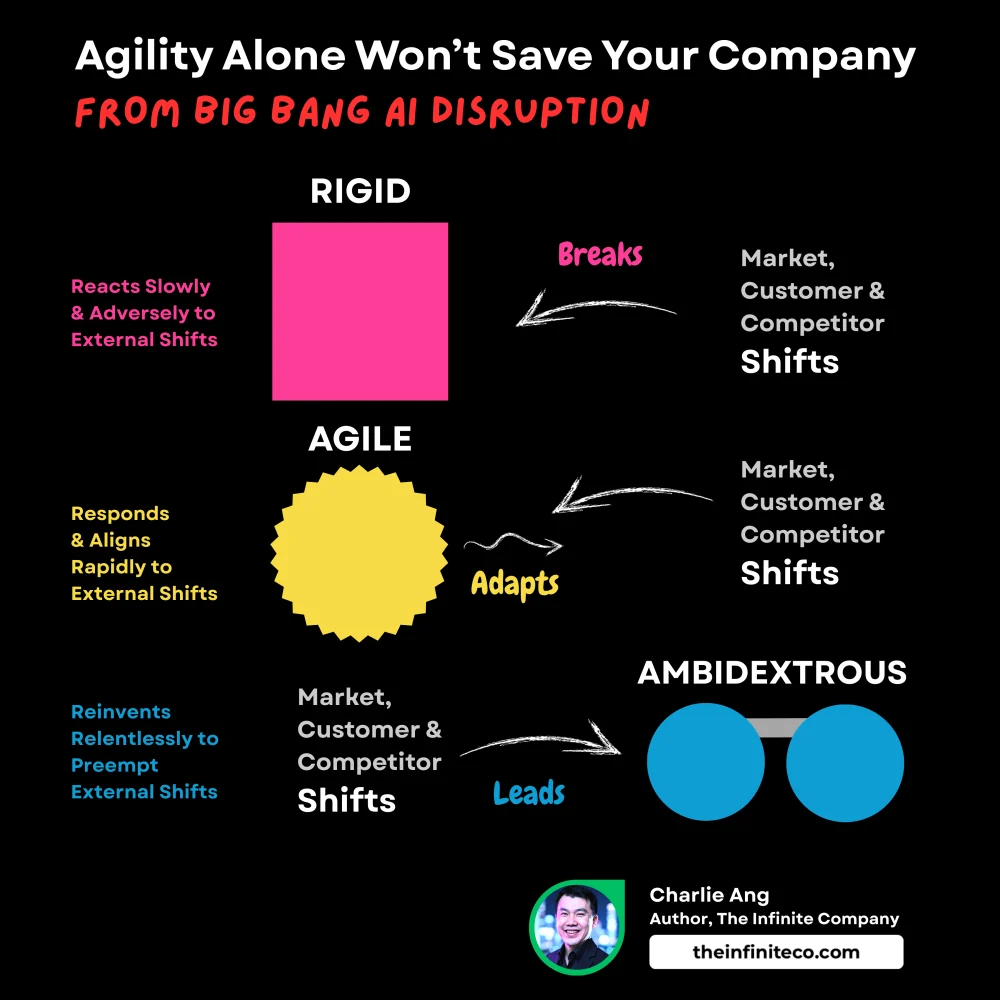
Agile is the midpoint, not the endpoint, of organizational transformation.
Agile is reactive.
It’s about being responsive and sensitive to external shifts.
It’s about moving fast and adapting by iterating in smaller increments.
These are all good. Necessary, even.
But agile is not enough.
Agile will not save your company from the impending Big Bang AI Disruption.
Revenue engines, but no reinvention engines
Even if Kodak, Blockbuster, Nokia, and Sears had been the most agile companies of their time, they still wouldn’t have survived digital disruption.
They had healthy revenue engines, but no reinvention engines.
They were busy “exploiting the now” while neglecting “exploring the new”.
They could have been highly agile, yet still run out of rope when digital disruptors rewrote the rules of their industry.
Netflix, Amazon, and Apple didn’t wait for customers to tell them what to do.
They weren’t just responding to needs or chasing lower prices.
Agile is great for going from 1 to N. But not for going from 0 to 1.
The new waterline: ambidexterity
So, what’s the new waterline for companies to survive the impending AI Disruption?
Ambidexterity: the top-level commitment and cross-organizational capability to reinvent continuously and relentlessly.
In layman’s terms: the ability to invent a new business from 0 to 1 while innovating your core business.
Ambidextrous is being preemptive and inventive, not merely responsive and adaptive.
In the Tech space, IBM and HP lost their “reinvent” mojo after a century or so of defining what every generation of computing is.
They fell into the innovator’s dilemma trap and missed out on the cloud computing revolution.
One blow is all you need for giants to fall from grace.
Ambidextrous companies, ambidextrous leaders
Time to invite Jeff Bezos and others onto the stage to show how it is done.
- Jeff Bezos invented Amazon Web Services while innovating Amazon.com.
- Steve Jobs invented the iPhone while innovating the iMac.
- Reed Hastings invented streaming while innovating Netflix’s DVD mail business.
- Meanwhile in China, BYD and Xiaomi created EV businesses while innovating their battery and consumer tech businesses.
- Huawei developed AI chips, smart cars, and cloud businesses while innovating its telecommunications core.
- Ping An pioneered digital healthcare while innovating its insurance business.
These are ambidextrous companies, with ambidextrous leaders. One cannot exist without the other.
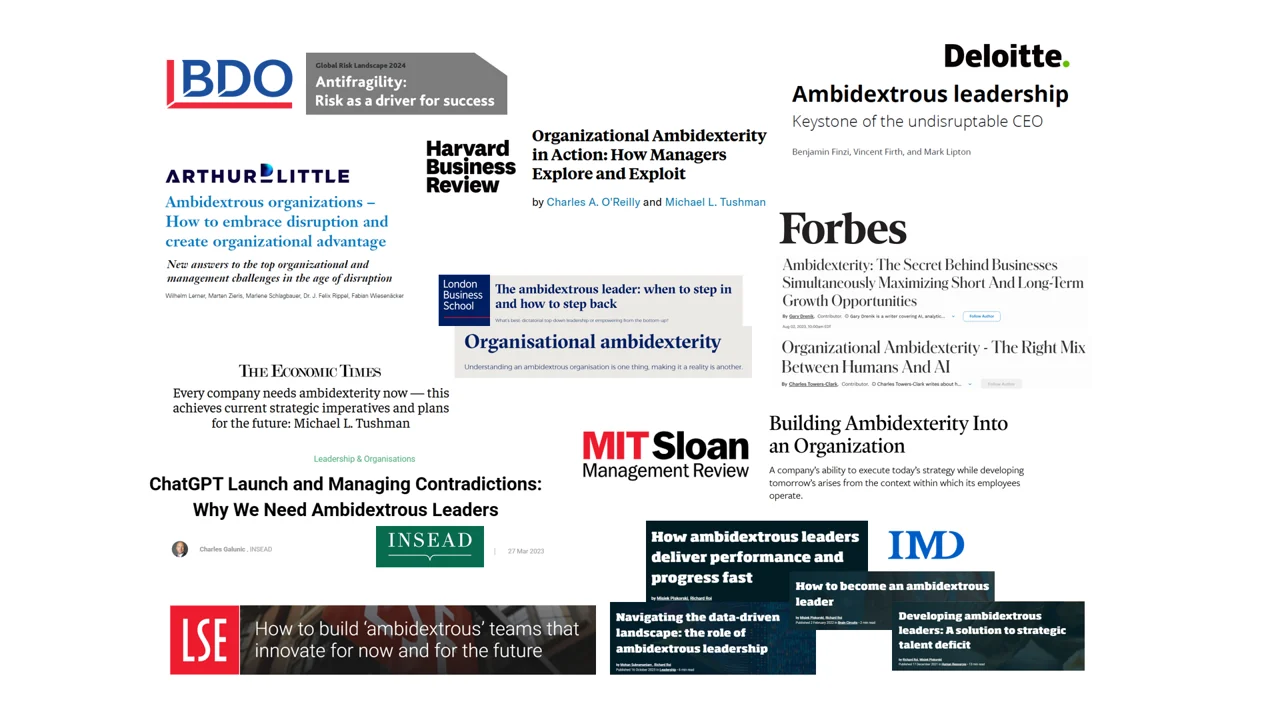
While ambidextrous leadership must start from the top, it must also pervade all the way down the organization from divisions, functions and to even the smallest teams and the individual contributor (in the form of self-leadership).
While these are iconic names, we all can be ambidextrous, in our respective market segments, product niches and professional careers.
In the age of AI, every industry needs reinvention in its proposition, products, and processes.
Some will involve 0 to 1 inventions and others 1 to N innovations.
Organizational ambidexterity will decide the new winners and losers of this latest chapter in creative destruction.
Don’t “agile” your way to extinction.
Take the crucial step up to become ambidextrous.
To adapt the Rangers motto: Executives lead the way.
And as the Scouts remind us: Be prepared.
Originally published in Charlie Ang's Intelligent Reinvention Memo newsletter on LinkedIn (Issue 23).

Charlie Ang is an Intelligent Reinvention Strategist, corporate futurist and AI keynote speaker based in Singapore and speaking worldwide. He helps organisations and leaders reinvent, rewire and retool for the Age of Intelligence, and has been featured by the BBC, Financial Times, National Geographic and CNA.